
For more than two millennia, it existed only on parchment. Now, it has emerged from the ground.
Archaeologists in Italy have officially confirmed the discovery of the long-lost basilica designed by Marcus Vitruvius Pollio, the Roman architect whose ideas shaped Western architecture itself. The monumental structure, uncovered beneath the historic center of Fano, marks the first physical building ever securely attributed to Vitruvius.
The announcement, made at the city’s Mediateca Montanari, is being described by experts and officials alike as a turning point for classical archaeology and architectural history.
A Basilica Known Only From Text—Until Now
Vitruvius described the basilica in Book V of De Architectura, outlining a rectangular public building surrounded by columns. For centuries, scholars debated whether it had ever existed beyond theory.
That debate is now over.
Excavations beneath Piazza Andrea Costa have revealed a monumental structure that matches Vitruvius’ own description with extraordinary precision, providing the first material confirmation of a building he personally claimed to have designed and built.
Until this discovery, every structure associated with Vitruvius relied on stylistic inference. This is the first time archaeology has met his words directly.
The Breakthrough Beneath Modern Fano
The path to confirmation began quietly in 2023, when renovation work along Via Vitruvio exposed Roman walls and marble pavements. Early signs pointed to a high-status public building, but modern construction limited deeper investigation.
That obstacle was finally removed during the redevelopment of Piazza Andrea Costa.
A carefully controlled stratigraphic probe uncovered foundations, column bases, and structural alignments that left little doubt: this was the basilica Vitruvius described.
The decisive moment came with the discovery of a fifth corner column, allowing archaeologists to fix the building’s orientation and full footprint with confidence.
When Text and Stone Align “to the Centimeter”
The architectural correspondence stunned even seasoned researchers.
The basilica follows a rectangular plan framed by a peristyle, with eight columns along the long sides and four along the shorter sides, precisely as outlined in De Architectura. Column diameters measure roughly five Roman feet (about 1.5 meters), with estimated original heights approaching 15 meters.
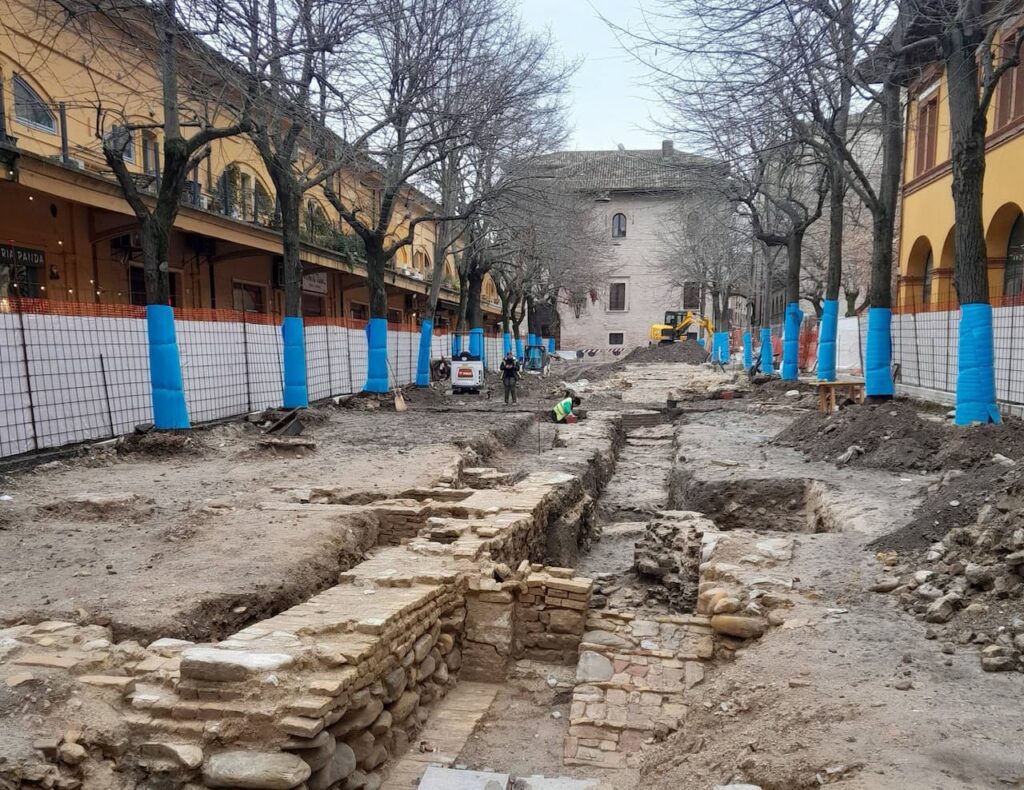
Structural details show columns bonded to pilasters and reinforced corners, indicating support for an upper level—a sophisticated engineering solution entirely consistent with Vitruvian design principles.
According to experts involved in the project, the reconstructed plan derived from the ancient text matches the excavated remains “to the centimeter.”
Officials React: “A Discovery 2,000 Years in the Making”
The confirmation was presented in the presence of regional and national authorities, underscoring its historical weight.
Mayor Luca Serfilippi captured the moment succinctly:
“This is a discovery we have been waiting for over 2,000 years. For centuries, the basilica existed only in words. Today, it becomes a tangible reality.”
Marche Region President Francesco Acquaroli emphasized that the find will reshape Fano’s historical narrative and urged coordinated efforts to transform it into a long-term cultural and tourism asset.
Italy’s Minister of Culture, Alessandro Giuli, went further, calling the discovery a dividing line in the history of archaeological research, framing it as a moment that will permanently alter how Roman architecture is studied and understood.
Why This Changes Architectural History
Vitruvius is not simply another Roman architect. His treatise shaped architectural thought from antiquity through the Renaissance and beyond. Concepts such as firmitas (durability), utilitas (function), and venustas (beauty) remain foundational today.
Until now, scholars could only speculate how those ideals were applied in real buildings.
The basilica at Fano changes that.
For the first time, researchers can directly examine how Vitruvius translated theory into stone, offering a rare laboratory for understanding Roman design logic, proportional systems, and urban planning under Augustus.
Excavations Continue, Certainty Remains
Funded through Italy’s National Recovery and Resilience Plan, excavations will continue in the months ahead. The focus is no longer on proving the basilica’s existence—that question has been definitively answered—but on understanding its wider urban context and preparing it for conservation and public presentation.
Superintendent Andrea Pessina noted that the discovery also provides a key reference point for interpreting nearby Roman remains, including structures beneath the former Sant’Agostino convent, allowing archaeologists to reconstruct Fano’s ancient civic core with unprecedented clarity.
A City Reclaims Its Place in History
For Fano, the basilica is more than an archaeological triumph. It is a recovered identity.
Once confined to the pages of an ancient manuscript, Vitruvius’ basilica now stands—fragmented but undeniable—beneath the modern city. Its stones confirm that the origins of Western architectural theory are not only written texts, but built realities waiting to be uncovered.
And after 2,000 years, one of the most influential buildings in architectural history has finally been found.
Cover Image Credit: One of the monumental column bases found in Piazza Andrea Costa in Fano. Italy’s Ministry of Culture