
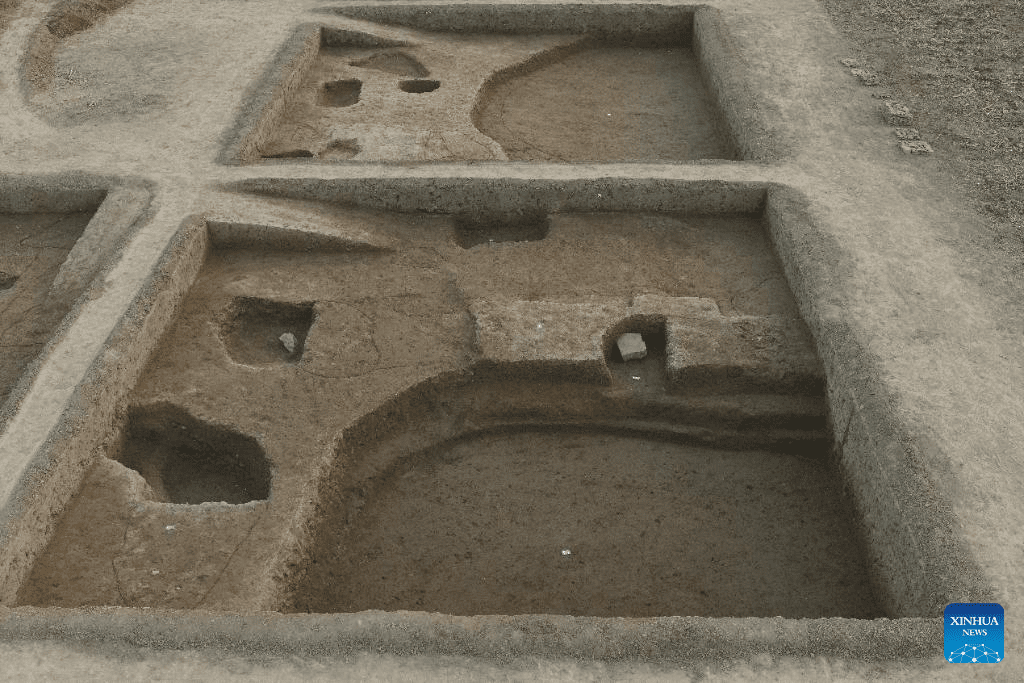
In Luoyang, one of imperial China’s longest-serving capitals, archaeologists have uncovered the remains of a vast Northern Wei Dynasty state granary, offering rare insight into how an early medieval empire safeguarded its survival through centralized food storage. The discovery, made just east of the imperial palace at the Han-Wei Luoyang Ancient City, reveals the logistical backbone that sustained officials, armies, and emergency relief systems across the state.
The discovery was made east of the imperial palace at the Han-Wei Luoyang Ancient City, in today’s Luoyang. Archaeologists have preliminarily identified the complex as part of the Tai Cang, the imperial granary that functioned as the Northern Wei state’s national grain reserve.
A Carefully Planned Storage System
A systematic survey of the area revealed an orderly grid of 168 storage pits, arranged in 14 columns and 12 rows—an unmistakable sign of centralized planning. So far, 13 of these pits have been fully excavated.
Each pit measures between 9 and 11 meters in diameter and reaches a depth of about four meters. Based on these dimensions, researchers estimate that each pit could store roughly 120 tonnes of millet, underscoring the extraordinary capacity of the facility.
The layout and location closely match historical descriptions of the Tai Cang recorded in early Chinese sources, strengthening the identification of the site as an imperial granary rather than a local or private installation.
“A Facility Serving the Entire State”
The excavation is being carried out by a team from the Chinese Academy of Social Sciences. According to the project’s lead archaeologist, Liu Tao, the find represents a major addition to what is already known about Luoyang’s administrative landscape.
“This marks another significant discovery at the Han-Wei Luoyang Ancient City, following earlier finds of storage facilities within the imperial palace,” Liu said.

Courtesy of the Institute of Archaeology, Chinese Academy of Social Sciences / Xinhua (handout).
He emphasized a crucial distinction: while granaries inside the palace complex were intended to supply the immediate needs of the imperial household, the Tai Cang served a far broader purpose. Grain stored here was allocated for official salaries, military logistics, and emergency relief during famines or natural disasters.
Only One Section Revealed—For Now
Archaeologists caution that the excavated pits likely represent only a portion of the original granary complex. Given the scale described in historical records, additional storage areas may still lie buried nearby.
Excavations and interdisciplinary research at the Han-Wei Luoyang Ancient City are ongoing, with future work expected to clarify how the granary connected to transport routes, administrative offices, and the wider urban fabric of the capital.
Luoyang: A Capital Across the Ages
The Han-Wei Luoyang Ancient City has a long and layered history. First established during the Western Zhou period (1046–771 BC), it later served as the capital of several dynasties, most notably the Eastern Han (25–220) and the Northern Wei. The city gradually fell out of use in the early Tang Dynasty (618–907).
This newly uncovered imperial granary adds a vital economic dimension to Luoyang’s story—revealing not just where emperors ruled, but how the state fed its bureaucracy, its armies, and its people.
An undated archival image shows the remains of a state-run imperial granary dating to the Northern Wei Dynasty (AD 386–534), located east of the imperial palace within the Han-Wei Luoyang Ancient City in Luoyang, Henan Province, central China.
Courtesy of the Institute of Archaeology, Chinese Academy of Social Sciences / Xinhua (handout).