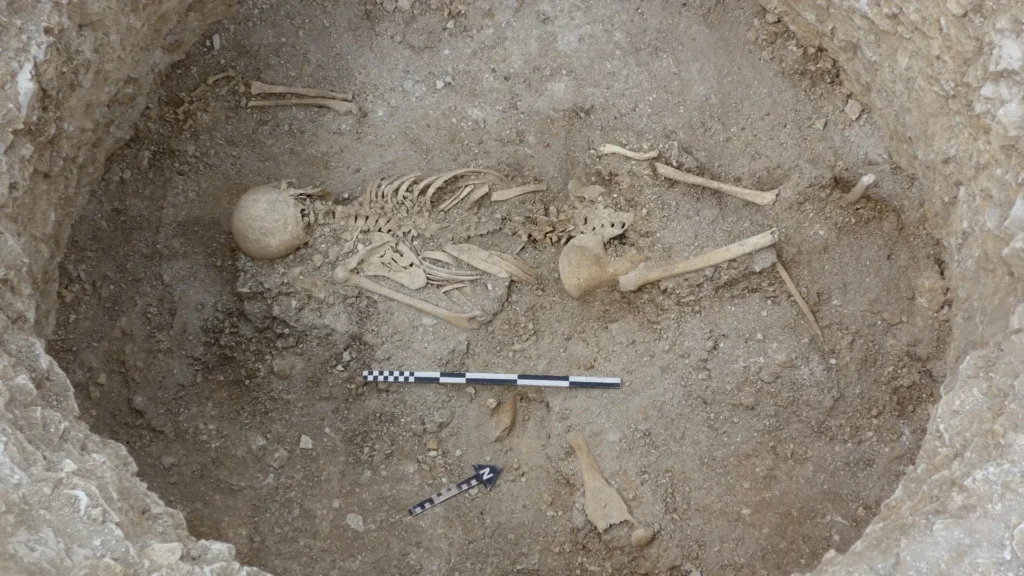
When archaeologists brushed away the Dorset soil, they didn’t expect to uncover the skeleton of a teenage girl lying face down — a chilling clue to a 2,000-year-old ritual. The grave, unearthed by researchers from Bournemouth University, may reveal one of Britain’s earliest known acts of human sacrifice, linked to the enigmatic Iron Age Durotriges tribe that inhabited southern England long before the Roman conquest.
The burial stood out immediately. The girl had been placed in a shallow pit with no grave goods, her body positioned in a way that defied all known customs of Iron Age Britain. Her hands may have been bound, and her prone posture — unusual and deliberate — suggests punishment, execution, or ritual sacrifice rather than a conventional interment.
“This appears to be the execution of a person carried out in a very theatrical manner,” said Dr. Miles Russell, Principal Academic in Prehistoric and Roman Archaeology at Bournemouth University. Russell, who leads the long-term Durotriges Project, believes the burial was more than a crime scene — it was a public statement etched into the landscape two millennia ago.
A Grim Chapter of Iron Age Life
The discovery was made while filming Sandi Toksvig’s Hidden Wonders, a new Channel 4 series exploring Britain’s ancient mysteries. Toksvig, a Cambridge-trained archaeologist herself, joined the excavation team as they unearthed domestic dwellings and a small cemetery used by the Iron Age Durotriges tribe — one of the last Celtic communities to resist Roman rule.
Among the routine finds of pottery, bronze ornaments, and a bone comb, the prone burial stood out sharply. “It was deeply moving,” Toksvig said. “You could sense that this was not a normal death.”
Researchers note that this is the third face-down burial of a young woman uncovered at the site in recent years. The first, found in 2010, showed evidence of a cut throat. Another, discovered in 2024, revealed blunt-force trauma to the arms and torso. The repetition of this pattern suggests a deliberate and possibly gender-specific ritual.
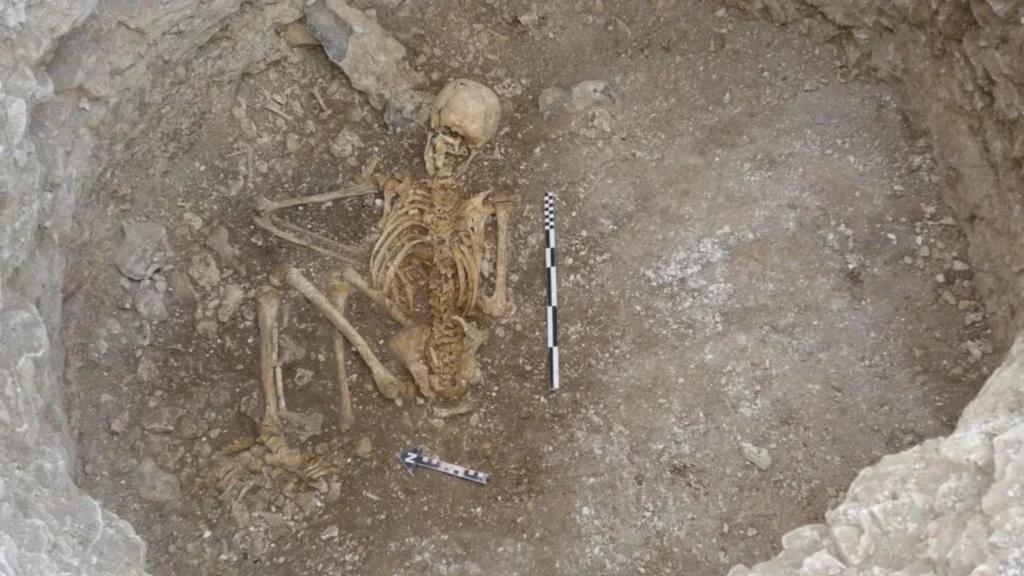
Women, Power, and Ritual in Iron Age Britain
Preliminary DNA analysis from the site has revealed that the Durotriges practiced a matrilineal system, in which lineage and inheritance passed through women. This rare social structure challenges long-held assumptions about gender roles in Iron Age Europe and echoes Roman accounts that described Celtic women as landowners and leaders.
If confirmed, the predominance of female victims could reflect complex social or religious dynamics — perhaps ritual offerings involving powerful women or outsiders perceived as symbolic mediators between life and death.
“It’s the first clear evidence of a matrilineal community in Western European prehistory,” added Dr. Russell. “That fact alone redefines how we understand gender and power in Iron Age Britain.”
A Society on the Brink of Change
The Durotriges lived through a period of profound transformation. Their settlements reveal hybrid craftsmanship — Roman-style brooches made with Iron Age techniques, imported pottery beside handmade wares — hinting at cultural tension between old traditions and the encroaching Roman world.
The face-down burials may represent this social upheaval: ritual attempts to contain spiritual forces or acts of punishment tied to shifting power structures.
For the archaeologists, this site is more than a graveyard. It’s a conversation between faith, fear, and authority — a tangible record of how people in a vanishing age confronted mortality and change.
As DNA and isotope tests continue, one mystery lingers beneath the Dorset soil:
Was she sacrificed, executed, or both?