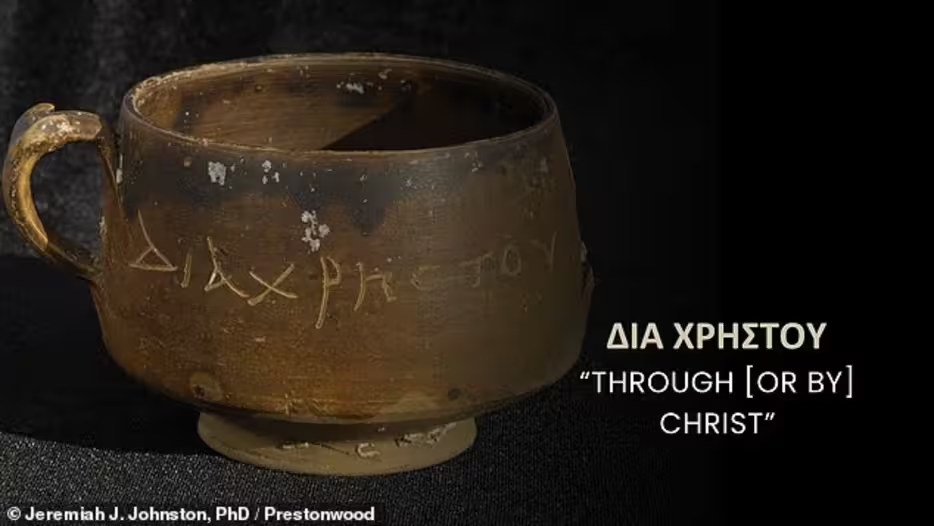
For decades, archaeologists have hunted for physical traces of Christianity’s earliest years—artifacts that might illuminate how quickly the name of Jesus spread beyond Judea. A modest ceramic bowl pulled from the seabed of Alexandria has become the latest, and perhaps most controversial, candidate.
A Find from Cleopatra’s Harbor
In 2008, French underwater archaeologist Franck Goddio and his team uncovered the cup from the submerged remains of Antirhodos, the island once attached to Cleopatra’s palace complex. Although one handle is missing, the vessel is otherwise intact and dates to a period straddling the late Hellenistic and early Roman eras (roughly 2nd century BCE–1st century CE).
Scratched across its surface is a short yet puzzling inscription in Greek: “DIA CHRSTOU O GOISTAIS.” The translation of this phrase has driven years of debate.
Reading the Words
- Direct link to Christ? Some biblical scholars argue the formula should be read as “through Christ, the magician/chanter,” a possible reference to the reputation of Jesus as a miracle-worker. They point out that early traditions already describe outsiders using his name for healing and exorcism.
- Alternative spellings. Others stress that the term may not be Christou but Chrestou, meaning “the good” or “the kind,” a common Greek epithet unrelated to Christianity.
- Magical vocabulary. The word goistais ties the phrase to the world of spells, chants, and ritual specialists. In Alexandria—a city where Jewish, pagan, and emerging Christian currents mixed—it was not unusual for magicians to borrow divine names to boost the power of their rites.
- Critical voices. Classical philologists have gone further, suggesting the inscription may reference a local figure or even medicinal practices, with “diakhristos” implying an ointment rather than Christ.
Why It Matters
If the bowl does invoke Jesus Christ, it would:
- represent the earliest archaeological evidence of his name beyond scripture,
- suggest that knowledge of Jesus reached Alexandria within a generation of his life,
- and highlight the city as a crucible of religious exchange, not only a political capital of Ptolemaic and Roman Egypt.
A Symbol of Uncertainty
Most specialists, however, stop short of declaring the bowl definitive proof. The wording is too brief, the context too ambiguous, and comparative material too scarce. Even Goddio himself has proposed that the vessel may have belonged to a fortune-teller who invoked names—Christ’s included—for added authority.
More Than One Story
Whether it preserves the first whisper of Christ outside the Gospels or simply echoes the magical pluralism of the Mediterranean, the so-called “Jesus Cup” captures the tensions of its age. It reminds us that early Alexandria was not only a crossroads of trade and empire, but also of faiths, spells, and experimentations with the divine.
Cover Image Credit: Dr Jerimiah Johnston