
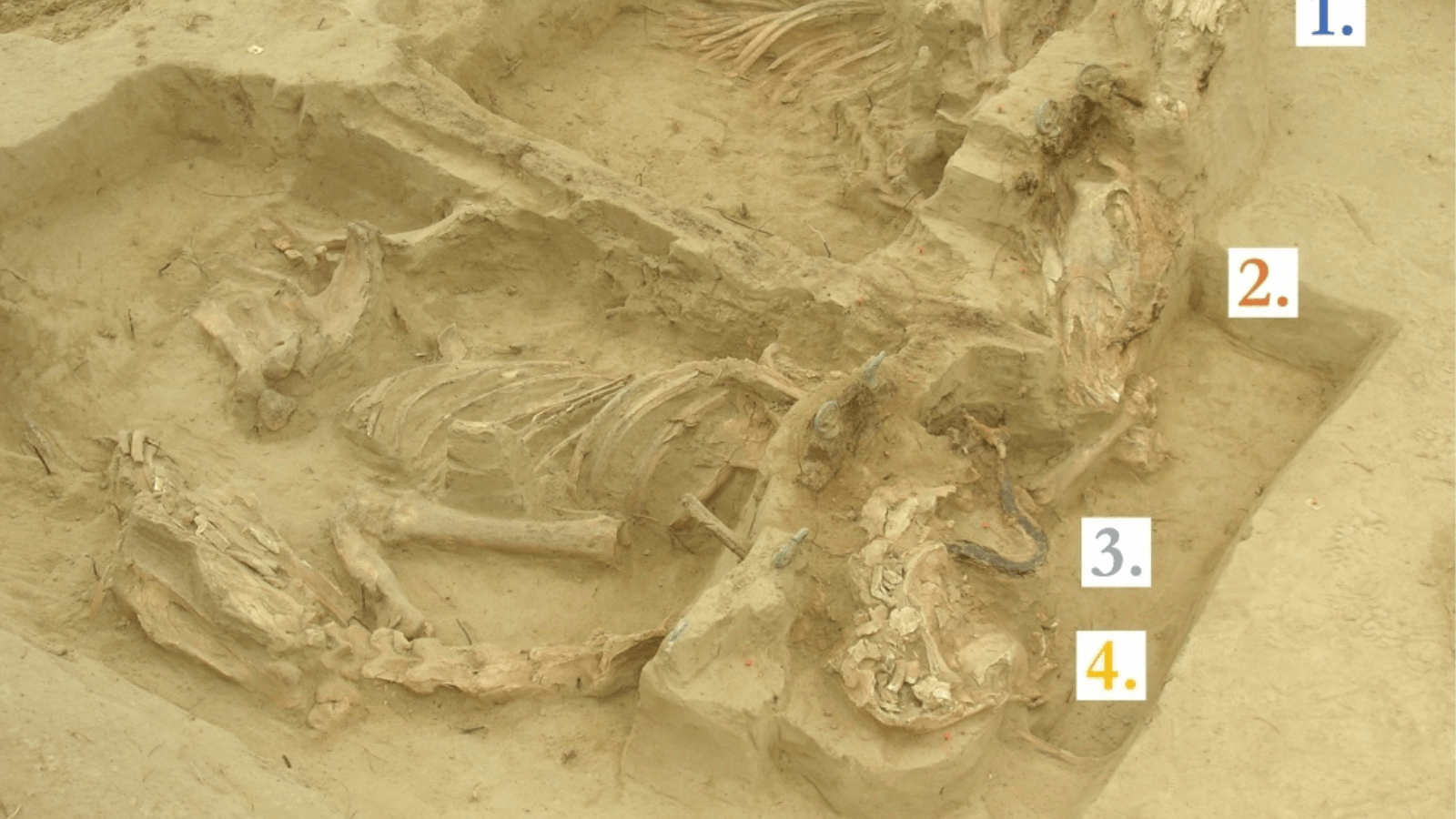
Around 1,800 years ago, a community in what is now Hungary staged an extraordinarily costly funerary ritual. Four horses were probably killed while still arranged as a team, then buried beside a four-wheeled Roman traveling carriage and four hunting dogs sacrificed during the same ceremony.
Archaeologists uncovered the unusual carriage burial at Sárisáp in 2012. A new assessment by archaeozoologist Annamária Bárány of the ELTE Natural History Museum now reveals the horses’ ages, physical differences and the marks left by years of strenuous work.
Archaeologists Expected a Bomb, Not a Roman Carriage
A team from Pázmány Péter Catholic University, directed by Balázs Major, was investigating a fourth-century mausoleum on a hill at Sárisáp when a geophysical survey detected a large concentration of metal nearby. At first, researchers suspected that the anomaly might represent an unexploded bomb left from the Second World War.
Excavation revealed something very different. The signal came from the iron fittings of a four-wheeled Roman traveling carriage dating to the late second or early third century AD.
Unlike many vehicles recovered from carriage burials, the Sárisáp carriage had not been dismantled before burial. Its wheels remained attached, and much of its ironwork survived in its original position, allowing archaeologists to reconstruct how the vehicle had once been built.
Zsolt Mráv of the Hungarian National Museum, an archaeologist specializing in Roman-period carriages, led the excavation of the vehicle and its animal remains. In front of the carriage lay the nearly complete skeletons of four horses arranged side by side, possibly preserving the positions they had occupied as a working team.
Their placement suggests that the horses may have been killed inside the burial pit without significantly disturbing the arrangement. Beside the horse on the far right, archaeologists found the partially overlapping skeletons of four dogs, which researchers say were also killed during the funerary ceremony.
The Four Horses Were Not a Perfectly Matched Team
According to the assessment published by the MTA–ELTE Momentum Bioarchaeology Research Group, all four horses were stallions. They stood approximately 136 to 144 centimeters at the withers, placing them within the same general medium-sized category.
Their ages, however, varied considerably. The youngest was about four and a half years old, while the oldest had reached approximately 15. The remaining horses were around six to seven and eight to nine years old when they died.
A carefully assembled driving team would normally include animals of similar age, size, temperament and working ability. The Sárisáp stallions did not match that ideal in every respect, but measurements of their bones suggest that their positions within the team may not have been accidental.
The two horses placed in the middle appear to have had proportionally longer hind limbs and a more running-oriented build. That difference may have mattered because the two central horses likely carried a greater share of the pulling load than those on the outside.
Researchers remain cautious about this interpretation. It depends on the assumption that the horses’ positions in the grave accurately reproduce the arrangement in which they worked during life.
Their Bones Preserved the Cost of Hard Work
The skeletons record more than the physical composition of the team. All four horses had additional bone growth on their phalanges, or toe bones, changes that researchers associate with prolonged overuse.
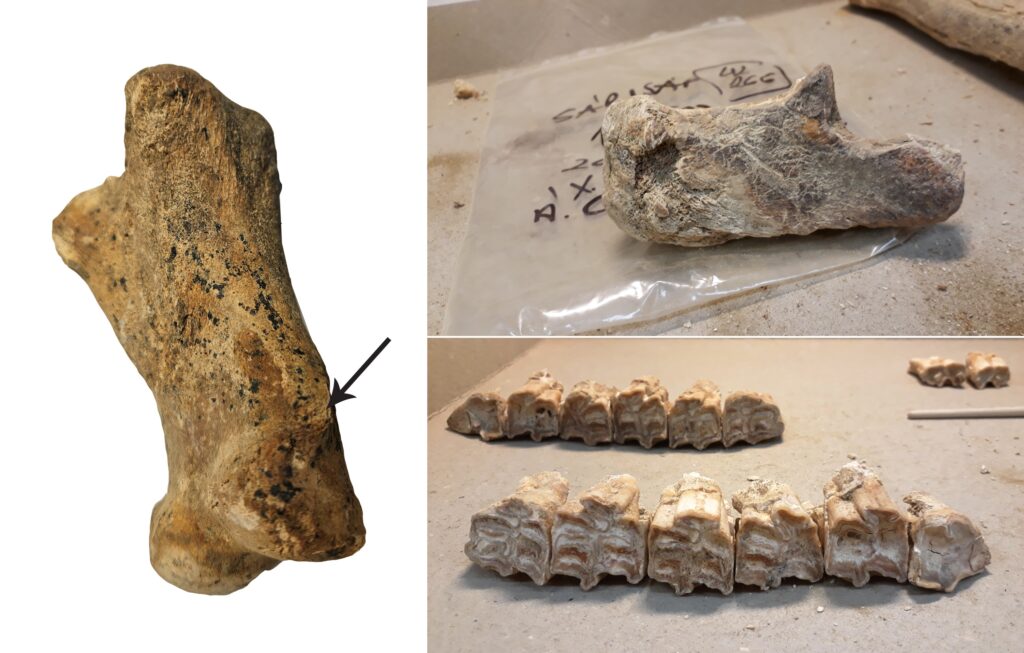
These joints form part of the anatomical system that absorbs pressure and prevents a horse’s lower legs from overextending while moving. Repeated stress on that system may have produced the abnormalities visible on the Sárisáp horses.
The carriage itself offers some context for their working lives. Researchers identify it as a relatively light, four-wheeled traveling vehicle designed to move quickly across uneven ground and poor roads. Its owner may have used it on routes connected with the Roman road between Solva, near modern Esztergom, and Aquincum in present-day Budapest.
The burial also provides the first securely excavated archaeological evidence from Pannonia for four horses harnessed side by side. Ancient images had already shown this expensive arrangement, but the Sárisáp grave preserved the animals and parts of their wooden yoke in place.
A Carriage Prepared for the Journey Beyond Death
Carriage burials in Roman Pannonia belonged to a world of wealth and public status. Scholars generally associate them with local elites living under Roman rule, particularly the Celtic Eravisci community of northeastern Pannonia.
These families appear to have treated the carriage as more than a prestigious means of transportation. In funerary imagery, the deceased often appears traveling by carriage with servants, horses and dogs, suggesting a symbolic journey toward the afterlife.
The precise identity of the family behind the Sárisáp ritual remains uncertain. The site stood near the border between the territories associated with the Eravisci and the neighboring Azali, raising the possibility that an Azali family had adopted a burial custom linked more closely with Eraviscan elites.
Nor can archaeologists securely connect the carriage pit with one particular human burial. In Pannonia, communities sometimes deposited vehicles as independent funerary offerings within cemeteries rather than placing them directly beside the remains of a specific individual.
The four dogs completed this costly display. Researchers describe them as fast-running hunting dogs, animals that would have required training and carried considerable value. Like the stallions and the decorated traveling carriage, they advertised the status of the people who could afford to sacrifice them.
The Sárisáp burial therefore preserves more than a dramatic act of animal sacrifice. It captures the final transformation of four working horses: after years of pulling a carriage across Roman Pannonia, they became part of a vehicle prepared for a symbolic journey beyond death.
Cover Image: The four stallions discovered in front of the Roman traveling carriage at Sárisáp. The adjoining graphic shows their estimated ages, ranging from about 4.5 to 15 years. Credit: Hungarian National Museum / Photo: Zsolt Mráv; graphic: Annamária Bárány