
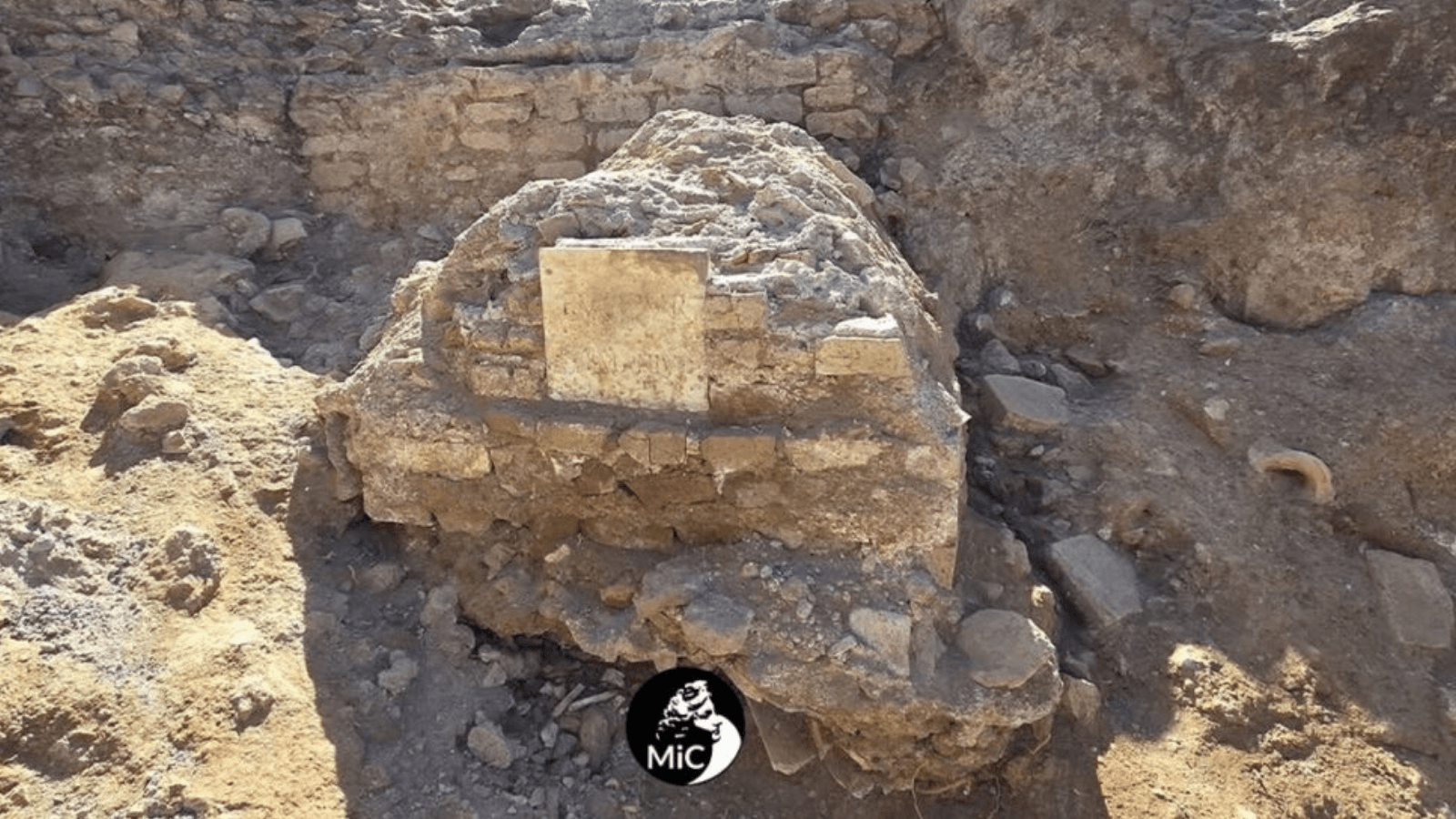
A marble inscription discovered at Hadrian’s Villa in Tivoli has revealed how Romans responded when lightning struck the imperial residence. Rather than treating the event as ordinary damage, they apparently buried its physical traces, separated the affected ground and placed it within the divine realm.
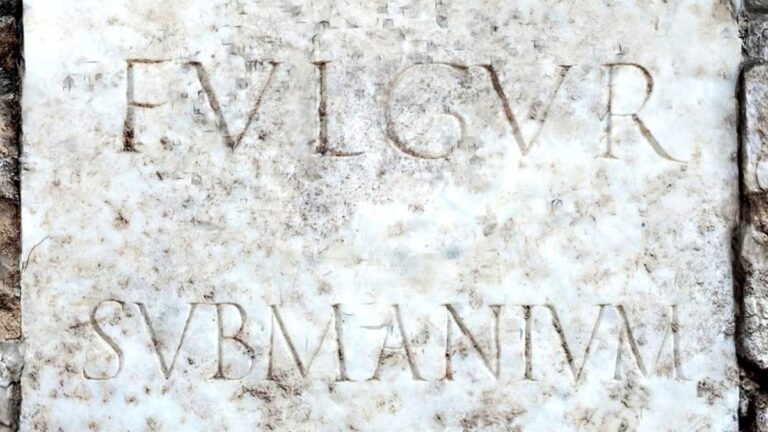
Archaeologists found the inscription in the area traditionally known as the “Amphitheatre,” between the remains of the structure and a natural bank of tuff. Carved across two lines, the fully preserved Latin text reads FVLGVR SVBMANIVM and identifies a nighttime lightning strike associated with Summanus, the Roman god of nocturnal thunder.
The discovery emerged during excavations directed by Fabio Giorgio Cavallero of the University of Urbino Carlo Bo. The project operates under authorization from Italy’s Ministry of Culture and in collaboration with the Villa Adriana and Villa d’Este Institute.
A Marble Marker Still in Its Original Place
The inscribed slab, measuring approximately 40 by 35 centimeters, remains fixed to the front of a small quadrangular structure built from tuff blocks joined with mortar. Its original position makes the find far more informative than an isolated inscription recovered from displaced debris.
Archaeologists believe the structure may have marked a bidental, a sacred enclosure established around a place struck by lightning. Such ground was considered religiosus because divine intervention had removed it from ordinary human use.
Roman ritual practice could require materials affected by a lightning strike to be collected and deposited in the earth. This act, known as fulgur conditum, transformed the location into a protected sacred space. The newly discovered inscription offers rare archaeological evidence of that process within one of the Roman Empire’s most elaborate residential complexes.
Why the Inscription Points to a Nighttime Strike
Roman religious tradition did not treat every lightning strike in the same way. Lightning seen during the day was generally associated with Jupiter, while nocturnal lightning belonged to Summanus, a more obscure deity whose precise nature puzzled even some ancient writers.
The wording FVLGVR SVBMANIVM identifies this event as a nocturnal strike connected with Summanus. The inscription therefore recorded more than the arrival of a storm: it classified the event according to the religious system through which Romans interpreted disturbances in the natural world.
Lightning was not simply understood as weather. It could signal that a deity had entered human space, requiring prescribed rituals and changes to the way the affected place was treated.
A Small Sacred Place Inside an Imperial Residence
Hadrian’s Villa is best known for its monumental architecture, including vast bath complexes, gardens, ceremonial halls and buildings inspired by different regions of the empire. The newly uncovered structure tells a quieter story about how religious practice shaped the imperial estate.
Instead of another monument designed to display power, archaeologists have found evidence of an unexpected event that prompted a ritual response. The working interpretation is that the Romans preserved material connected with a lightning strike, defined the affected space and recorded its religious meaning in stone.
Alberto Samonà, director of the Villa Adriana and Villa d’Este Institute, said the discovery shifts attention away from the villa’s monumental architecture and toward the more intimate sphere of Roman religious life. Because the inscription remains in place, researchers can examine the ritual marker together with the structure and the archaeological deposits around it.
The Strike May Have Changed This Part of the Villa
The discovery may also help archaeologists reconstruct how the so-called Amphitheatre sector changed over time. Excavations conducted in 2024 identified the remains of a palace in the same area, and researchers now want to establish the stratigraphic relationship between that building, the later leveling and burial of its structures, and the installation associated with the lightning ritual.
Cavallero said this sequence could clarify whether the fulgur conditum influenced the subsequent reorganization of the surrounding spaces. Further investigation may establish when the ritual installation was created and how it related to different phases in the history of the monumental area.
Researchers have not yet announced a precise date for the inscription or the ritual structure. Its survival in its original setting, however, preserves something rarely visible at Roman archaeological sites: the moment when a natural event altered the religious identity of a place.
Long after the storm itself disappeared, its meaning remained embedded in the landscape of Hadrian’s Villa. The marble inscription still marks where the Romans believed lightning had crossed the boundary between the human and divine worlds.
Cover Image: he inscribed marble slab remains in its original position on a small quadrangular structure that may have marked a sacred bidental. Credit: Italian Ministry of Culture (MiC)