
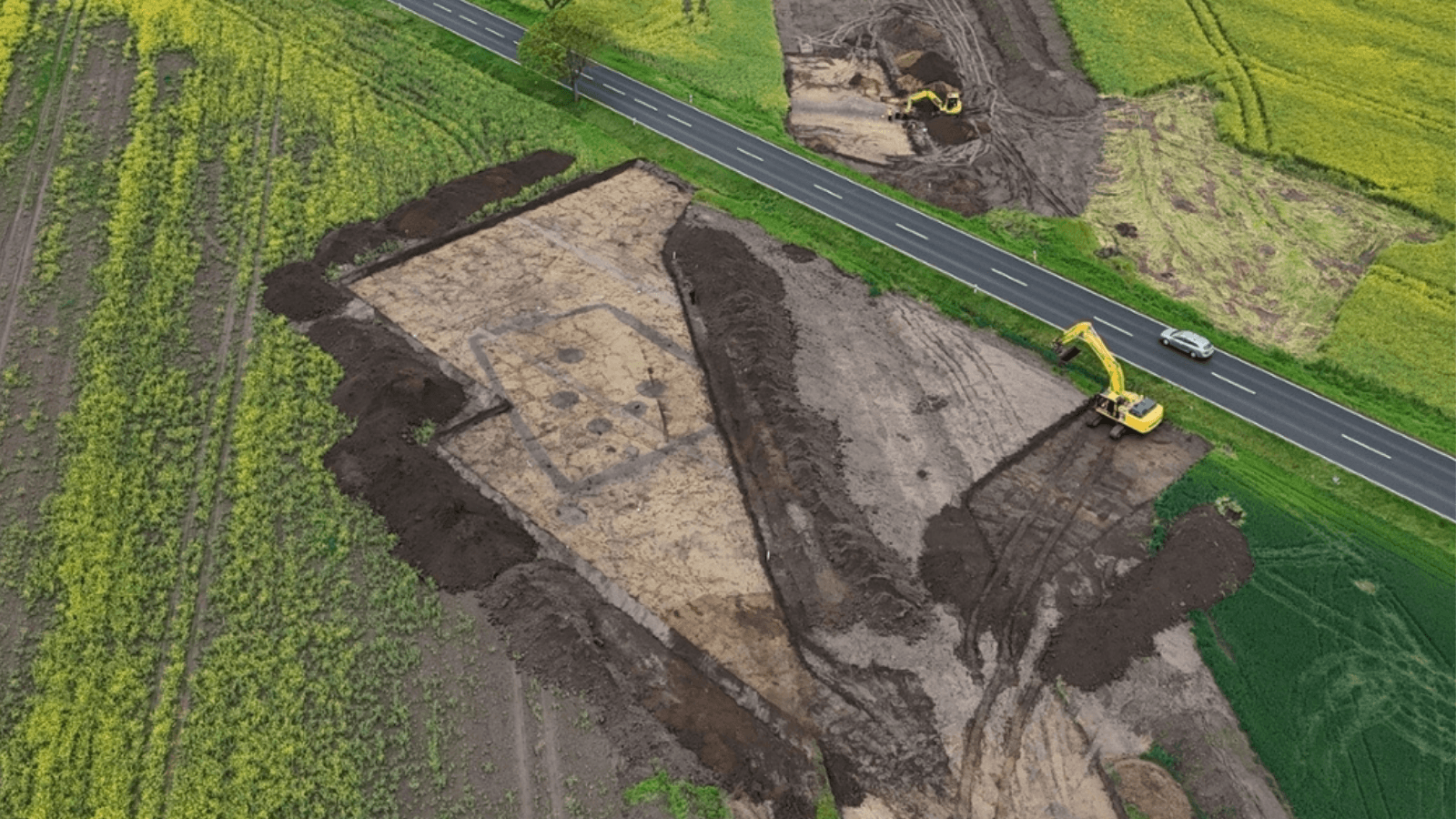
A rare Neolithic burial monument in Germany has emerged along the route of a new pipeline, revealing a vast trapezoidal structure built around a single grave more than 5,000 years ago.
Archaeologists discovered the monument near Döhlen in Saxony’s Leipzig district during investigations preceding the construction of a district-heating and hydrogen pipeline between Leuna and Kulkwitz. Measuring approximately 20 by 25 metres, the structure dates from between 3800 and 3400 BC.
The burial monument belongs to the Baalberge culture, a Neolithic cultural group found primarily in central Germany. Archaeologists recognize this culture through its characteristic pottery forms and monumental funerary architecture.
A dark trapezoid beneath the soil
What survived was not a standing stone structure or an intact burial chamber. A continuous ditch instead preserved the outline of a large trapezoid aligned northeast to southwest.
During excavations in July 2026, the dark soil filling the ancient ditch contrasted sharply with the lighter natural ground. Drone photographs revealed the monument’s carefully planned geometric form, even though thousands of years of agriculture and erosion had removed any visible structure above it.
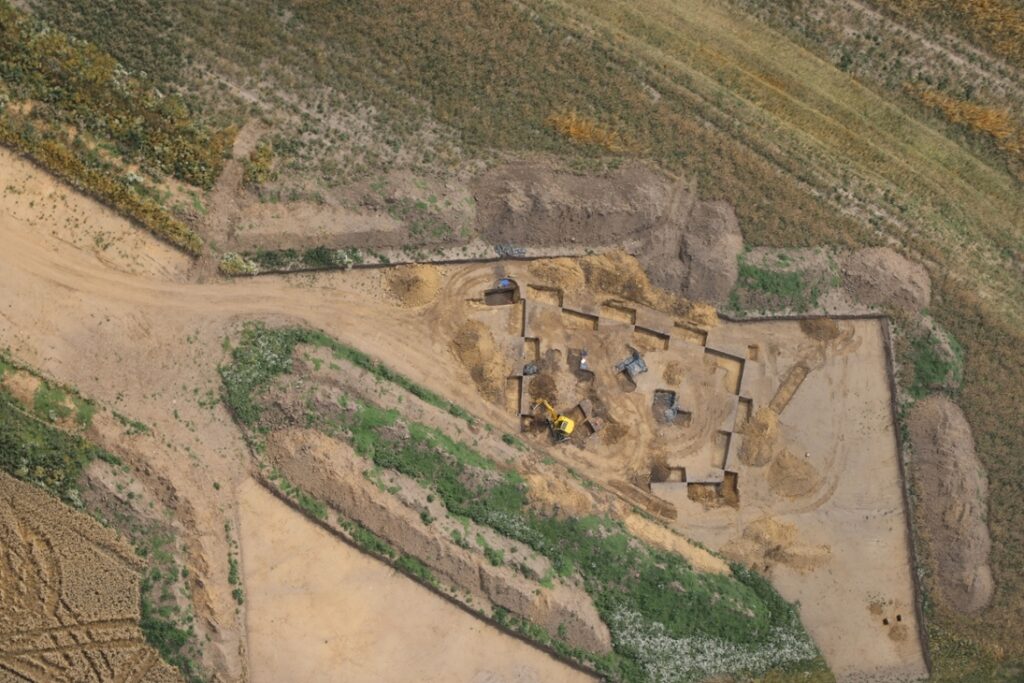
Inside the trapezoid, archaeologists identified seven circular pits. A pit on the western side contained human remains placed in a flexed position on their side. The individual’s head lay toward the south, while the face turned west.
The Saxony State Office for Archaeology has not announced the person’s sex or age. No grave goods accompanied the burial, and the larger, deeper pits inside the monument also produced no artefacts. Only two smaller pits contained fragments of pottery.
A monument for a single burial
The absence of valuable objects does not diminish the significance of the discovery. Creating a ditch around an area measuring 20 by 25 metres required planning, labour and cooperation far beyond what was necessary simply to place a body in the ground.
Comparable trapezoidal monuments discovered elsewhere in the Leipzig district are thought to have supported burial mounds. Archaeologists have not confirmed that such a mound once covered the Döhlen grave, but its size and layout place it within the same monumental funerary tradition.
Similar structures have been documented at Altranstädt, Zwenkau and Kieritzsch. Most contained only one burial, while archaeologists found a second individual in rare cases.
The striking difference between the monuments’ scale and the small number of people buried inside them suggests that these graves were not intended for the wider community. According to the Saxony State Office for Archaeology, researchers associate them with individuals who held a special social position.
The Döhlen burial supports that interpretation, although the lack of grave goods leaves many questions unanswered. Archaeologists cannot yet determine who the individual was or why the community devoted such considerable effort to constructing the monument.
Another piece of Saxony’s Neolithic landscape
The discovery is important not because it is the first trapezoidal grave found in Saxony, but because it adds another well-documented example to a growing regional concentration. Researchers can compare its dimensions, orientation and burial position with related monuments across the Leipzig district.
Scientific excavation directors Stefan Tessenow and Frank Schell of the Saxony State Office for Archaeology are leading work at the site. Investigations are continuing along the future pipeline route, where additional traces of prehistoric activity may still survive.
The Döhlen monument demonstrates how a structure erased from the modern landscape can remain legible beneath the soil. Its dark outline preserves evidence not only of a Neolithic burial, but also of the substantial communal effort devoted to one person’s grave.