

While investigating the prehistoric wetlands of Duvensee Moor in Schleswig-Holstein, archaeologists uncovered an aurochs skull mounted on a wooden post, positioned only a few meters from what is believed to be the oldest known cremation burial in northern Germany.
Dating back roughly 10,500 years, the find suggests that Mesolithic hunter-gatherers practiced complex funerary rituals in which animal symbolism may have played an important role. For archaeologists, the discovery provides rare evidence of how early societies expressed beliefs about death, memory, and the natural world at the beginning of the current warm period following the last Ice Age.
An Exceptional Mesolithic Landscape
The wetlands of Duvensee Moor, located in the district of Herzogtum Lauenburg, are among the most important archaeological landscapes in northern Europe for studying the early Mesolithic period.
When glaciers retreated at the end of the last Ice Age, lakes formed across the region, creating environments that attracted small groups of hunter-gatherers. Over time, peat deposits accumulated across these wetlands, sealing and preserving traces of human activity.
This unique environment has allowed organic materials—including wood, plant remains, and bone—to survive for millennia. As a result, archaeologists can reconstruct not only individual burials but entire ritual landscapes, something rarely possible at prehistoric sites.
Current excavations are led by the Leibniz Centre for Archaeology (LEIZA) in collaboration with the Archaeological State Office of Schleswig-Holstein and the Museum for Archaeology Schloss Gottorf.
The Oldest Cremation Burial in Northern Germany
The story of the mysterious aurochs skull begins with an earlier discovery.
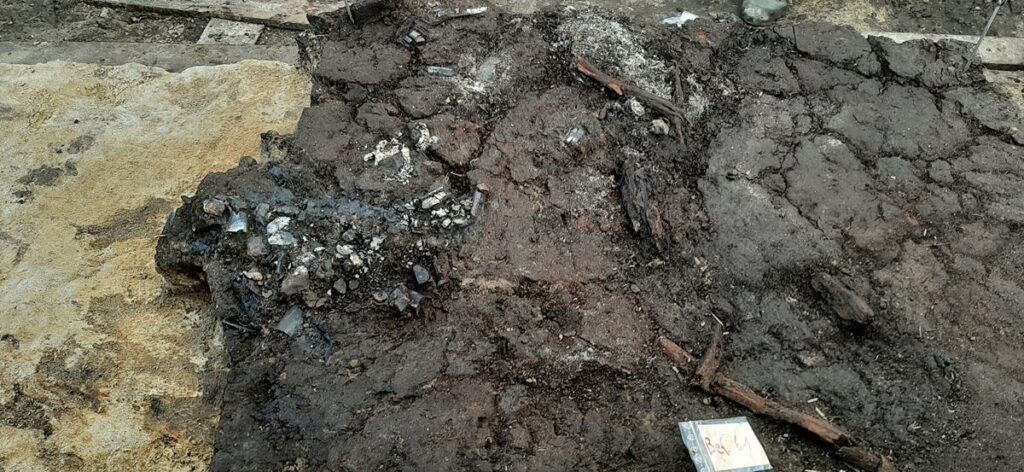
During excavations conducted in 2022 and 2023, archaeologists uncovered a cremation burial dating to approximately 10,500 years ago. This makes it the earliest known example of cremation in northern Germany.
Early Holocene cremation graves are extremely rare in Europe. Only two other examples—one from the Netherlands and another from Denmark—are known, and both are significantly less well preserved.
According to project leader Dr. Harald Lübke, the burial at the excavation area known as Lüchow LA 11 is exceptional because large sections of the ancient ground surface remained intact beneath the peat layer.
The cremated remains were placed in a shallow pit together with fragments of the funeral pyre. Evidence suggests the grave remained visible above ground for some time, indicating that it may have served as a focal point for repeated ritual activity.
Aurochs Skull Mounted on a Post
During further excavations in the summer of 2025, researchers made a surprising discovery in a former shallow-water area near the burial: a complete aurochs skull.
Aurochs—the powerful wild cattle that are the ancestors of modern domestic cows—once roamed across much of Europe. Known for their size and formidable horns, they were among the most impressive animals encountered by Mesolithic hunters.
What puzzled archaeologists was the condition of the skull. It showed no signs of butchery or deliberate breakage, which would normally be expected if the animal had been processed for food.
Because the bones were fragile, the entire find was removed as a block of sediment and transported to the conservation laboratory at Schloss Gottorf.
There, conservators discovered something unexpected.
Hidden inside the skull was a fragment of pinewood. A CT scan later confirmed that the skull had once been mounted onto a wooden post through the occipital opening at the back of the skull. At some point in the past the post had broken, leaving a piece trapped inside.
The evidence strongly suggests that the skull had originally been displayed on a post near the burial as part of a ceremonial arrangement.
A Possible Ritual Landscape
The find becomes even more intriguing when viewed alongside earlier discoveries from the site.
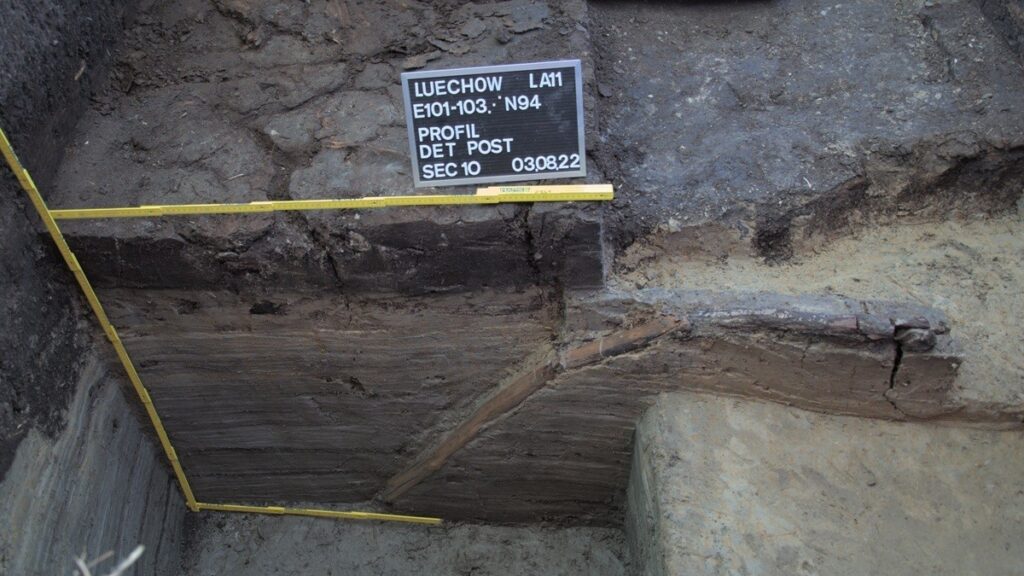
During previous excavations, archaeologists had already identified another wooden post in the same area, this one made from poplar wood. Because the wood species differ, researchers believe the posts likely served different purposes.
One possibility is that the cremation burial was once surrounded by multiple animal skulls mounted on posts, forming a symbolic enclosure around the grave.
Such practices could reflect animistic or totemistic belief systems, in which animals were regarded as spiritual beings connected to human communities.
Ethnographic studies of hunter-gatherer societies in Europe, Asia, and North America show that animal skulls were often displayed during rituals or used to mark sacred spaces linked to death and remembrance.
If this interpretation is correct, the finds at Lüchow LA 11 may represent some of the earliest archaeological evidence of such ritual traditions in northern Europe.
A Site Under Threat
Because of the exceptional preservation conditions at Duvensee Moor, the excavation has also become an important training ground for archaeology students. Since 2023, universities including Kiel, Rostock, and the Free University of Berlin have participated in field schools focused on wetland archaeology.
Researchers now hope to expand investigations in surrounding areas to determine whether additional posts or animal skulls were once part of the same ritual complex.
Yet the site faces a growing threat.
Climate change and the gradual drying of peatlands are beginning to damage organic materials that have survived for thousands of years beneath the bog surface.
For archaeologists, each excavation season may therefore be a race against time—an opportunity to recover fragile evidence of how the earliest communities of post-Ice-Age Europe lived, hunted, honored their dead, and interpreted the forces of nature around them.
The discoveries at Duvensee Moor suggest that 10,500 years ago, death rituals were already deeply symbolic and intertwined with the animal world, offering a rare glimpse into the spiritual imagination of Europe’s earliest Mesolithic societies.
Cover Image Credit: The aurochs skull during excavation and conservation work in the laboratory of the Museum of Archaeology at Schloss Gottorf. Credit: Museum of Archaeology, Schloss Gottorf / Corinna Mayer