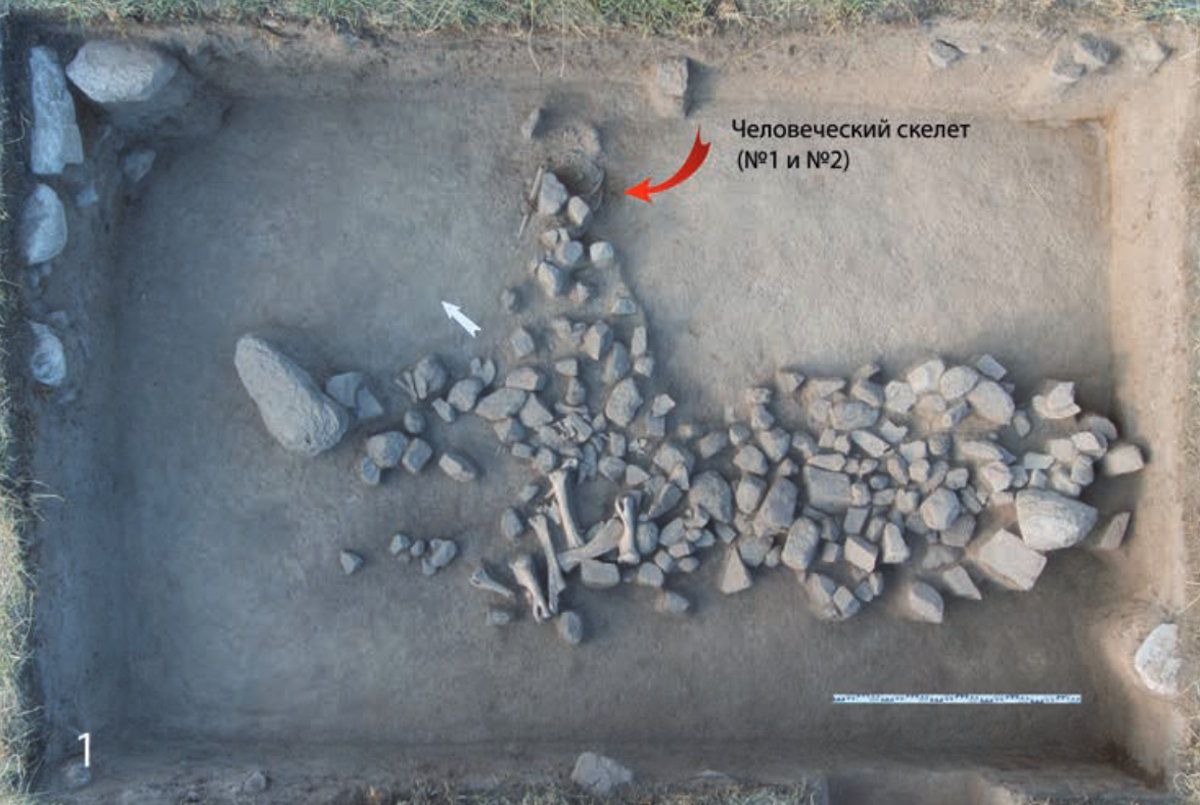
A team of archaeologists has uncovered Kazakhstan’s oldest known human burial at the Koken settlement, revealing a chapter of human history that predates the dawn of herding and agriculture in the region. Radiocarbon analysis dates the discovery to around 7,000 years ago, offering the first direct evidence of human presence in the Kazakh steppe during the Early Neolithic period.
Discovery Beneath Bronze Age Layers
The ancient burial was found beneath later Bronze Age structures at Koken, near the Kokentau Mountains of eastern Kazakhstan. Excavations led by Dr. Paula Doumani Dupuy of Nazarbayev University, Dr. Zhuldyz Tashmanbetova of Washington University in St. Louis, and Academician Zainolla Samashev from the Margulan Institute of Archaeology revealed that beneath the Bronze Age settlement lay undisturbed layers of Stone Age occupation.
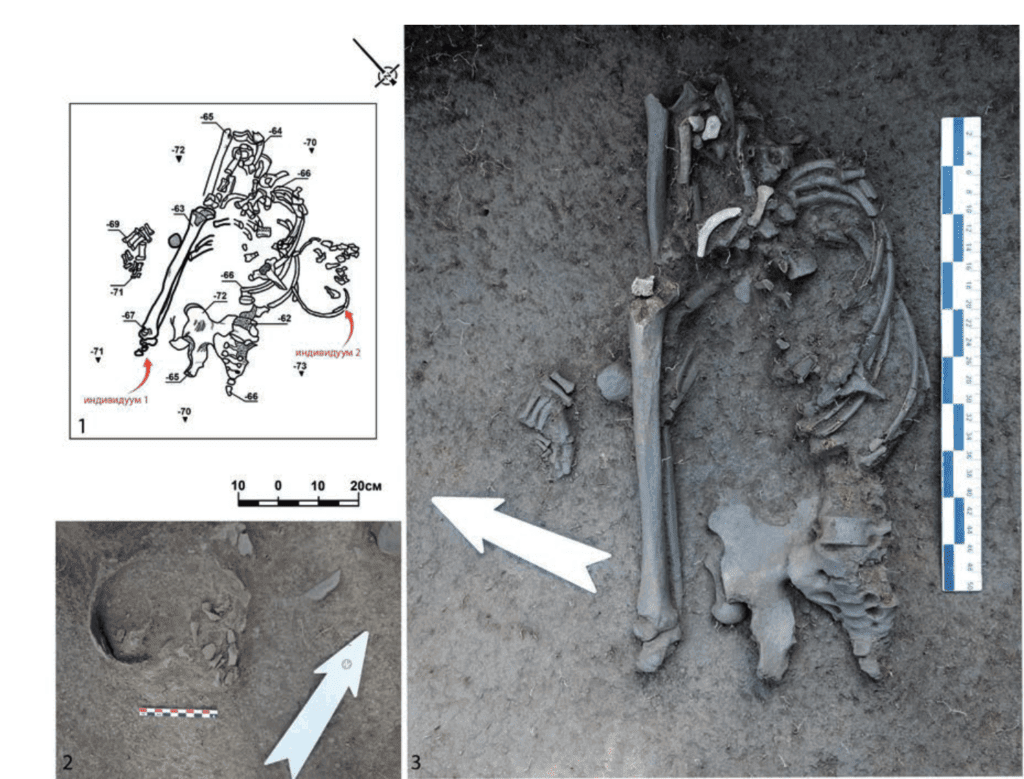
Within these deeper layers, archaeologists identified an oval-shaped grave pit containing two individuals — a tightly flexed adult skeleton and a detached skull belonging to an adolescent. Radiocarbon dating of the human remains yielded calibrated dates between 5471 and 5222 BC, establishing this as the earliest scientifically dated burial ever recorded in Kazakhstan.
Rituals of the Early Steppe Dwellers
The burial posture — the adult positioned on the right side, knees drawn to the chest — suggests a deliberate funerary arrangement. The body appears to have been bound or wrapped prior to interment, a gesture interpreted by the research team as symbolizing rebirth or return to the Earth’s womb, a concept known in other Early Holocene traditions across Siberia and Central Asia.
“The Koken burial gives us a tangible connection to the first communities that inhabited the Kazakh steppe,” said Dr. Doumani Dupuy. “Their burial practices demonstrate symbolic thought and ritual complexity thousands of years earlier than previously known.”
A Multi-Layered Settlement
The Koken site, located near Semey (formerly Semipalatinsk), sits at the base of the Kokentau range within a semi-arid steppe landscape. Excavations revealed that the area remained continuously occupied for millennia. Above the Neolithic grave, researchers found traces of later domestic activity — including ash deposits, pottery shards, and animal bones — culminating in an ethnographic-period refuse pit that partially disturbed the ancient burial.
Radiocarbon tests on a horse bone from this upper layer dated between 1690 and 1920 AD, showing that the site was reused as a domestic area long after its prehistoric occupation.
Despite these later intrusions, much of the skeleton remained intact. Osteological analysis identified the main interment as a young adult, while the separated cranium belonged to a teenager. Ongoing DNA and isotopic research is expected to clarify potential familial ties and genetic origins of the two individuals.
Stone Tools and Technological Context
Associated finds include finely worked flint, jasper, and carnelian tools, typical of a microlithic stone industry. The tool assemblage closely resembles material from Lake Baikal and the Altai Mountains, indicating cultural interaction and shared technological traditions across the Eurasian steppe by the mid-6th millennium BC.

Unlike later Bronze Age kurgans, the Koken burial lacked monumental features or grave goods. Its simplicity, however, reflects a shared Neolithic mortuary pattern found across Mongolia, Siberia, and northern Central Asia, where contracted-body burials and isolated skulls often symbolized ancestor veneration or multi-stage funerary rituals. Similar practices are known from Shamanka II, Lokomotiv, and Khariulyn Gozgor, suggesting a wider symbolic network spanning thousands of kilometers.
Extending Kazakhstan’s Prehistoric Timeline
Prior to this discovery, the oldest securely dated burials in Kazakhstan were known from Zhelezinka and Bestamak, roughly a millennium younger. The Koken find therefore pushes back the record of human occupation and ritual activity in the region to the mid-6th millennium BC, revealing that early foragers were already establishing long-term settlements in the steppe long before the emergence of agriculture or pastoralism.
“Koken represents a turning point in Kazakhstan’s prehistory,” said Academician Samashev. “It links the deep cultural roots of Central Asia with the early development of steppe societies that would later shape the nomadic civilizations of Eurasia.”
Further excavations at Koken are expected to explore deeper Mesolithic layers, potentially revealing traces of even older habitation. For now, this 7,000-year-old grave stands as the earliest known evidence of human life in Kazakhstan — a quiet testament to the first inhabitants of the steppe.
Doumani Dupuy, P. N., Tashmanbetova, Z., Kiyasbek, G., Merts, V., Coil, R., Zhuniskhanov, A., & Samashev, Z. (2025). Earliest human burial in Kazakhstan: Neolithic findings from the Koken settlement. Kazakhstan Archaeology, 3(21), 164–186. https://doi.org/10.52967/akz2023.3.21.164.186
Cover Image Credit: Dr. Paula Doumani Dupuy