
It looked like an ordinary stone.
But in the vast, wind-swept terrain of southwestern Wyoming, an 11-year-old boy paused — and changed the story of a 48-million-year-old landscape.
Last fall, while exploring Bureau of Land Management (BLM) public land in the Greater Green River Basin, young fossil enthusiast Touren made a discovery that has since drawn international attention: a remarkably well-preserved turtle fossil dating to the Eocene Epoch.
A Window Into Eocene Wyoming
Today, southwestern Wyoming is dry, rugged, and windswept. But around 48 million years ago, the region looked radically different. During the Eocene, the Greater Green River Basin supported a warm, almost subtropical ecosystem shaped by rivers, wetlands, and the remnants of ancient Lake Gosiute.
This lush environment sustained early mammals, crocodilians, fish, and turtles. The fossil Touren uncovered comes from this ancient world — a time when North America was experiencing significant climatic and ecological transformation.
Based on geological dating of the surrounding rock layer, paleontologists estimate the specimen to be roughly 48–50 million years old.
A Sharp Eye on Public Land
Touren was exploring the area with his grandparents when he noticed something unusual among scattered shells and stones. Rather than dismissing it as another rock, he took a closer look — and realized it might be something significant.
He reported the find to the Bureau of Land Management’s Rock Springs Field Office. Specialists later confirmed that the fossil was located on federally managed public land, triggering proper documentation and protection procedures.
Instead of being removed casually or damaged by erosion, the fossil was stabilized and prepared for professional excavation.
That decision made all the difference.
Excavation Reveals a Soft-Shelled Turtle
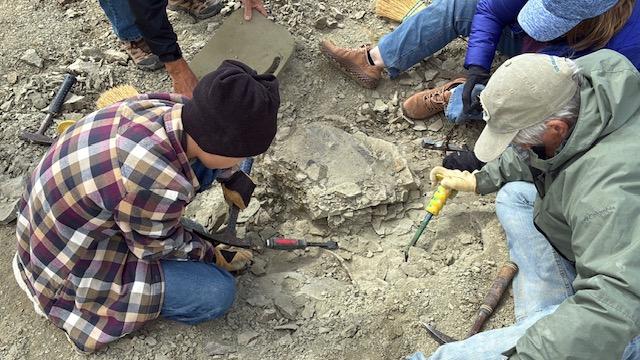
In September 2025, JP Cavigelli, museum collections specialist at the Tate Geological Museum at Casper College, led a formal excavation effort. Touren and his grandparents were invited to witness the process.
Careful excavation revealed a nearly complete turtle carapace — the upper shell. While no additional skeletal elements were preserved, the shell itself was in exceptional condition.

Paleontologists identified the fossil as belonging to the trionychid family, commonly known as soft-shelled turtles. Unlike hard-shelled species, trionychids have flatter, more flexible shells that are not fully fused underneath.
Members of this family still exist today, suggesting that this ancient turtle may have resembled its modern relatives in both form and aquatic behavior.
Recently released images show the interior of the shell, offering researchers additional insight into its preservation and structure.
From Field Site to Museum Collection
After excavation, the fossil was transported to the Tate Geological Museum — a Bureau of Land Management–approved repository. There, preparation and conservation work are ongoing.
Volunteers are carefully cleaning and stabilizing the specimen, gradually revealing details that were hidden within the surrounding matrix. Early photographs from the site captured the shell’s exterior surface, while later images document its interior.
As recognition for responsibly reporting the discovery, Touren was allowed to help during excavation and given the opportunity to name the fossil.
He chose the nickname “Little Timmy.”
The Role of Public Lands in Scientific Discovery
Officials emphasized that the discovery underscores the importance of protecting fossils on public lands. Had the specimen been removed improperly, critical scientific information about its geological context would have been lost.
The Bureau of Land Management oversees millions of acres across the western United States and maintains an active paleontology program dedicated to preserving fossils for research and education.
By reporting the fossil rather than collecting it privately, Touren ensured that an important piece of Wyoming’s prehistoric ecosystem will remain accessible to scientists and the public alike.
It’s a reminder that even in landscapes that seem empty at first glance, deep time is still waiting — sometimes just beneath our feet.
Cover Image Credit: A close-up shows the fossilized turtle shell on BLM-managed land during excavation. Craig Thomas, BLM Rock Springs Field Office