
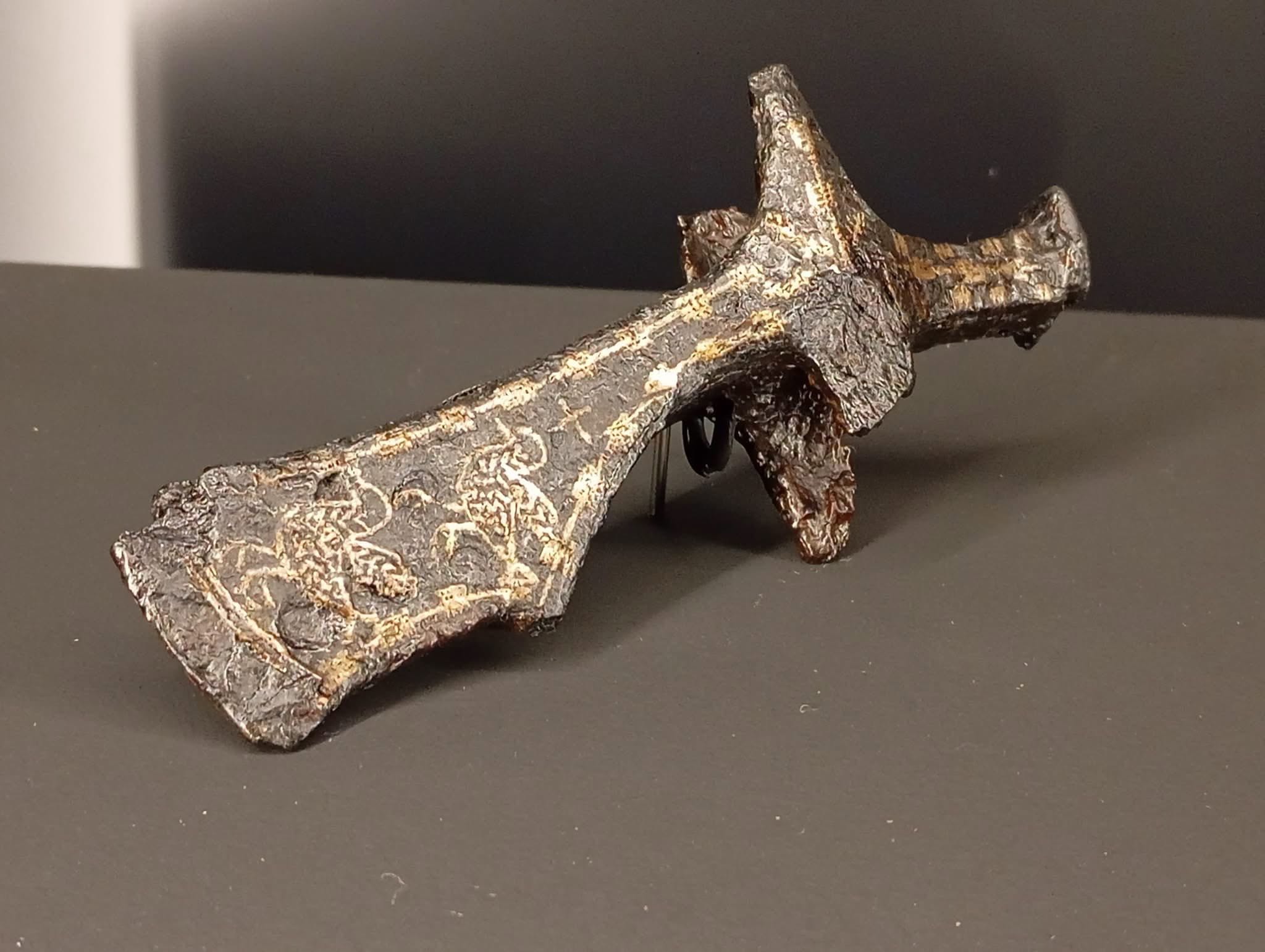
A tiny axe found near the Czech village of Bašnice looks at first like a weapon. Its size tells a different story.
Measuring only 10.8 centimeters long and weighing just 78 grams, the early medieval object was far too small to serve as a practical battle axe. Instead, archaeologists now see it as a rare prestige item, a carefully decorated symbol of rank from a period when power in Central Europe was being reshaped by warrior elites, local dynasties, and the spread of Christianity.
Known as the Bašnice “bird axe,” or ptačí sekerka in Czech, the artefact was discovered in spring 2019 near Bašnice in the Jičín district of Czechia. After conservation and scientific examination, its unusual character became clear: this was not an ordinary tool or battlefield weapon, but one of the most striking small objects known from the early medieval world of Bohemia.
Silver Birds, a Cross, and a 78-Gram Axe
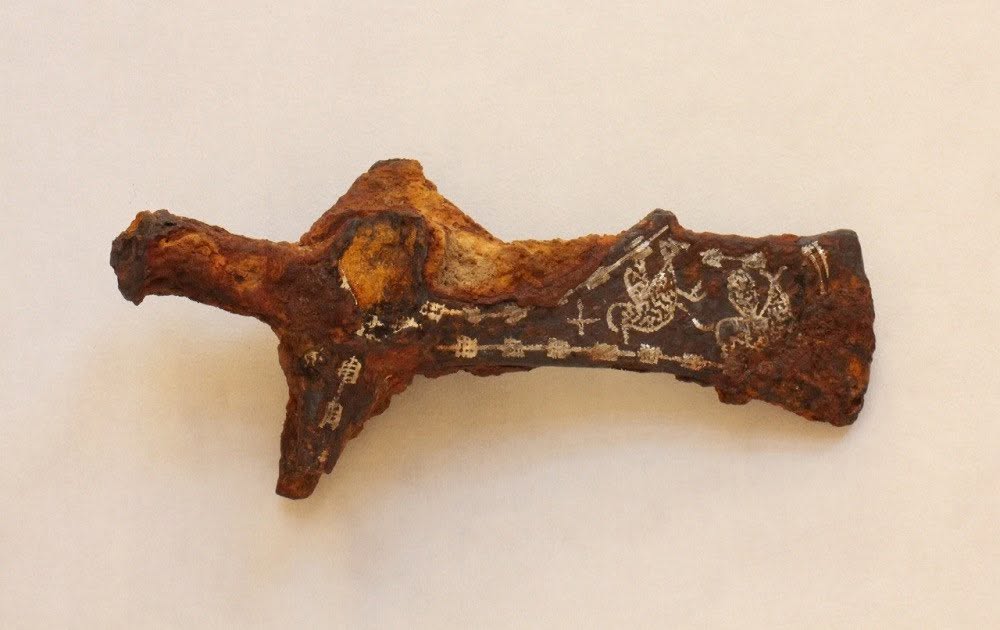
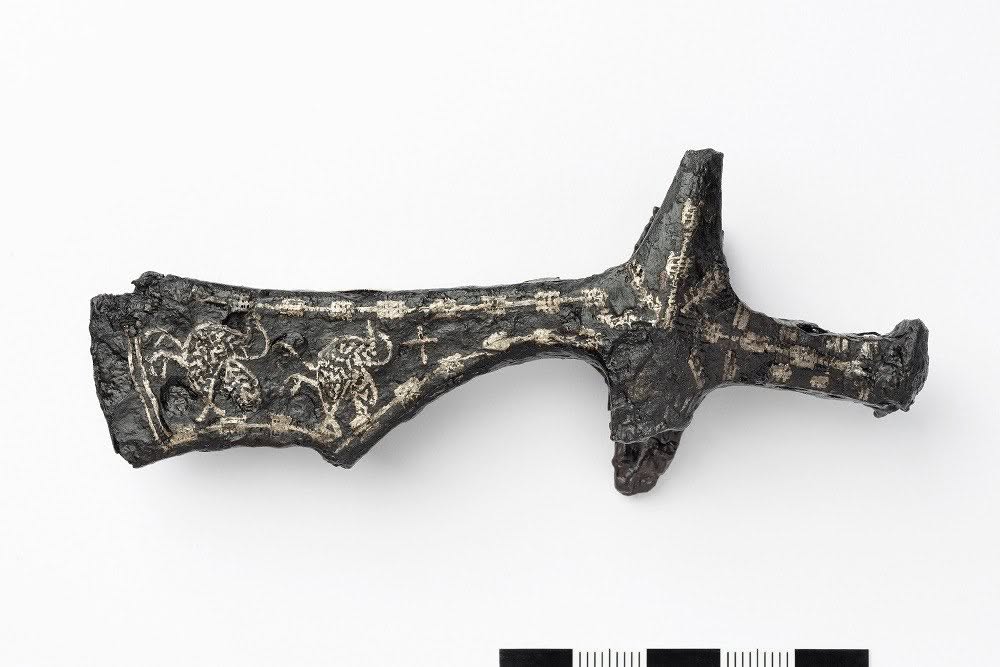
The axe head is made of iron, but its surface carries delicate silver decoration. Two small bird figures appear on the blade, accompanied by a cross, star-like motifs, geometric lines, and plant-like ornament.
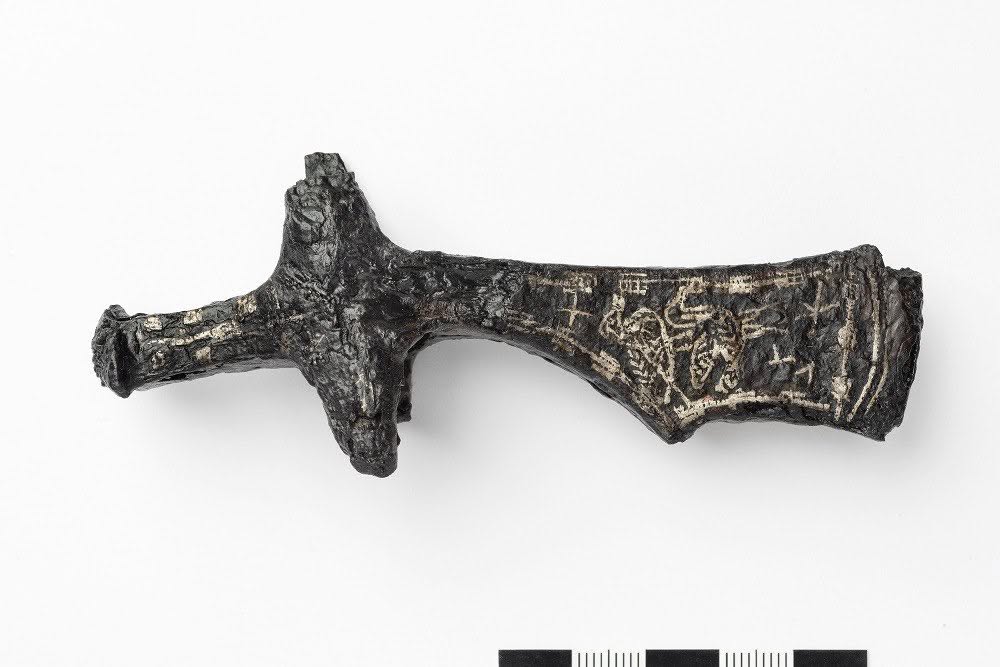
The combination is visually powerful. The birds give the object its modern nickname, while the cross places it in a world where Christian symbols were becoming increasingly visible. The geometric and vegetal elements add another layer of meaning, suggesting that the object was meant to be seen, handled, and recognized as something special.
Its miniature size is crucial. A functional axe had to survive impact, weight, and repeated use. The Bašnice axe was made for something else. It likely acted as a ceremonial or symbolic object, perhaps connected with rank, lineage, protection, or elite identity.
A Rare Object from the Age of Great Moravia
Researchers date the axe to the second half of the 9th century or the early decades of the 10th century. This places it close to the world of Great Moravia and the early Czech principality, a period when Central Europe was undergoing deep political and religious change.
Axes of this general type are associated with the Great Moravian environment, but the Bašnice example stands apart because of its miniature form and silver inlay. Its decoration suggests access to skilled craftsmanship and to the visual language of power used by early medieval elites.
The cross is especially important, but it should not be read too simply. In the 9th and 10th centuries, Christian imagery, older symbolic traditions, and aristocratic display often overlapped. The birds may have carried meanings connected with the soul, the sky, protection, or status. Their exact meaning remains open, which is part of what makes the object so compelling.
Was It a Grave Gift?
The findspot lies near early medieval Slavic burial mounds, raising the possibility that the axe may once have belonged to a grave context. That cannot be proven with certainty, because the original archaeological setting is not fully preserved.
Still, the idea is significant. Similar small symbolic weapons have sometimes been linked with children’s or young male burials in elite environments. If the Bašnice axe was placed with a young person, it may have represented not military experience but inherited status. In that case, the object would have spoken less about what its owner had done and more about who he was expected to be.
This gives the axe a more human dimension. It may not have belonged to a battle-hardened warrior. It may have marked belonging, ancestry, and the social ambitions of a powerful family.
Laboratory Work Revealed Its Craftsmanship
The axe’s importance became clearer after conservation. Corrosion and soil deposits had hidden much of the surface decoration. Once cleaned and studied, the silver inlay revealed the birds, cross, stars, and border ornaments in greater detail.
Material analysis showed that the iron body had been decorated with high-purity silver. Traces of other metals, including copper, were also detected, suggesting that the maker may have used subtle visual contrasts in the decoration.
A small wooden remnant preserved inside the shaft hole added another rare detail. It is thought to come from hawthorn wood, a useful clue for understanding how the object may once have been mounted.
A Small Object with a Larger Story
The Bašnice bird axe is now kept in the collection of the Museum of Eastern Bohemia in Hradec Králové. Its importance lies not in size, but in what it reveals.
At just 78 grams, it brings together iron, silver, birds, stars, and a cross in one compact object. It belongs to a moment when Central European elites were using objects not only for war, but also for display, belief, and social identity.
The Bašnice axe reminds us that archaeology does not always need a palace, a battlefield, or a royal tomb to tell a powerful story. Sometimes, an object small enough to fit in the hand can preserve the ambitions of an entire age.
Rokoská, P. (2023). Miniaturní raně středověká sekera zdobená motivem ptáčků z Bašnic (okres Jičín). Archaeologia historica, 48(1), 219–237. DOI: 10.5817/AH2023-1-10.