
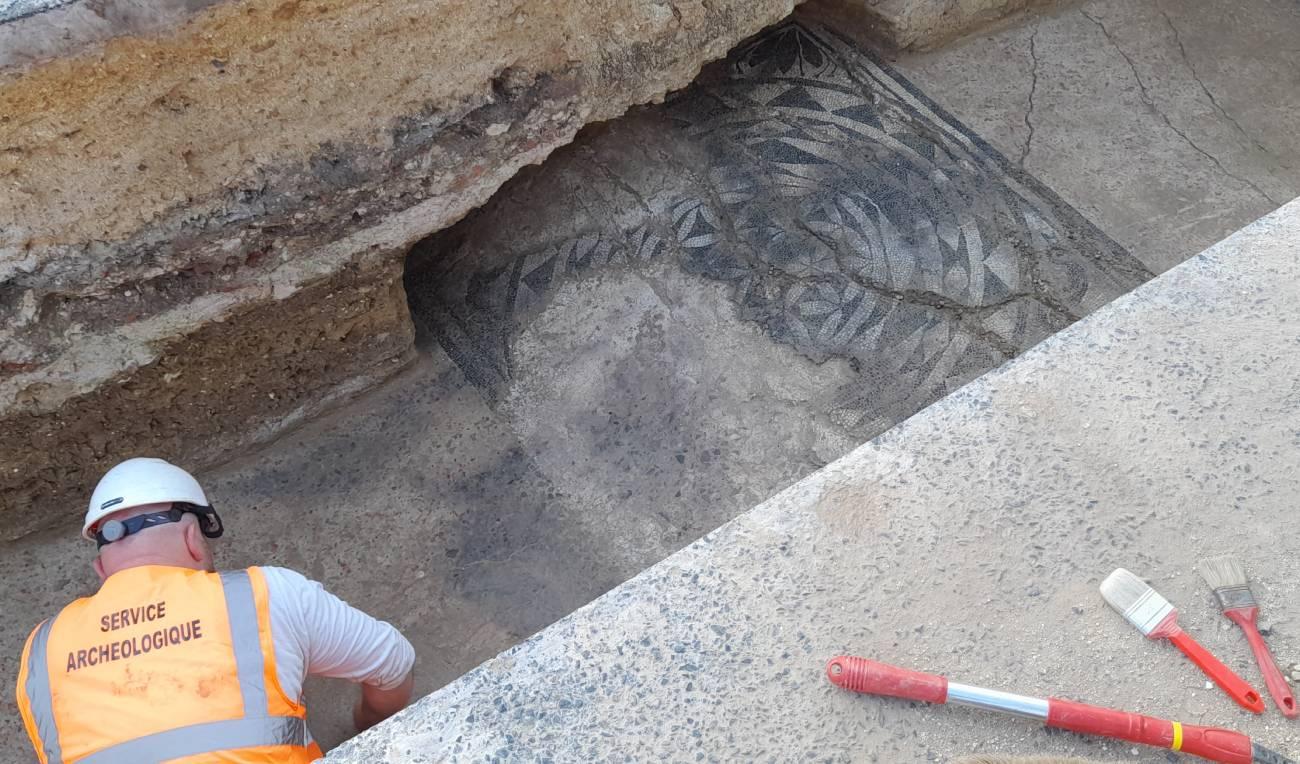
A nearly 2,000-year-old Roman mosaic discovered beneath Soissons is revealing an unusually refined glimpse of elite life in ancient northern France.
Archaeologists from the Conseil Départemental de l’Aisne uncovered the exceptional Gallo-Roman pavement in the Saint-Crépin district during preventive archaeology work linked to the installation of a district heating network. Dated to the late 1st century AD, the mosaic is believed to have decorated the floor of a Roman villa, most likely a reception room measuring close to 50 square meters.
What makes the discovery stand out is not only its preservation, but its construction. The pavement was made with two techniques: one part in concrete, the other in tesserae, the small cubes of stone or glass paste used to create mosaic decoration. This “mixed” pavement is rarely documented at such a scale and in such good condition in the region.
A mixed Roman pavement of rare quality
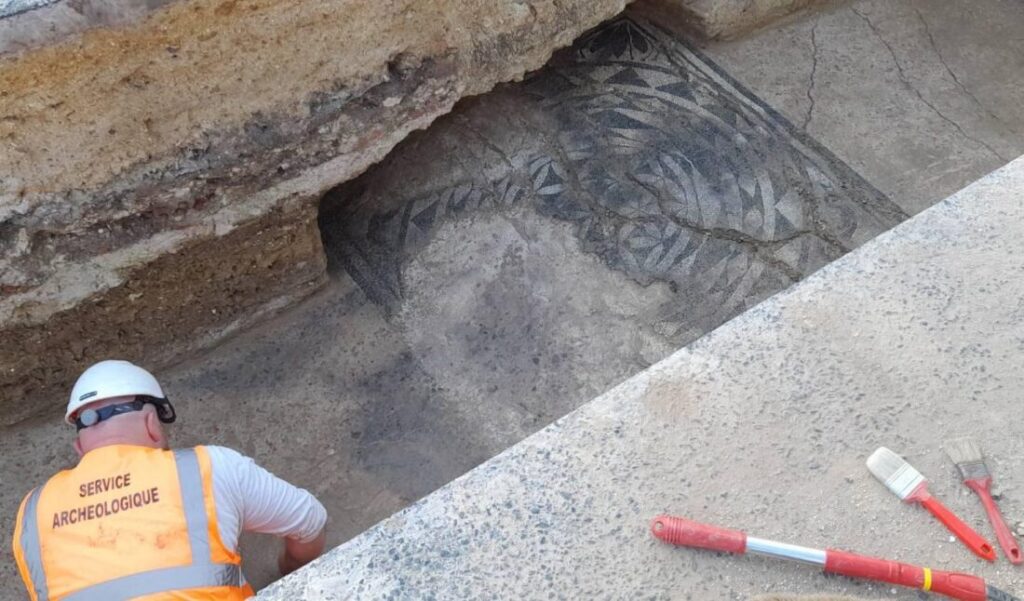
The central decorated panel measures 1.56 meters on each side. It is arranged around a black-and-white tessellated medallion, surrounded by concentric lines and interlocking rhombuses. The design is geometric, carefully balanced, and clearly intended for a room where visual impression mattered.
In Roman domestic architecture, a decorated reception room was never just a private space. It was a setting for visitors, meals, conversation, and social display. Floors like this helped communicate the owner’s wealth, cultural taste, and familiarity with Roman styles.
The Soissons pavement appears to belong to that world. Its combination of concrete and tessellated decoration also raises technical questions. Archaeologists will now examine how the two construction methods were joined, whether the floor was planned as a single decorative program, and what its materials can reveal about local workshop practices in Roman Gaul.
The dolphin with red fins
One corner of the central panel contains the mosaic’s most distinctive detail: a dolphin with red fins.
The figure is small compared with the geometric composition, but it may be one of the most informative parts of the floor. Animal motifs can preserve evidence of the mosaicist’s technique, including the handling of color, the direction of the tesserae, and the way movement was suggested through simple forms.
Dolphins were familiar images in Roman art. They were often associated with water, speed, prosperity, and the wider Mediterranean cultural world. In an inland city such as Soissons, the motif may also point to the tastes of local elites who adopted imperial-era decorative language inside their homes.
The red fins make the figure especially memorable. They add a rare note of color to a composition otherwise dominated by geometric order, and they may help specialists compare the pavement with other Gallo-Roman mosaics from northern France.
Roman Soissons beneath the modern city
The discovery adds important evidence for the Roman-period history of Soissons. The Saint-Crépin district, where the mosaic was found, appears to have been an ancient neighborhood occupied between the 1st and 3rd centuries AD.
The presence of a villa with a richly decorated reception room suggests that this area was home to members of the local elite. These were people who lived within a Romanized cultural environment and expressed their status through architecture, interior decoration, and domestic ceremony.
Soissons, anciently connected with the territory of the Suessiones, became part of the Roman landscape of northern Gaul after the conquest. Finds such as this mosaic show how Roman influence was not limited to administration or military control. It entered houses, dining rooms, decorative choices, and the daily habits of privileged families.
For that reason, the pavement is more than a beautiful floor. It is evidence of how local identity and Roman cultural models overlapped in a provincial city nearly two millennia ago.
Preventive archaeology during modern works
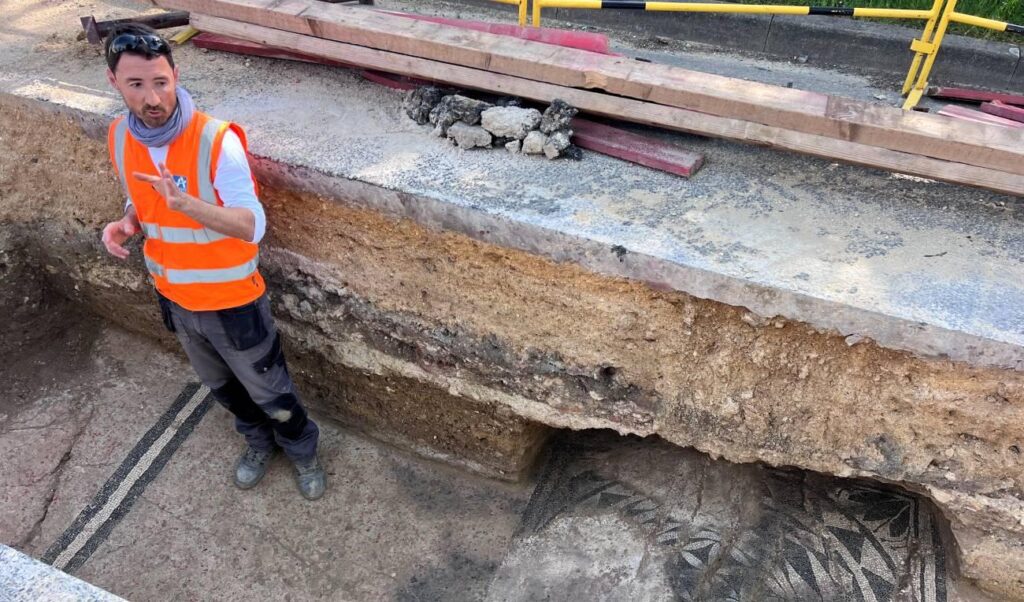
The mosaic was discovered during construction work, but officials say the find has not delayed the district heating project. The operation was carried out through close coordination between the Departmental Archaeological Service and the teams responsible for the infrastructure works.
This kind of discovery shows the value of preventive archaeology in historic urban areas. Beneath modern streets and service networks, ancient remains can survive in places where large research excavations would not normally take place. When archaeological teams are involved early, important finds can be documented and protected without stopping public works.
In Soissons, the department’s knowledge of the terrain helped the operation move efficiently while preserving the remains.
Study, removal, and possible public display
A detailed phase of analysis will now begin with specialists in Roman mosaics. Researchers will study the materials, construction sequence, decorative layout, and technical relationship between the concrete and tessellated sections.
The Conseil Départemental de l’Aisne is also evaluating whether the mosaic can be lifted from its original location. Removing a pavement of this kind is a delicate process, but it may offer the best chance for long-term conservation.
If the removal is approved, the next stages will include extraction, laboratory study, restoration, and possibly public presentation. For now, the Soissons mosaic stands among the most notable recent Roman-period finds reported in the Aisne department.
Its rare two-technique construction, nearly 2,000-year-old date, refined geometric design, and red-finned dolphin motif make it an important new piece in the study of elite life in Gallo-Roman northern France.