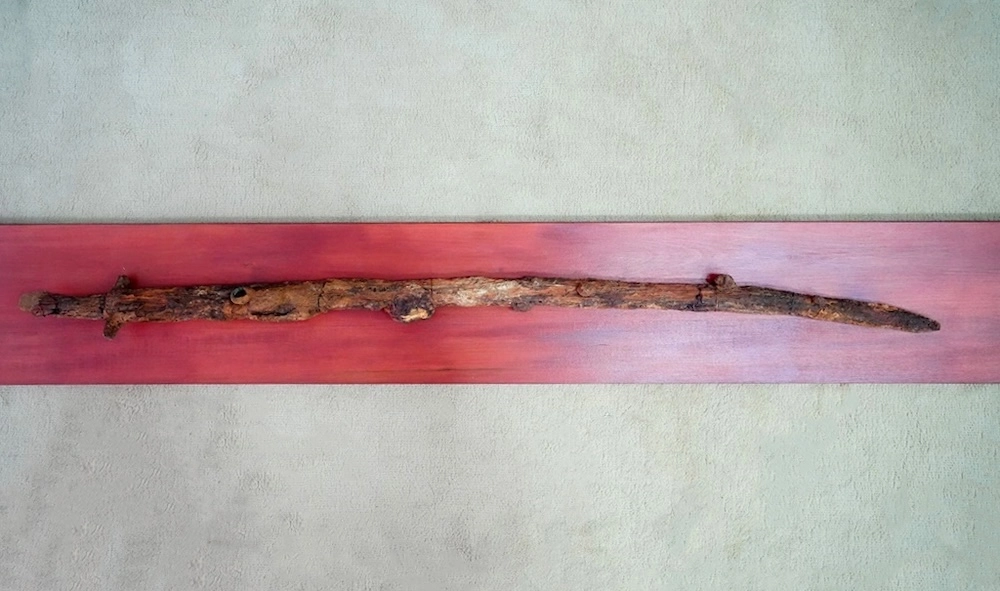
A 112-centimeter saber has emerged from a 13th-century grave near Russia’s lower Volga, still preserved inside the wooden scabbard that protected it for centuries.
The weapon was discovered at the Orlinoye Gnezdo settlement and ground burial cemetery in the Astrakhan region, where archaeologists have been examining a medieval burial ground in Krasnoyarsky District. Its size alone makes it unusual. While many medieval sabers of this type were closer to 70 centimeters long, this example stretches well over a meter with its scabbard. The blade itself is nearly one meter long.
Museum specialists believe the saber was not an ordinary battlefield weapon. Its length, construction and rare state of preservation suggest it may have been made to order, perhaps for a warrior of special rank in the turbulent world of the 13th-century Eurasian steppe.
A grave that stood apart
The discovery was made during excavations by specialists from the scientific and production institution “Nasledie” in Astrakhan Oblast. Archaeologists examined a 50-square-meter area on a small rise at Orlinoye Gnezdo, where they identified more than 50 Muslim burials.
Most graves contained no objects. But two burials uncovered near the end of the field season changed the character of the site.
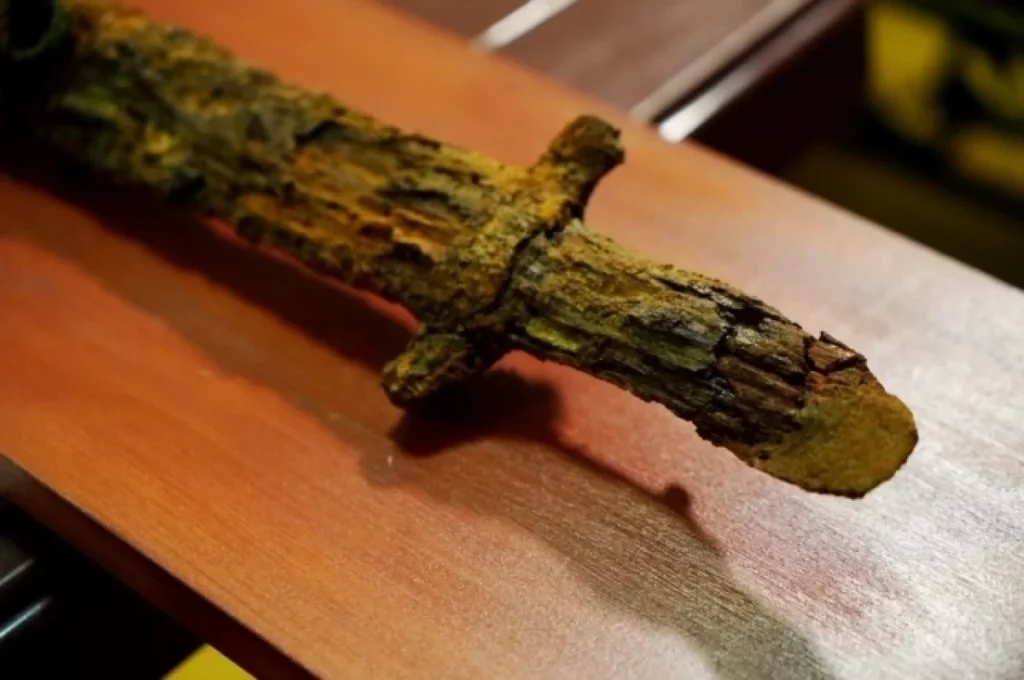
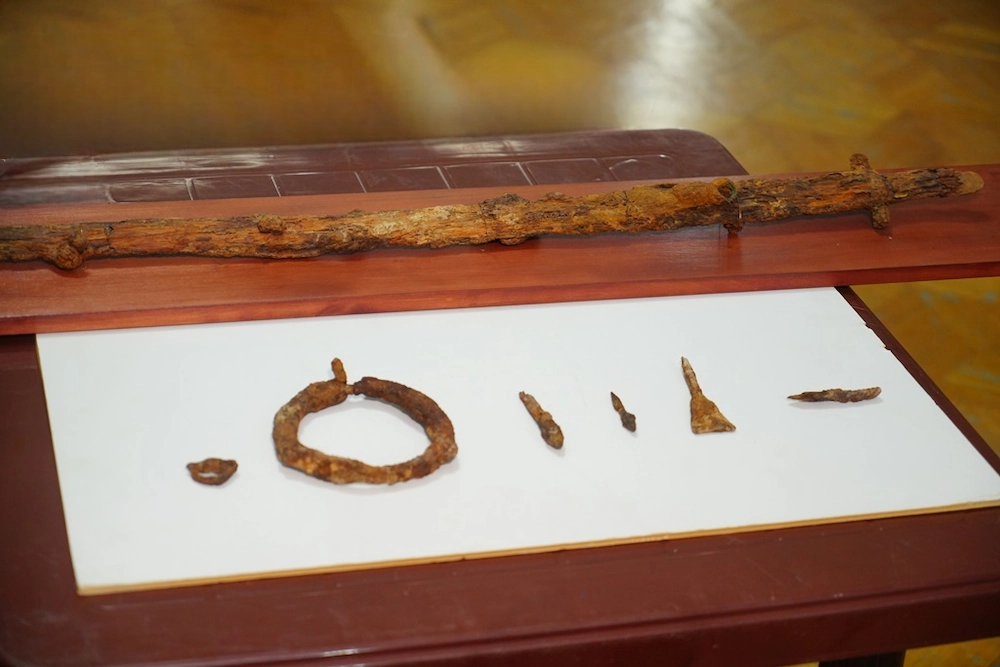
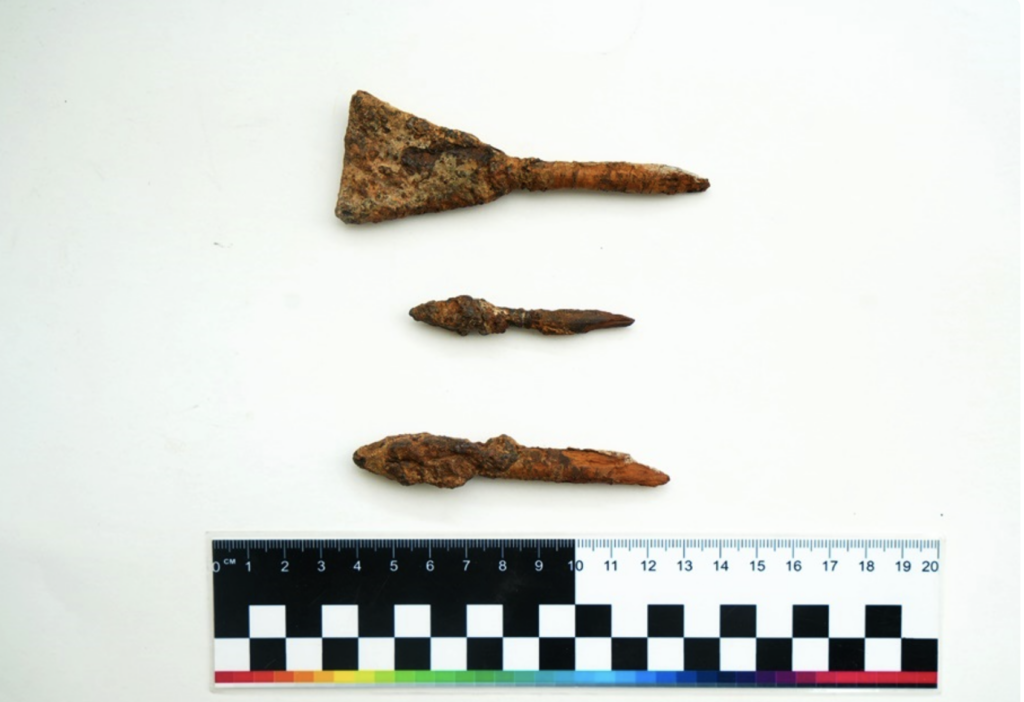
The lower burial, recorded as Burial No. 53 and dated to around the middle of the 13th century, contained the remains of a man placed in an oval grave pit with his head to the east. Near the body were arrowheads, possible traces of decayed leather armor, and the unusually long saber, still lying inside its wooden scabbard.
The dark coating observed over the head and upper body may come from organic materials that once formed part of armor or protective equipment. If confirmed, the traces would strengthen the interpretation of the grave as that of a mounted warrior or a man closely associated with warfare.
A blade preserved by its own decay
The saber was not lifted from the ground as a loose object. Archaeologists removed it as a block together with the surrounding earth. The block weighed about 15 kilograms, and conservation work later took four months.
Restorer Mikhail Golovachev described the preservation as exceptional. The iron blade had remained inside the wooden scabbard, and iron oxides appear to have helped preserve parts of the wood. In most medieval iron objects, organic materials vanish almost completely. Here, the corrosion process helped leave behind rare evidence of the weapon’s original form and fittings.
That makes the saber valuable not only as a striking object, but also as a technical clue. Its surviving suspension element may help researchers understand how it was worn, while the wooden scabbard offers information that is often lost in steppe-period weapons.
Beneath the saber, archaeologists also found about 50 square centimeters of birch bark. The material may represent the remains of a quiver, adding another martial detail to the burial.
Too long for its owner?
The weapon’s length remains the central puzzle.
Golovachev noted that ordinary medieval sabers were widely available through arms networks, but this example appears too long for standard production. One possibility is that it was made for an unusually tall man, perhaps close to two meters in height. Drawing such a long blade from a scabbard would have required a broad reach.
Yet the skeleton in the grave measured about 175 centimeters.
That difference keeps the interpretation open. The saber may have been inherited, symbolic, ceremonial, or designed for a form of mounted combat not fully understood from the burial alone. It may also have signaled status more than practical use. In either case, the weapon was important enough to be placed with the dead.
A second burial hints at violence
Above the warrior burial, archaeologists found another grave, Burial No. 52. This man had been placed with his head to the west, in a position described as highly unusual by archaeologist Tatyana Grechkina. The body appears to have been laid face down. There were also signs that the hands may have been bound before burial, and the skull position suggested severe trauma to the neck.
Still, the grave does not look like a simple disposal. About 20 centimeters north of the body, archaeologists found horse leg bones, a stirrup and a harness buckle. These details point to ritual, symbolic or status-related meaning, even if the man’s death remains unexplained.
Together, the two burials create a rare and uneasy archaeological picture: one grave marked by possible violence, another by weapons, armor traces and a saber that does not fit easily into known categories.
A rare glimpse of the medieval lower Volga
The artifacts, including the saber, stirrup, belt buckle, arrowheads and a knife fragment, have been transferred to the Astrakhan Museum-Reserve. Museum officials said they are being formally registered into the collection and are expected to go on display at the Local History Museum closer to August.
For researchers, the discovery opens a window onto the lower Volga during one of the most dynamic periods of the medieval steppe. The 13th century brought war, migration, trade and political transformation across Eurasia. In the Astrakhan region, Islamic burial customs, horse culture and military identity met in a landscape shaped by movement and conflict.
The saber now gives that world a sharper edge. It is not only a rare weapon preserved in wood. It is a surviving trace of a frontier society where status, violence and burial customs could be written into the ground with iron, horse gear and the body of a man whose story remains only partly visible.
Cover Image Credit: Astrakhan Museum-Reserve