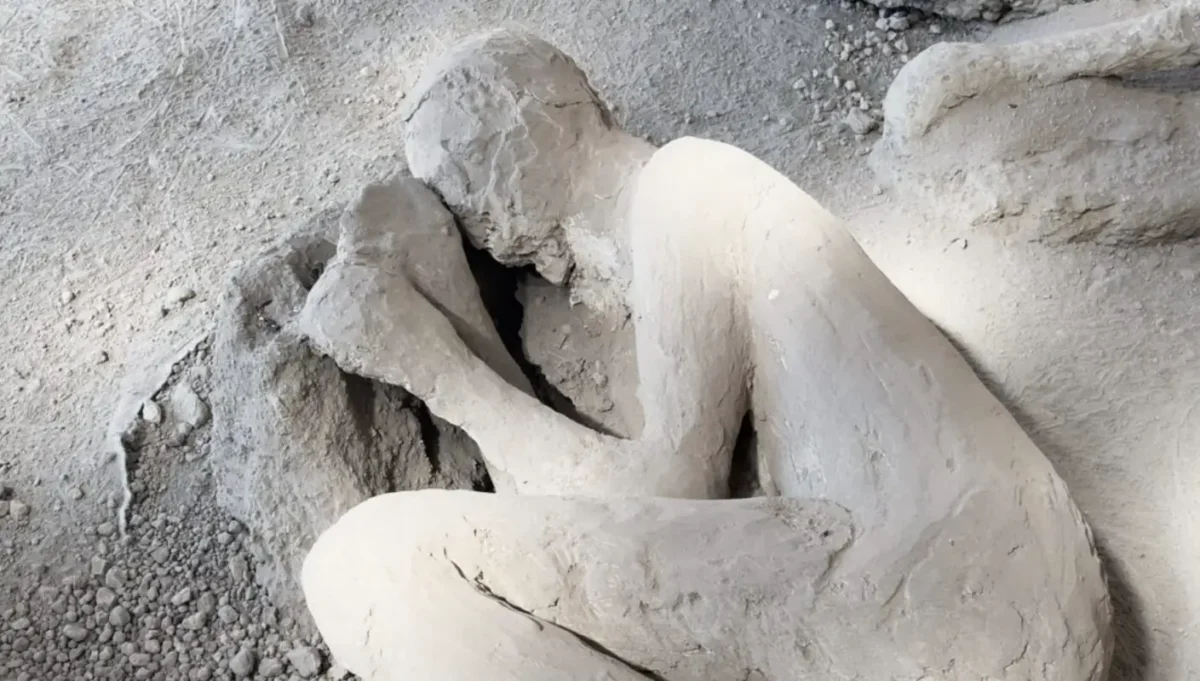
A Pompeii victim who died while fleeing the eruption of Mount Vesuvius in AD 79 may have been a Roman doctor, according to new scans of objects preserved inside his plaster cast. The small case, coins and tools found with the man suggest he may have carried the equipment of a medicus during the city’s final hours.
The find comes from a renewed study of materials recovered from the Orto dei Fuggiaschi, or Garden of the Fugitives, one of Pompeii’s most emotionally charged archaeological areas. Excavated in 1961 under Amedeo Maiuri, the site revealed the casts of people who were caught by the pyroclastic cloud while trying to escape the doomed Roman city.
Among them was the individual now identified in the study as victim 46. Unlike a generic disaster victim, he appears to have carried a compact personal set that may point to his profession. Preserved with the plaster cast were a small case, a textile bag with bronze and silver coins, and several objects that researchers say are compatible with medical practice.
A small box from Pompeii’s final hours
The object had remained hidden inside the cast since the original excavation. Recent work by specialists at the Pompeii Archaeological Park allowed researchers to examine it without damaging the cast.
The personal set included a small box made from organic material with metal fittings, a textile bag containing bronze and silver coins, and several small objects compatible with professional tools. Among the most important items was a small stone coticula, a plate that could have been used to grind or prepare medicinal and cosmetic substances.
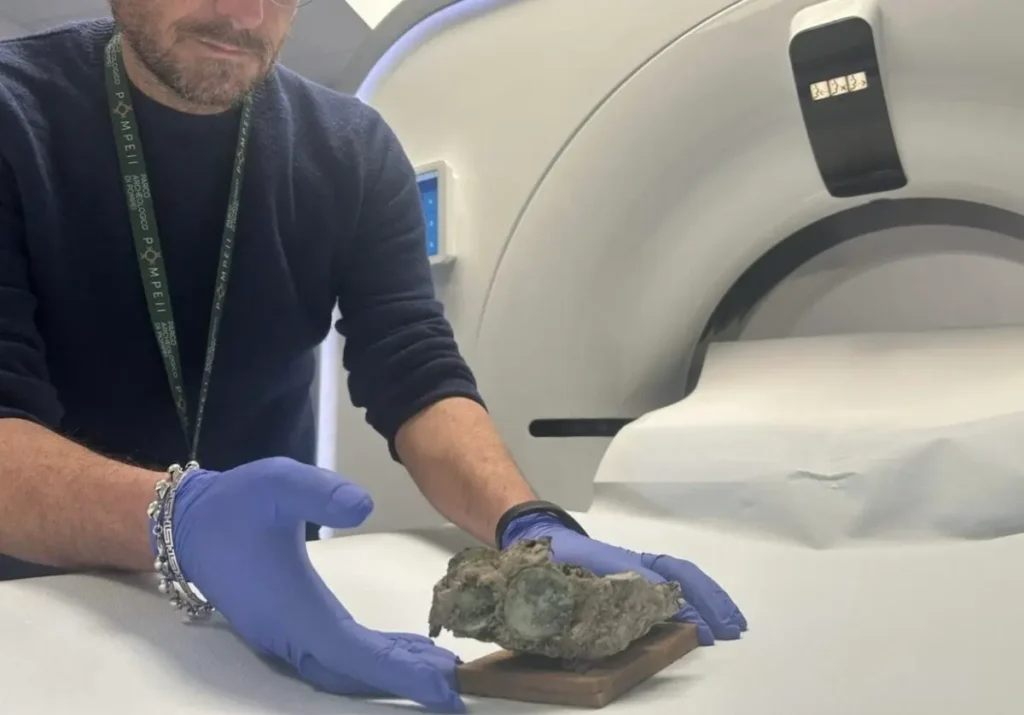
Researchers also identified small metal instruments that may represent medical or surgical tools, although the interpretation remains cautious. Taken together, the evidence supports the hypothesis that the victim may have been a medicus, a physician or medical practitioner in the Roman world.
It is a rare kind of archaeological identification. Pompeii often preserves the final posture of its victims. In this case, it may also preserve something far more personal: the profession that shaped a man’s life before the eruption ended it.
Medical imaging reveals what excavation could not
The breakthrough came through diagnostic methods more commonly used in modern medicine. X-rays, CT scans, AI-assisted imaging and 3D reconstructions allowed researchers to see inside the cast and examine the objects without physically removing them.
The scans also revealed the refined structure of the small case. It was not a simple container. It had a sophisticated closing system that included a toothed wheel, showing that it was carefully made and probably important to its owner.
That detail gives the discovery unusual weight. This was not an ordinary object dropped in panic. It seems to have been a portable professional kit, something the man considered important enough to carry as he tried to escape the city.
A human story behind the plaster cast
The Garden of the Fugitives has long stood as one of Pompeii’s most powerful reminders of the disaster. The victims found there were struck down while attempting to flee, likely toward the area near the Porta Nocera.
Gabriel Zuchtriegel, director of the Pompeii Archaeological Park, said the discovery suggests a man who may have carried his tools not only to rebuild his life elsewhere through his profession, but perhaps also to help others during the crisis.
That possibility makes the find especially moving. Archaeology rarely gives such a close view of personal identity. Names vanish. Faces fade. Professions are usually guessed from fragmentary clues.
Here, however, a small box hidden in plaster has changed the story. The victim was not only one of many who died in Pompeii. He may have been a doctor, carrying the tools of his work through the city’s final hours.
Nearly 2,000 years after the eruption, and more than six decades after his cast was excavated, the man from the Garden of the Fugitives is no longer only a silent figure in plaster. He is a glimpse of a life interrupted.
Cover Image: The plaster cast of the Pompeii eruption victim in which researchers identified the case interpreted as a possible medical kit. Credit: Parco archeologico di Pompei