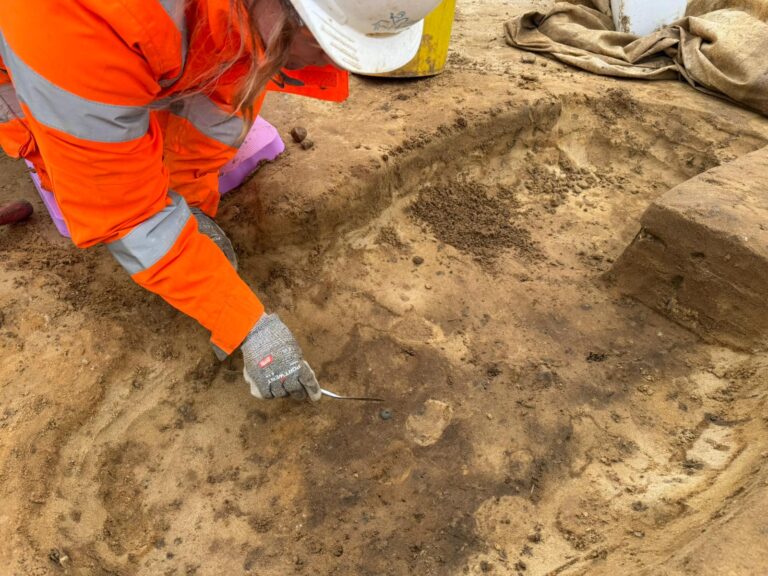
Archaeologists from Oxford Cotswold Archaeology, working as part of the ongoing excavations connected with the Sizewell C nuclear power station project, have uncovered a remarkable group of personal ornaments. The finds include Roman brooches, a decorated hair or dress pin, Anglo-Saxon beads from burial grounds, and a medieval object that may once have been worn by a pilgrim.
The objects are small, but they carry a rare kind of human evidence. A brooch could fasten a cloak. A pin could hold a hairstyle in place. A bead could mark age, identity or status. A religious pendant could travel with someone across a medieval landscape. Together, the finds show that jewelry was never only decoration. It was a visible language of the body.
A Roman pin from Wickham Market
Some of the earliest pieces were found during excavations at Wickham Market, along the A12. Among them is a complete Roman hair or dress pin with a plain, round head that is now separate from the shaft. The upper part of the object is decorated with crossed bands, a small but careful detail that suggests it was meant to be seen.
Archaeologists date the pin to around the 2nd century AD, when Roman material culture had become increasingly visible in Britain after the conquest. Pins of this kind were probably introduced to the province after the Roman invasion and used to secure hair or clothing.
It is an intimate object. Unlike a wall, road or military installation, it speaks directly to the body. Someone at Wickham Market may once have used it while arranging their hair, fastening clothing or preparing for daily life in a community shaped by Roman influence.
Brooches that fastened more than clothing
Brooches were among the most important personal objects in Roman Britain, and several examples have emerged from the Sizewell C archaeology programme. Two finds stand out.
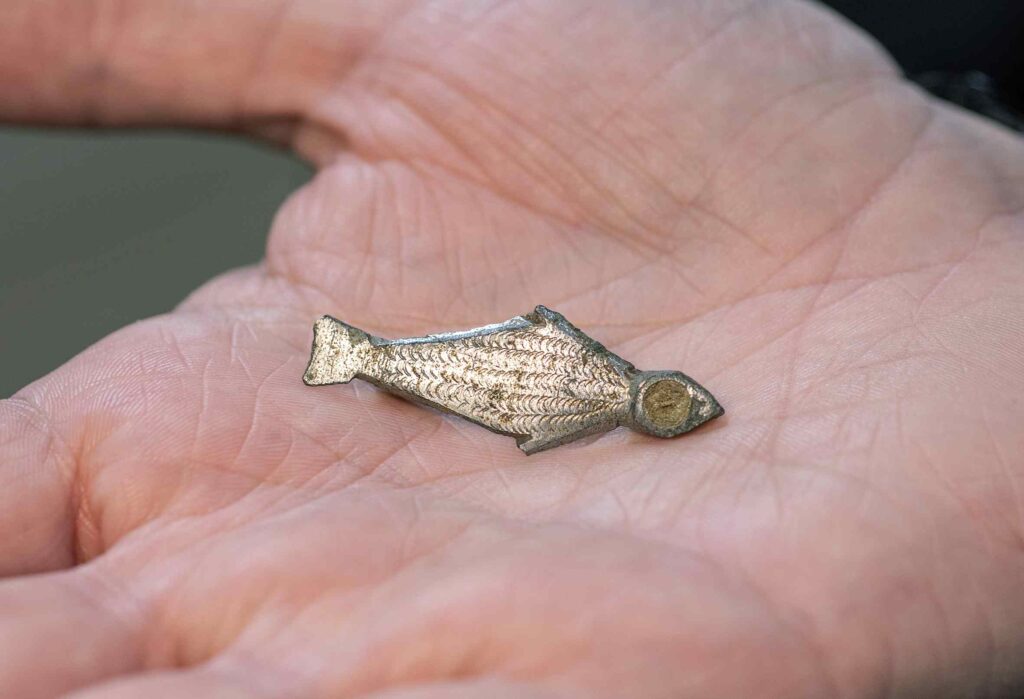
One is a zoomorphic fish brooch made from copper alloy and coated with silver. Dating between the 1st and 3rd centuries AD, it originally had an enamelled eye, although that detail and the fastening pin have not survived. Even in its damaged state, the brooch preserves the outline of a carefully designed object that combined function, ornament and symbolism.
Another notable find is a Hod Hill brooch made from tinned or silvered copper alloy. Hod Hill brooches are often linked with the Roman military and take their name from the hillfort site in Dorset. They were used to fasten clothing, but their distribution can also point to movement, military networks and the wider circulation of objects in Roman Britain.
A brooch may seem like a simple fastening device. In archaeology, however, it can say much more. It can hint at fashion, occupation, military contact, trade or the cultural choices of the person who wore it.
Anglo-Saxon beads from fragile graves
The story then moves into the Anglo-Saxon period, where some of the most evocative discoveries came from two cemeteries near Theberton and Middleton, along the route of the new Sizewell Link Road.
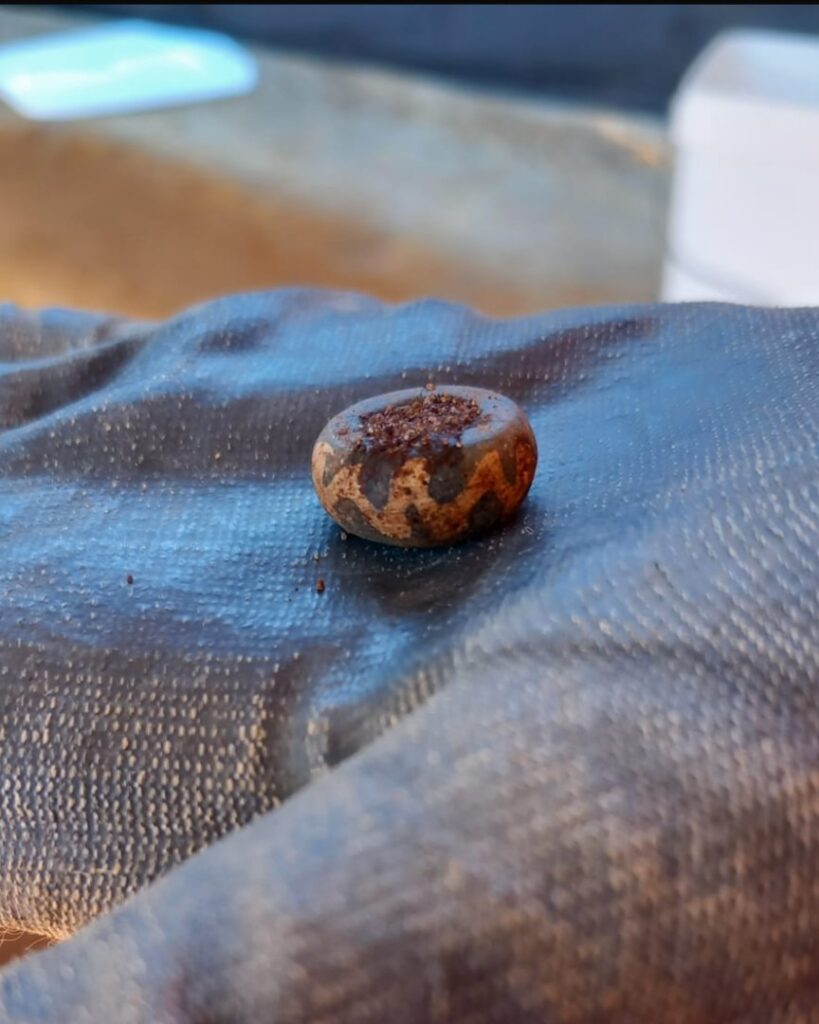
Several graves contained beads, probably worn in suspended loops or as part of personal ornament. Their variety is striking. The beads differ in colour, size and pattern, offering a glimpse of how Anglo-Saxon communities used adornment to express identity and perhaps social position.
These beads are also important dating evidence. Glass beads from one higher-status cemetery belong to later 6th-century AD forms, a period when Anglo-Saxon communities were producing their own beads. Some of the glass may have been made by reworking Late Roman material, suggesting that older materials did not simply disappear after Roman rule ended. They could be reused, reshaped and given new meaning.
In another cemetery, one grave produced seven beads, including two striped spherical examples and a large white bead. The preservation conditions were poor because of acidic sandy soils. In some cases, the bodies survived only as faint traces in the sand.
That makes the beads especially powerful. Where bones have largely vanished, the ornaments remain. They preserve a connection to people whose physical remains were almost erased by time, leaving behind only the objects once placed with them.
A medieval object linked to pilgrimage
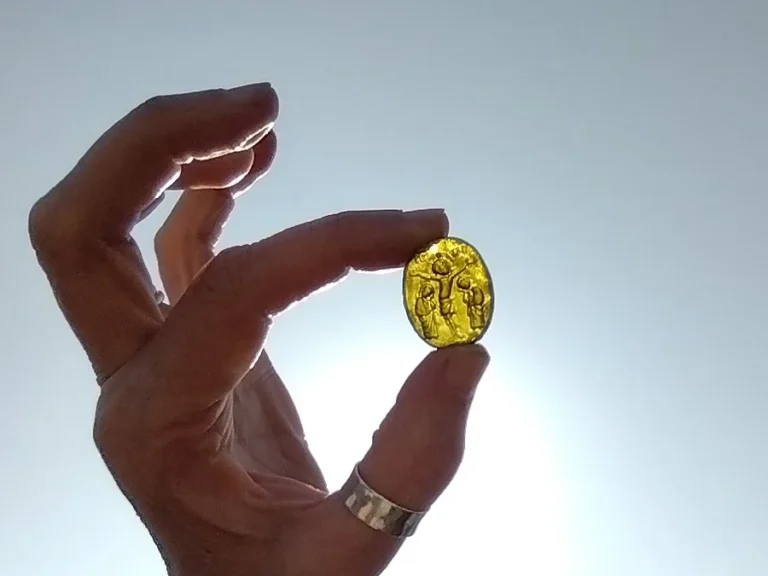
One of the most striking finds from the excavations is a molded Venetian glass object dating to around the 13th century. It may have formed the central part of a necklace or seal and depicts the Crucifixion.
Objects of this kind were often carried or worn by pilgrims. Its discovery in fields around Leiston Abbey raises the possibility that it was lost by someone moving through the religious landscape of medieval Suffolk. Perhaps it slipped from clothing, fell from a necklace or was dropped during a journey that passed near the abbey.
The object clearly carried Christian meaning. It also belongs to a wider medieval world in which faith was often worn, touched and carried close to the body. Like the Roman brooches and Anglo-Saxon beads, it shows how personal objects could hold more than beauty. They could carry memory, devotion and identity.
Jewelry as a record of human lives
The discoveries from Suffolk show how infrastructure-led archaeology can recover deeply personal traces of the past. Roads, power projects and construction schemes often expose landscapes that have been occupied for centuries. In this case, the work has brought to light objects that once belonged to real people, not only settlements or burial grounds.
Across Roman, Anglo-Saxon and medieval contexts, the jewelry tells a continuous story of self-presentation. People fastened clothing, arranged their hair, wore beads, carried religious symbols and marked who they were through objects placed on the body.
The pieces are small enough to fit in the palm of a hand. Yet they open a wide view onto ancient life in Suffolk, from Roman Britain to the Middle Ages.
Cover Image Credit: Oxford Cotswold Archaeology