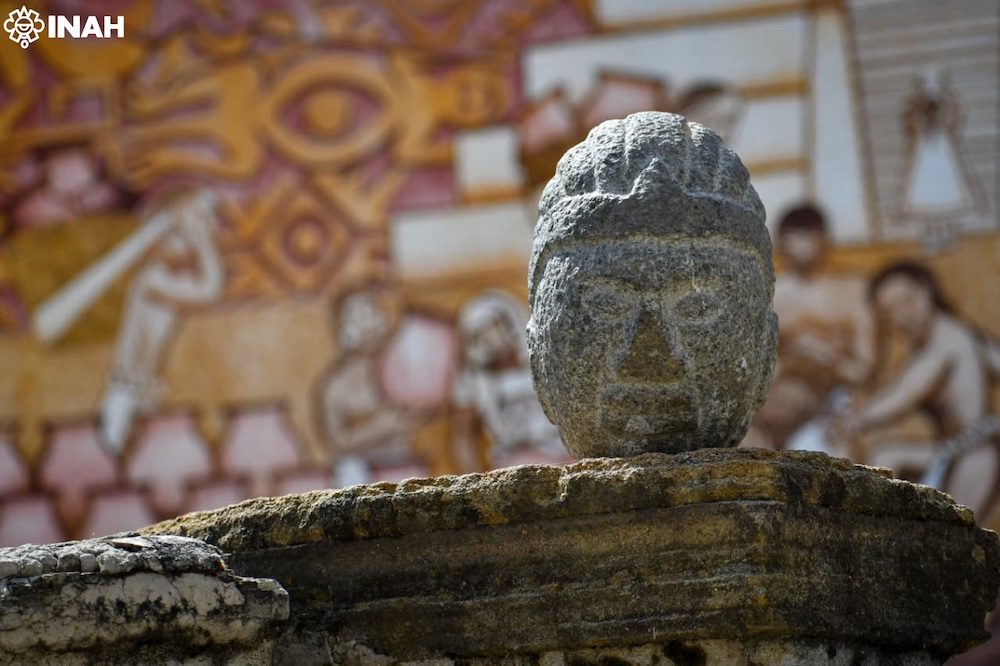
A 1,300-year-old maize god sculpture discovered in Tlaxcala, Mexico, is offering rare insight into Epiclassic Mesoamerican belief systems and cultural connections across the region.
The basalt artifact was uncovered in San Damián Texoloc during excavation work on private land. The recovery was led by José Eduardo Contreras Martínez, working with the National Institute of Anthropology and History. Specialists date the sculpture to around 600–900 CE and associate it with the Olmeca-Xicalanca cultural sphere, closely linked to the nearby site of Cacaxtla.
A Carefully Carved Face with Regional Clues
The piece measures approximately 29 centimeters in height and weighs about 30 kilograms. It depicts the head of a young figure with an elongated skull, almond-shaped eyes, a broad nose, and full lips.
These features are not random. They resemble populations from Mexico’s southeastern Gulf Coast, pointing to possible cultural interaction or movement across regions during the Epiclassic period.
Carved from basalt, the sculpture carries refined details. A tiara with a triangular projection rises from the forehead, while large circular ear ornaments with feather-like pendants frame the face. The long, thick hair is swept backward.
One detail stands out: the flat base.
This suggests the object was designed to stand upright not as a fragment, but as a complete, independent figure.
A Deity at the Center of Life
In Mesoamerican thought, maize was not simply a crop, it was existence itself.
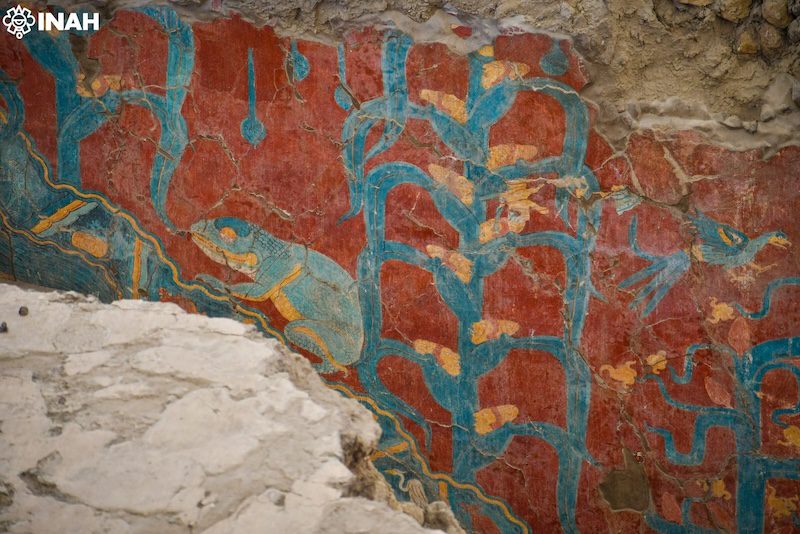
The maize god represented fertility, renewal, and political authority. Its imagery appears widely across murals, ceramics, and manuscripts, reflecting a belief system where agricultural cycles were inseparable from human identity.
The newly discovered sculpture aligns closely with visual traditions at Cacaxtla. In the murals of the so-called Red Temple, elongated skulls appear in symbolic forms linked to maize, blending human and agricultural imagery into a unified narrative of regeneration.
Echoes Across Mesoamerican Traditions
The significance of the find extends beyond Tlaxcala.
In the Dresden Codex, one of the most important surviving pre-Hispanic manuscripts, the maize god appears in scenes of conflict and renewal tied to rain deities. These depictions reflect a shared mythological framework where survival depended on the balance between drought and rain.
A similar narrative appears in the Battle Mural at Cacaxtla. There, bird-costumed warriors, interpreted as linked to the maize god are shown confronting figures associated with storm forces.
The message is consistent:
life, death, and rebirth were part of a continuous cycle governed by divine forces.
A Symbol with Deep Historical Roots
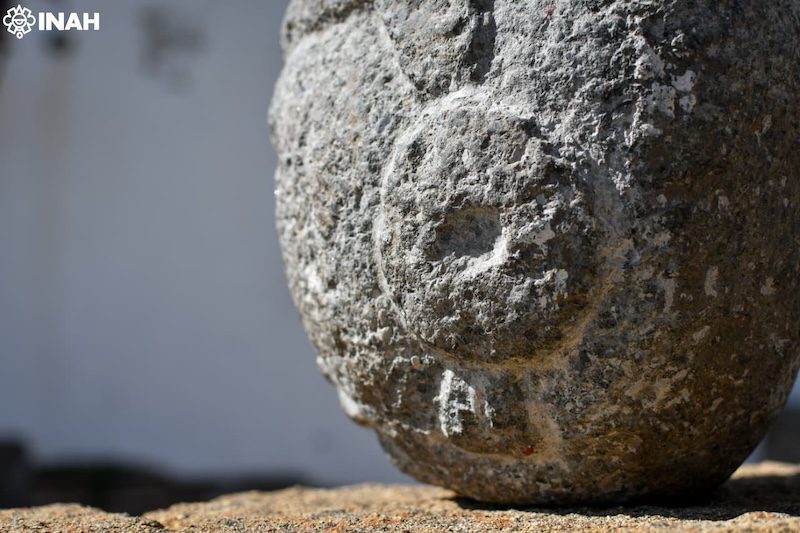
The triangular element on the sculpture’s tiara may point to an even older tradition.
Comparable motifs appear in Olmec imagery from the Middle Preclassic period, where stylized maize sprouts symbolized life and growth. If confirmed, this continuity would suggest that certain visual elements persisted for centuries, adapting across cultures while retaining their core meaning.
Mexico’s Secretary of Culture, Claudia Curiel de Icaza, emphasized that discoveries like this help illuminate both specific cultures and the broader historical processes that shaped the country’s identity.
Why This Discovery Matters
The sculpture is currently under detailed study at the Ocotelulco Site Museum in Tlaxcala, where specialists are analyzing its material, craftsmanship, and iconography.
But its importance is already clear.
This is not just a carved stone head.
It is a direct expression of a worldview in which survival, power, and identity were inseparable, and where maize stood at the center of everything.
Cover Image Credit: Enrique Chávez, CINAH Tlaxcala.