
In Upper Egypt’s Sohag region, archaeologists have uncovered a remarkably intact monastic residential complex dating to the Byzantine era — a discovery that offers rare, concrete insight into how early Christian monks organized their daily lives, prayer routines, and communal spaces.
The site, excavated at Al-Qariah Bil-Dueir in the Tama district by an Egyptian mission of the Supreme Council of Antiquities, sheds new light on monastic life far beyond the better-known religious centers of Late Antique Egypt.
A Planned Monastic Settlement, Not an Isolated Hermitage
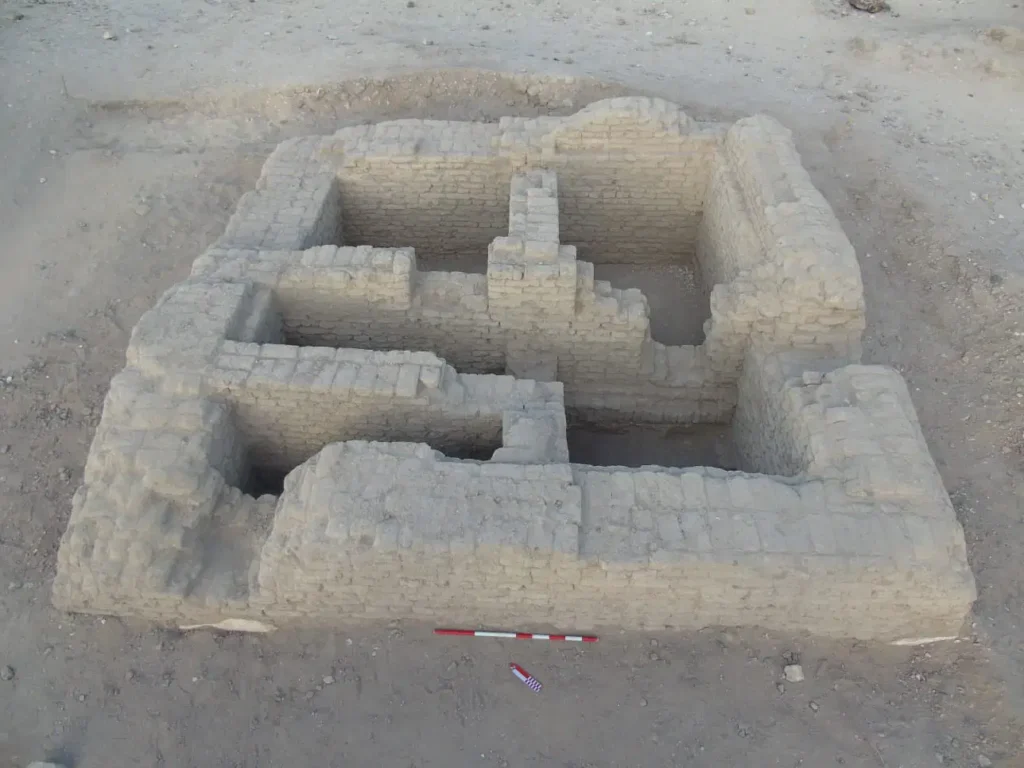
According to Mohamed Ismail Khaled, the architectural remains point to a stable and carefully organized monastic community rather than scattered hermit dwellings. Excavations revealed multiple mudbrick buildings aligned on a west–east axis, indicating intentional planning consistent with Byzantine monastic principles.
The structures vary in size but follow a coherent layout. Rectangular halls are paired with smaller rooms shaped as apses or prayer niches — architectural forms closely associated with early Christian worship. Several compact vaulted chambers are interpreted as monks’ cells, likely used for private prayer and contemplation.
Traces of plaster, recessed wall niches, and layered flooring further suggest that these buildings were not temporary shelters but long-term residential spaces designed for communal religious life.
Courtyards, Dining Areas, and a Central Church
One of the most striking features of the complex is the presence of southern courtyards, which appear to have functioned as shared gathering areas. Main entrances open directly into these spaces, reinforcing the communal character of the settlement.
Small circular structures identified nearby are believed to have served as communal dining halls — a reminder that Byzantine monasticism balanced spiritual discipline with structured daily routines.
Mohamed Nagib reported the discovery of a larger mudbrick building measuring roughly 14 by 10 meters, interpreted as the monastery’s main church. Oriented east–west, the structure follows a tripartite plan with nave, choir, and sanctuary — a layout typical of Byzantine ecclesiastical architecture.
Brick pillar bases inside the nave suggest the church once supported a central dome, while the sanctuary’s semicircular form and flanking chambers mirror church designs seen across the Eastern Mediterranean during Late Antiquity.
Objects That Speak of Literacy and Daily Work
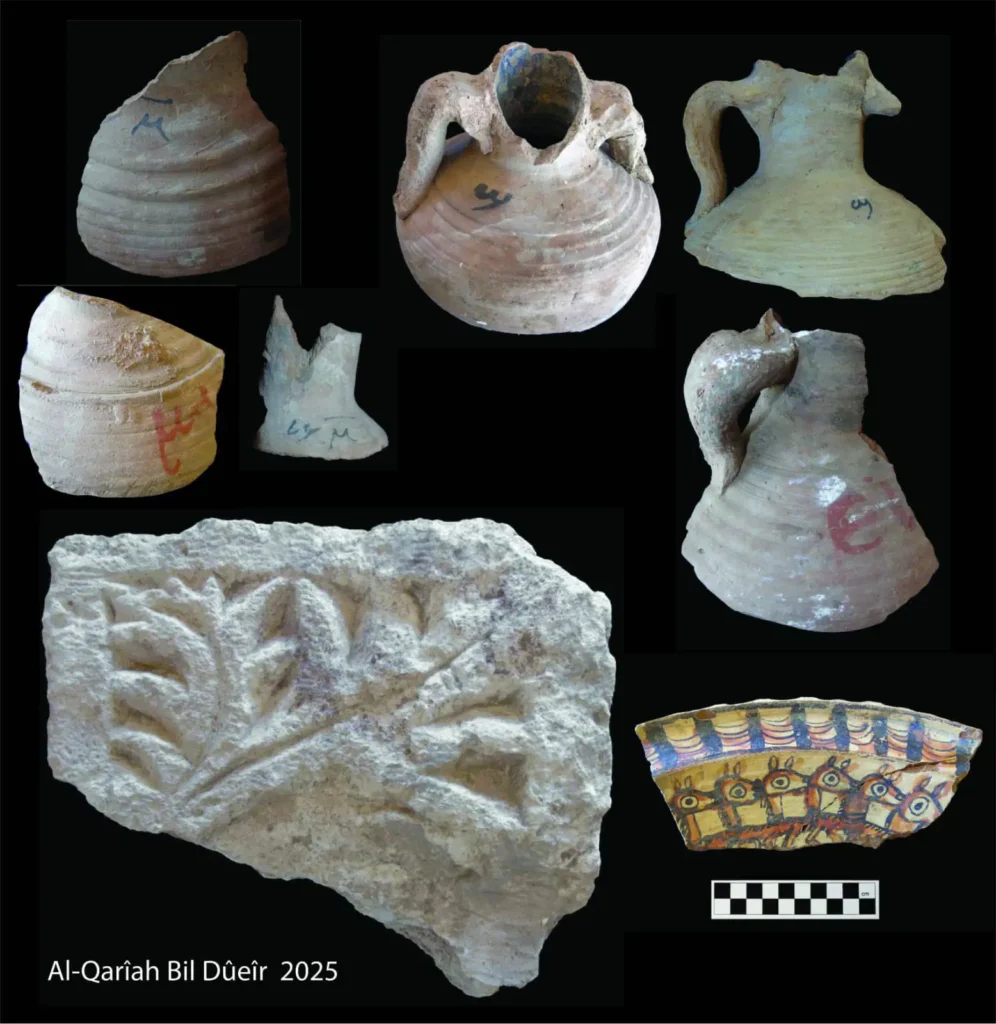
Beyond architecture, the material finds offer an unusually intimate view of monastic life. Archaeologists recovered storage amphorae, some marked with inscribed names, letters, or numbers, hinting at internal administration and resource management.
Fragments of ostraca bearing Coptic inscriptions, along with domestic tools and engraved limestone slabs, point to a literate monastic community engaged not only in prayer but also in record-keeping and daily labor.
Mission director Walid El-Sayed emphasized that these artifacts provide rare evidence for how monks balanced spiritual practice with practical organization in Byzantine Upper Egypt.
Sohag and the Heartland of Early Egyptian Monasticism
The discovery gains deeper significance when viewed within the wider religious landscape of Sohag. During the 4th to 7th centuries CE, the region was a major center of Christian monastic culture.
Nearby stand the White Monastery and the Red Monastery, both closely associated with Saint Shenoute and the influential Shenoutean monastic federation. These institutions shaped Coptic theology, education, and communal monastic organization for centuries.
The newly uncovered complex adds physical depth to this historical narrative, showing how Byzantine monastic ideals were translated into lived spaces — from prayer rooms and churches to dining halls and work areas.
A Living Legacy of Egypt’s Christian Past
Researchers argue that the find is more than an isolated archaeological discovery. It underscores the continuity of monastic traditions in Upper Egypt, many of which remain embedded in Coptic Christian identity today.
As excavations at Al-Qariah Bil-Dueir continue, archaeologists hope to clarify the monastery’s economic activities, social hierarchy, and connections with neighboring religious centers — further illuminating a formative chapter in Egypt’s Christian heritage.
Egypt’s Minister of Tourism and Antiquities
Cover Image Credit: Egypt’s Minister of Tourism and Antiquities