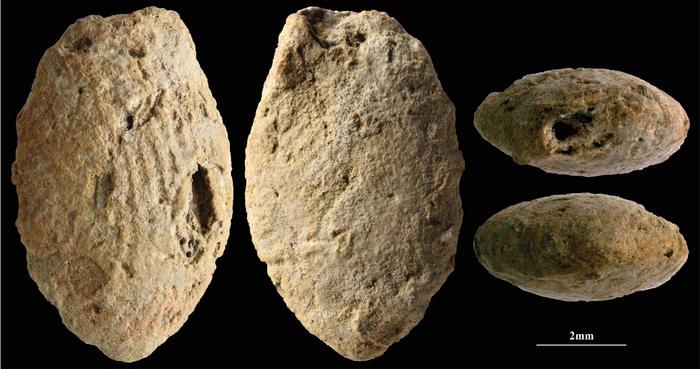
Fifteen thousand years ago, in a landscape that had not yet seen farms, cities, or pottery, people were already shaping clay with intention. Among them were children, pressing their fingers into soft surfaces and leaving behind traces that have survived for millennia. What they created was not meant for cooking or storage, but for something far more revealing—expression, identity, and shared meaning.
A new archaeological study shows that children played a direct role in producing some of the earliest known clay objects in human history, long before the emergence of ceramic technology or agricultural life. The discovery, published in Science Advances, focuses on a remarkable assemblage of clay beads and pendants attributed to Natufian hunter-gatherers living in what is now Israel around 15,000 years ago.
These objects fundamentally reshape our understanding of how and why clay first entered human culture.
Clay Before Pottery: Children at the Center of Early Creativity
For decades, clay was primarily associated with the Neolithic period, when pottery became essential for cooking, storage, and daily life. Yet the Natufian evidence tells a different story—one in which clay appears much earlier, and in a completely different role.
An international team led by Laurent Davin, working under the supervision of Prof. Leore Grosman, analyzed 142 clay beads and pendants recovered from four key sites: el-Wad, Nahal Oren, Hayonim, and Eynan-Mallaha. These sites span more than three thousand years of occupation, offering a rare window into long-term cultural practices.
What makes this discovery especially compelling is not only the number of objects, but the clear evidence that children were actively involved in shaping them. Clay was not restricted to specialists or ritual elites; it was part of everyday life, accessible and shared across age groups.
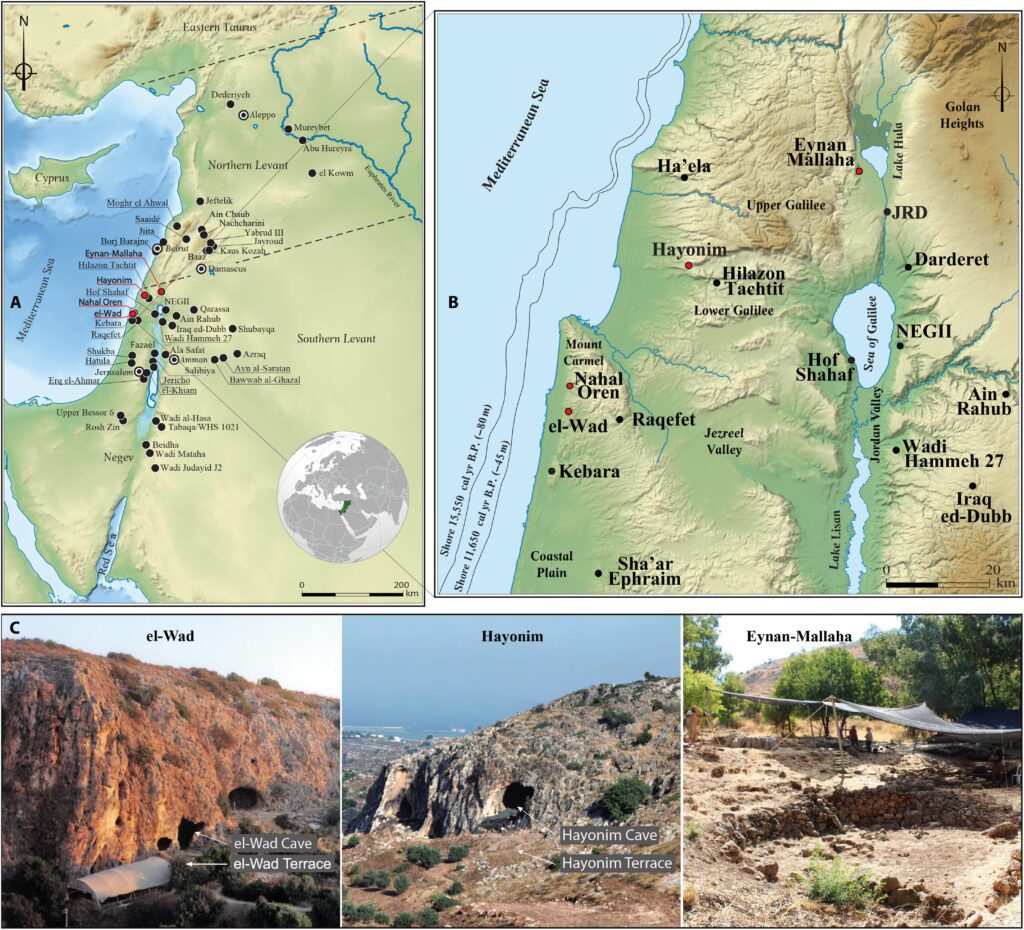
(A) The Levant. (B) The southern Levant highlighting el-Wad, Nahal Oren, Hayonim, and Eynan-Mallaha (in red), with reconstructed Mediterranean shorelines at the beginning and end of the Natufian period (sea levels at –80 m and –45 m) and the extent of Lake Lisan around 15,000 cal BP. (C) From left to right: el-Wad, Hayonim, and Eynan-Mallaha. Credit: Authors of the study
A Sustained Tradition of Meaning, Not Experimentation
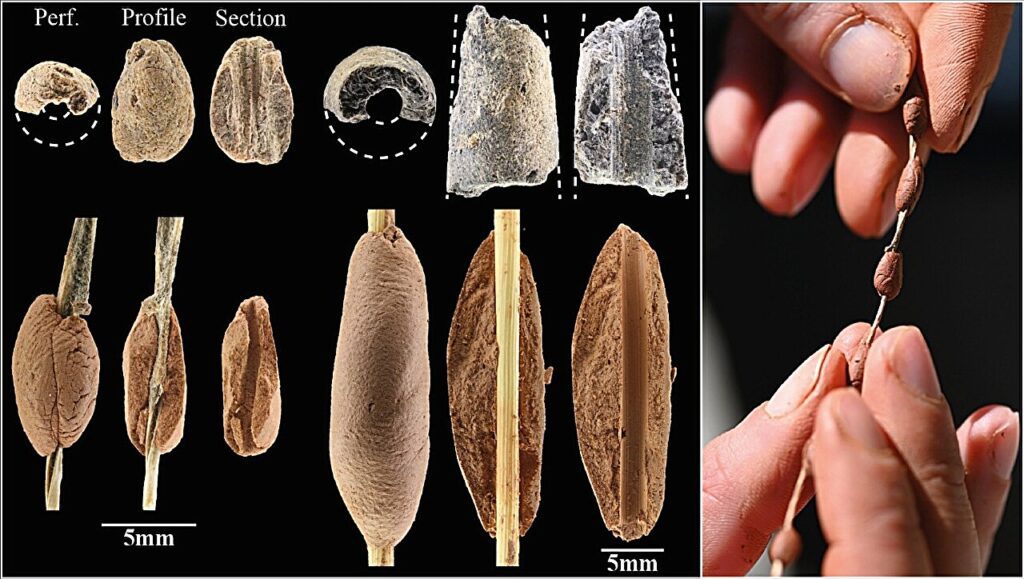
The beads themselves reveal a level of consistency that is difficult to dismiss as casual or experimental. They were shaped into distinct forms—cylinders, discs, and elongated ellipses—and in many cases coated with red ochre using an early version of engobe, a technique involving a thin layer of liquid clay applied to the surface.
This represents the earliest known use of such decorative treatment anywhere in the world.
More importantly, the repetition of forms across multiple sites suggests that this was a recognized visual tradition, one that persisted across generations. Clay, in this context, functioned as a medium of communication long before it became a tool for domestic utility.
Children, Nature, and the Language of Form
A closer look at the shapes of the beads reveals another layer of meaning. Researchers identified 19 distinct types, many of which appear to reflect the forms of plants central to Natufian life, including wild barley, einkorn wheat, lentils, and peas.
These were not abstract motifs. They were the very plants that structured subsistence, daily routines, and seasonal rhythms.
Traces of plant fibers preserved on several beads indicate how they were strung and worn, suggesting that these objects were part of personal adornment. In this light, it becomes clear that children and adults alike were engaging with a shared symbolic language, one rooted in the natural world around them.
Plants were not only consumed—they were represented, stylized, and transformed into markers of identity.
Fingerprints Across Generations
The most striking evidence, however, lies in the physical traces left behind during the making process.
Researchers identified 50 preserved fingerprints on the clay surfaces, making it possible to determine the age range of the individuals involved. The results point to a diverse group: children, adolescents, and adults all contributed to the production of these objects.
In one particularly telling example, a tiny clay ring measuring just 10 millimeters in diameter appears to have been made specifically for a child, both in scale and execution.
This finding suggests that children were not passive observers, but active participants in cultural practices. Through making, wearing, and possibly exchanging these objects, they were learning social norms, identities, and shared meanings from an early age.
A Symbolic Shift Before Agriculture
Perhaps the most important implication of this discovery is its timing. The Natufians lived at a moment when human groups were beginning to settle more permanently, yet still relied on hunting and gathering.
It is within this transitional world that clay emerges—not as a practical necessity, but as a symbolic material.
Alongside recent discoveries such as a clay figurine from Nahal Ein Gev II, the beads indicate that a “symbolic transformation” was already underway. Communities were beginning to express identity, affiliation, and social relationships through visible and portable objects.
And significantly, children were part of that process.
Rethinking the Origins of Cultural Expression
The Natufians are often described as precursors to agricultural societies, but this discovery suggests a more complex role. They were not simply adapting to new conditions; they were actively shaping new ways of thinking and expressing.
Through clay, they created objects that carried meaning beyond function—objects that connected individuals to communities, and communities to shared symbols.
That these objects bear the fingerprints of children makes the story even more powerful. It reminds us that the development of human culture was not only driven by necessity or innovation, but also by learning, imitation, and participation across generations.
Long before pottery, before farming, and before written language, children were already helping to shape the material expressions of who we are.
The Hebrew University of Jerusalem
Cover Image: A butterfly-shaped clay bead from the Final Natufian phase at Eynan-Mallaha in the Upper Jordan Valley, coated in red ochre and bearing the preserved fingerprints of the child—around 10 years old—who shaped it approximately 12,000 years ago. Additional beads uncovered at nearby sites also show clear evidence of being crafted by children, forming what researchers describe as the largest known collection of Paleolithic fingerprints. Credit: Laurent Davin
Laurent Davin, Modelling identities among the first-sedentary communities: emergence of clay personal ornaments in Epipaleolithic Southwest Asia, Science Advances (2026). DOI: 10.1126/sciadv.aea2158.