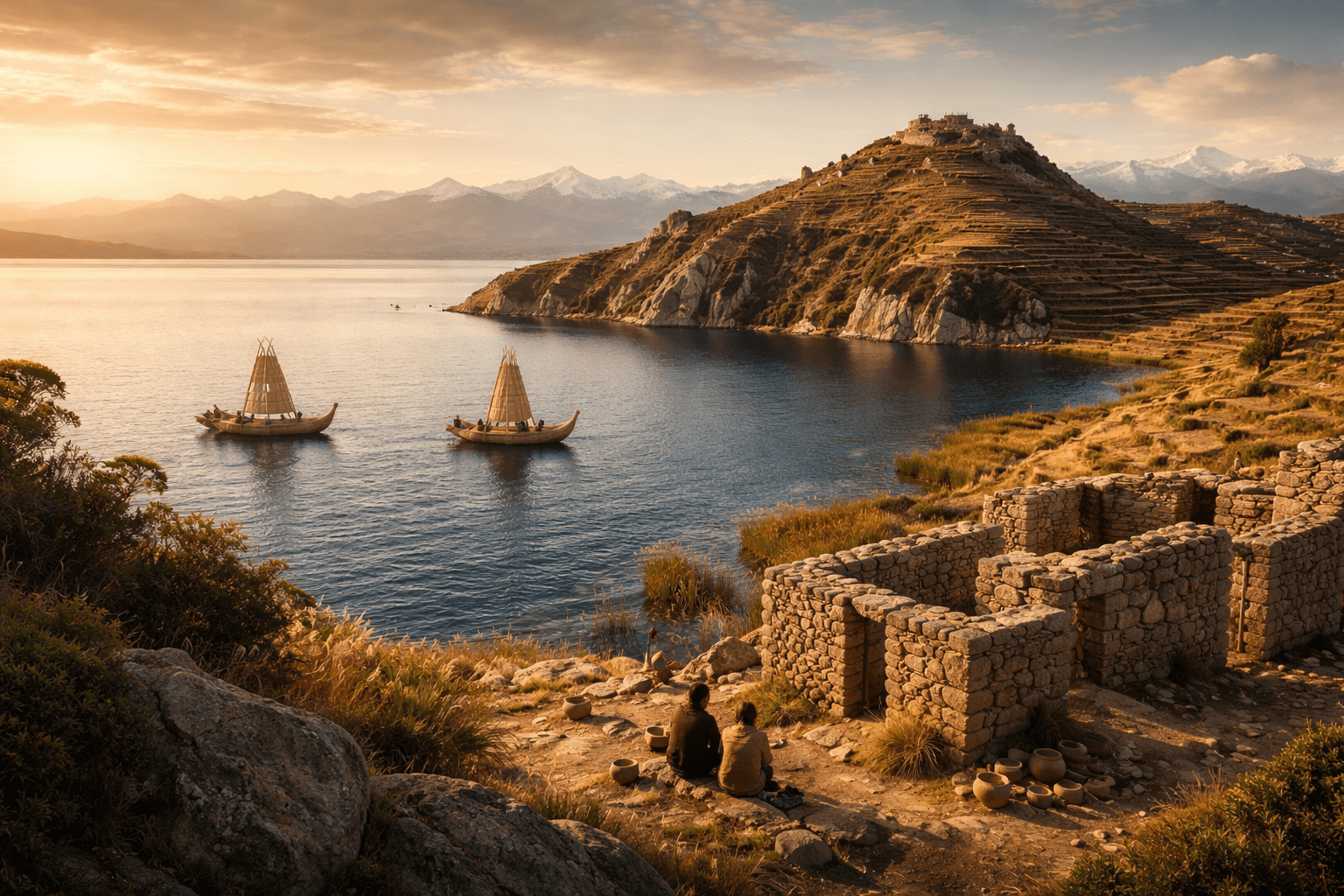
A windswept island rising from the waters of Lake Titicaca—long revered in Andean cosmology—has revealed a far deeper human past than anyone expected. New scientific analysis shows that people were living on Bolivia’s Island of the Sun as early as 3500 BC, pushing the timeline of settlement in the Titicaca Basin back by centuries.
This is not simply a revised date. It reshapes how archaeologists understand movement, technology, and early community life in one of the world’s most challenging high-altitude environments.
A breakthrough hidden in old excavations
At the center of this discovery lies the archaeological site of Ch’uxuqullu, first excavated decades ago but only now fully understood through modern radiocarbon dating techniques. Using Accelerator Mass Spectrometry (AMS), researchers reanalyzed charred organic remains preserved in deep occupational layers.
The results were striking.
Samples dated between 3635 and 3381 BC confirm that the site was occupied during the fourth millennium BC—making it one of the earliest known settlements in the entire Lake Titicaca region.
What once seemed like a later phase of human presence now emerges as part of a much earlier story.
Reaching the island required boats
One detail quietly transforms the significance of this discovery: geography.
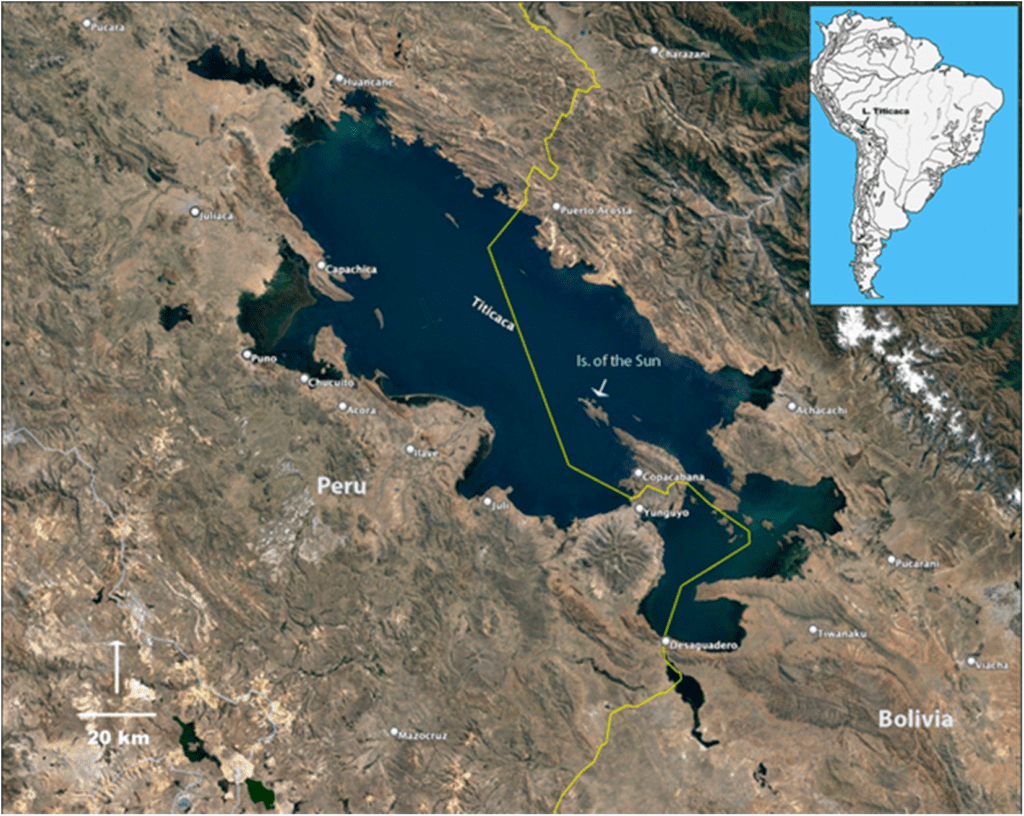
Even during periods when Lake Titicaca’s water levels dropped significantly, the Island of the Sun was likely never fully connected to the mainland. Geological and bathymetric data indicate that surrounding waters remained deep enough to prevent simple land access.
That changes everything.
If people were living on the island around 3500 BC, they must have used watercraft—boats capable of transporting people, tools, and resources across open water. This suggests that lake navigation was not a late development, but an established practice far earlier than previously assumed.
For decades, research emphasized camelid caravans as the backbone of early Andean mobility. This discovery introduces a more complex picture—one in which water routes played a central role alongside land-based networks.
A connected world, not an isolated island
Artifacts recovered from Ch’uxuqullu reinforce this interpretation. Archaeologists identified a wide range of nonlocal materials, including obsidian, quartz, and various types of chert—resources that do not naturally occur on the island.
Their presence points to long-distance exchange networks already in operation.
Rather than isolated highland foragers, the inhabitants of the Titicaca Basin appear to have been active participants in interconnected systems of movement, communication, and resource exchange—both across land and over water.
In this light, the island was never truly remote. It was part of a broader, dynamic landscape.
The slow shift toward settled life
The site also offers insight into a critical transformation in human history: the gradual move from highly mobile lifestyles to more sustained patterns of habitation.
At Ch’uxuqullu, archaeologists identified a continuous sequence of occupation layers with no major interruptions. Although no permanent structures were found, the evidence suggests repeated and long-term use of the same location.
This reflects an early form of semi-sedentary behavior.
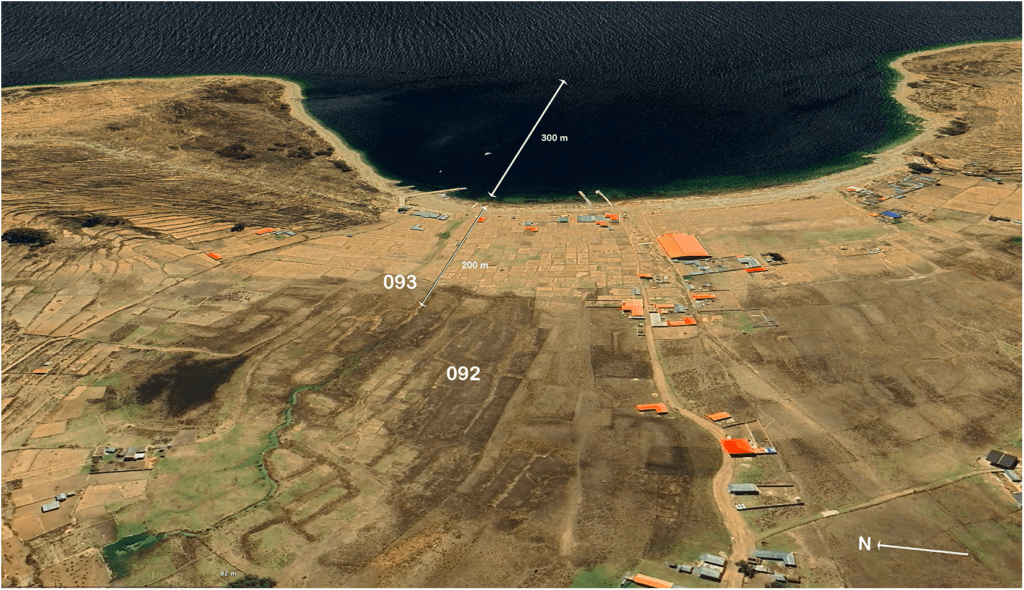
The surrounding environment helps explain why. The nearby wetlands of Challa Bay would have provided reliable access to fish, birds, and edible plants—resources capable of supporting repeated seasonal or long-term stays.
This was not a one-time visit. It was a place people returned to again and again.
Pottery and cultural continuity
Another important layer of the story emerges with the appearance of pottery. Ceramic fragments found at the site date to between the 12th and 10th centuries BC, indicating that the island’s inhabitants remained connected to broader technological and cultural developments across the region.
The pottery styles closely resemble those found on the mainland, reinforcing the idea that the Island of the Sun was fully integrated into regional networks despite its insular setting.
Continuity, not isolation, defines its history.
A deeper past beneath a sacred landscape
Today, the Island of the Sun is best known as a sacred place within Inca tradition—a landscape tied to origin myths and pilgrimage routes. But this new research reveals that its significance stretches back thousands of years before the rise of Andean civilizations.
Long before empires, before monumental architecture, and before written history, small groups of people were already crossing the waters of Lake Titicaca with purpose.
They carried tools, materials, and knowledge. They navigated open water. They returned to the same places.
And in doing so, they quietly laid the foundations of a connected Andean world—far earlier than we once imagined.
Source: Stanish C, Damiata B. A Fourth Millennium BC Occupation on the Island of the Sun, Lake Titicaca, Bolivia. Latin American Antiquity. Published online 2026:1-10. doi:10.1017/laq.2025.10158
Cover Image Credit: Arkeonews – This image was generated by the author using AI.