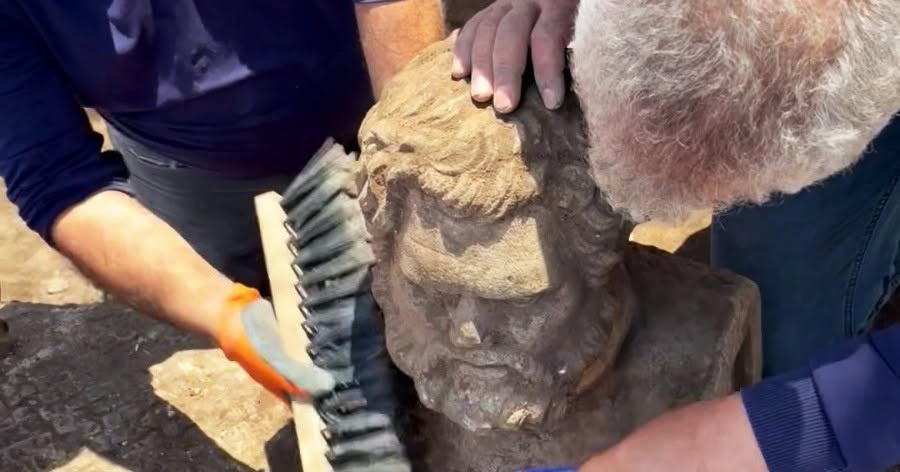
Two intact marble busts dating back about 1,700 years have been uncovered near Binyamina in northern Israel, lying face down inside the collection pit of a Roman-Byzantine winepress.
The discovery, announced by the Israel Antiquities Authority, stands out because the statues were not found where they once stood. They had been carefully placed inside the wine-collection pit after the installation went out of use, leaving archaeologists with an unusual question: why were marble portraits from the Greco-Roman world buried in a winepress?
One of the busts preserves a Greek inscription with the name “Lycurgus,” a detail that connects the find to the cultural memory of antiquity.
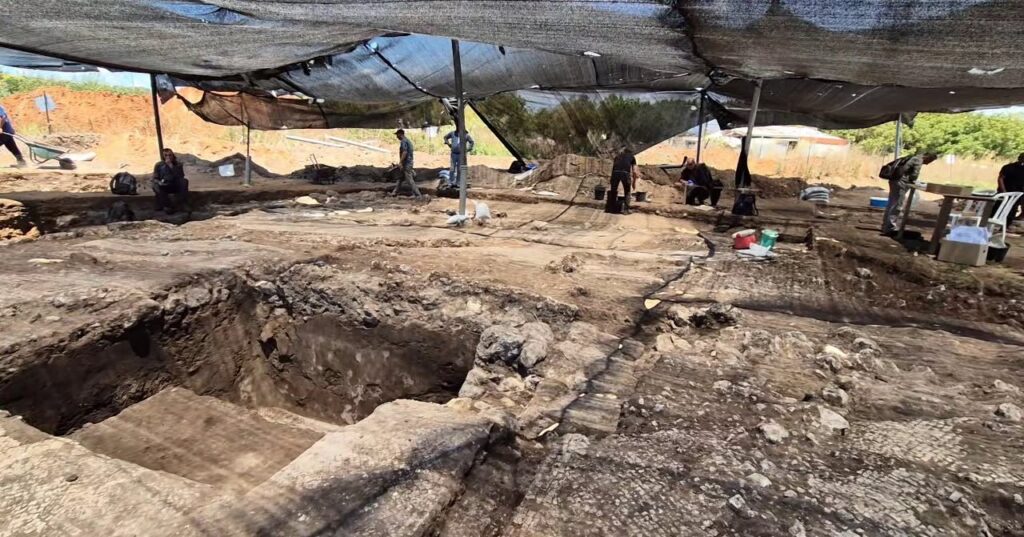
Marble portraits placed inside a winepress pit
The two busts, described as protomes, were uncovered during an archaeological excavation conducted by the Israel Antiquities Authority as part of the “Connecting Israel” infrastructure project, led by the Ministry of Transportation and Israel Railways.
Eliran Oren and Avishag Reiss, the excavation directors on behalf of the Israel Antiquities Authority, said the statues date to the Roman period. Their position inside the winepress, however, is what makes the find especially striking.
According to the archaeologists, the busts were found neatly laid, face down, inside the wine-collection pit. This means they were buried only after the winepress had fallen out of use.
Marble portraits were created for display. They belonged in spaces where status, education, and cultural memory were meant to be seen. In this case, however, they ended their visible life inside a practical installation once used for wine production.
Whether they were placed there for protection, disposal, concealment, or another reason remains unknown.
The name Lycurgus points to the Greek past
The Greek inscription on one of the busts preserves the name “Lycurgus.” Dr. Peter Gendelman, a Caesarea-region expert with the Israel Antiquities Authority, noted that two major figures from Greek history carried this name.
One was Lycurgus of Sparta, traditionally associated with the laws and social order of Sparta. The other was Lycurgus of Athens, a 4th-century BCE statesman and orator.
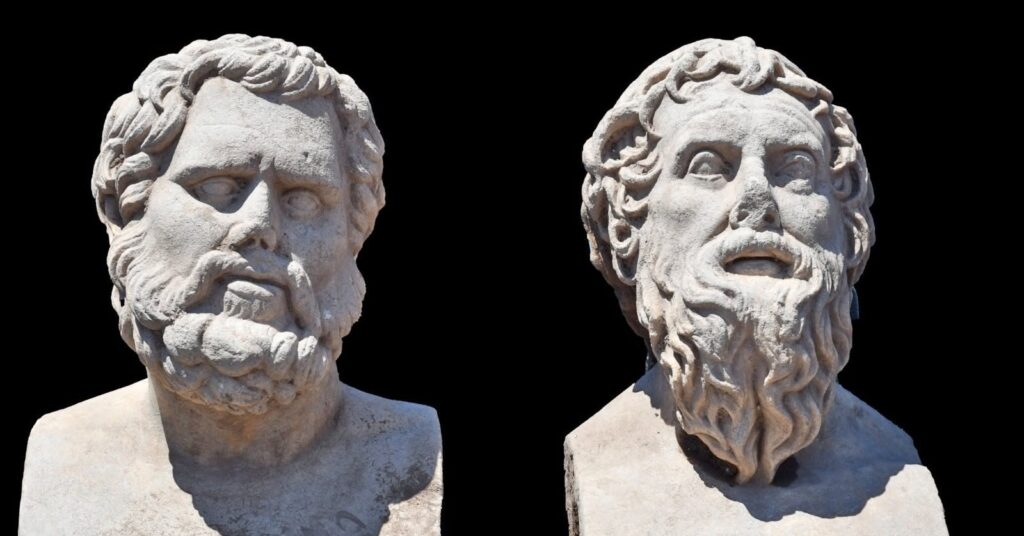
The inscription does not yet allow a firm identification. Its importance lies elsewhere: it shows that the bust belonged to a visual and intellectual tradition in which Roman-period elites surrounded themselves with figures from the Greek past.
Portraits of philosophers, statesmen, poets, and legendary lawgivers appeared in public buildings and elite homes across the Roman world. They were decorative, but they also carried a message. To own or display such images was to signal learning, refinement, and attachment to the classical tradition.
A possible villa connection near Caesarea
The location of the find gives the discovery wider significance. The statues were found near Binyamina, not far from Caesarea, one of the most important cities on the eastern Mediterranean coast during the Roman and Byzantine periods.
Founded under Herod the Great, Caesarea grew into a major port, administrative center, and urban hub. Its wealthy residents had access to imported goods, decorated homes, bathhouses, and the visual culture of the wider Roman world.
That possibility fits the character of the objects. Marble portraits of this kind were exactly the sort of items wealthy Roman-period households used to project education, taste, and status.
Their final placement, however, remains the most intriguing part of the story. At some point, after their original display setting was abandoned or changed, the busts were moved and placed face down inside the winepress pit.
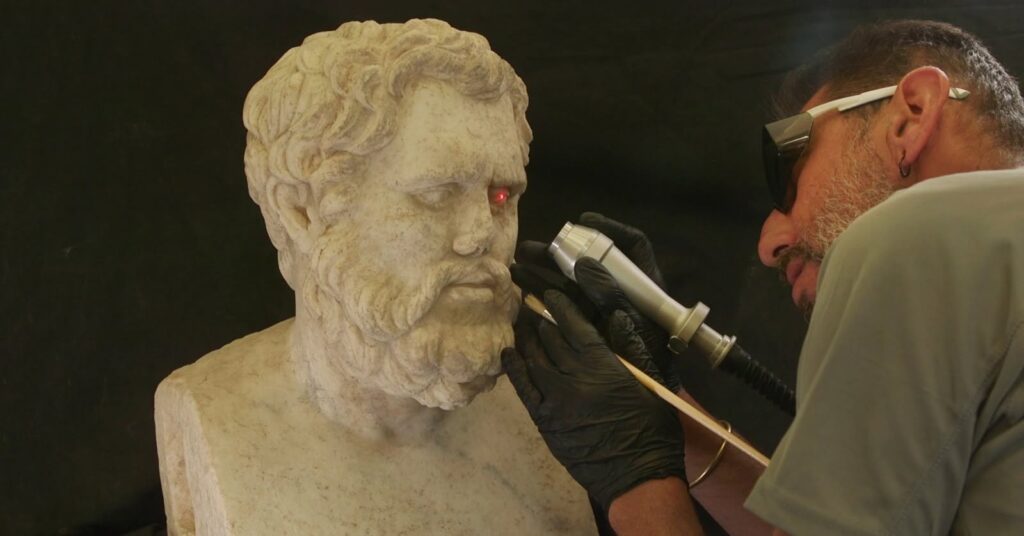
Conservation may clarify their story
The discovery joins a series of historical figure portraits previously found in the Caesarea region, but its archaeological setting makes it especially rare. These were not isolated fragments or reused building stones. They were intact busts, deliberately arranged in a feature that had lost its original function.
After their initial public display, the statues will undergo cleaning, conservation, and further research. Specialists are expected to examine the marble, carving style, inscription, and burial context to better understand where the busts were made, how they were displayed, and why they were eventually placed inside the winepress.
Cover Image: Israel Antiquities Authority