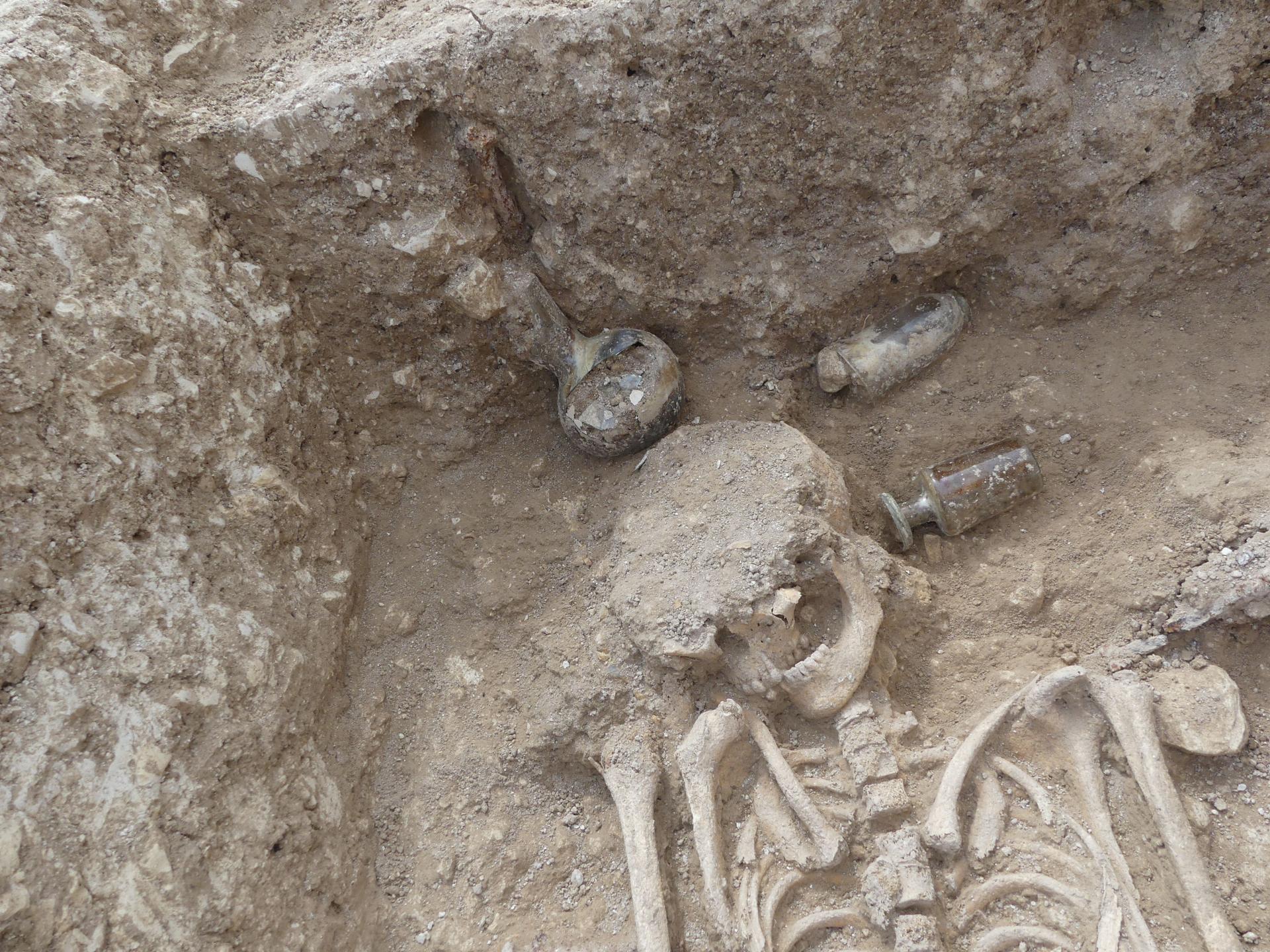
Archaeologists excavating near Troyes in northeastern France have uncovered three Late Roman graves containing glass bottles, ceramic vessels and a regional amphora, objects deliberately placed with the dead around 1,700 years ago.
The burials were discovered at La Rivière-de-Corps in the Aube department during excavations by France’s National Institute for Preventive Archaeological Research (Inrap). Dating to the late third or early fourth century AD, they form part of a much longer history of occupation at a site used repeatedly from antiquity into the medieval and modern periods.
Three Late Roman graves
The three burials were concentrated within only a few square meters, just outside an earlier enclosed area. Archaeologists identified one individual as a woman and another as an immature person, while the poor preservation of the third skeleton prevented a reliable sex determination.
Because the graves were placed so close together, researchers have raised the possibility that the individuals belonged to the same family or social group. Their relationship, however, remains uncertain and will require further study of the human remains.
The arrangement is particularly significant because the graves were not empty burials. Several objects accompanied the dead, providing evidence for funerary customs practiced by people living in the countryside around Roman Troyes.
Glass bottles placed beside the dead
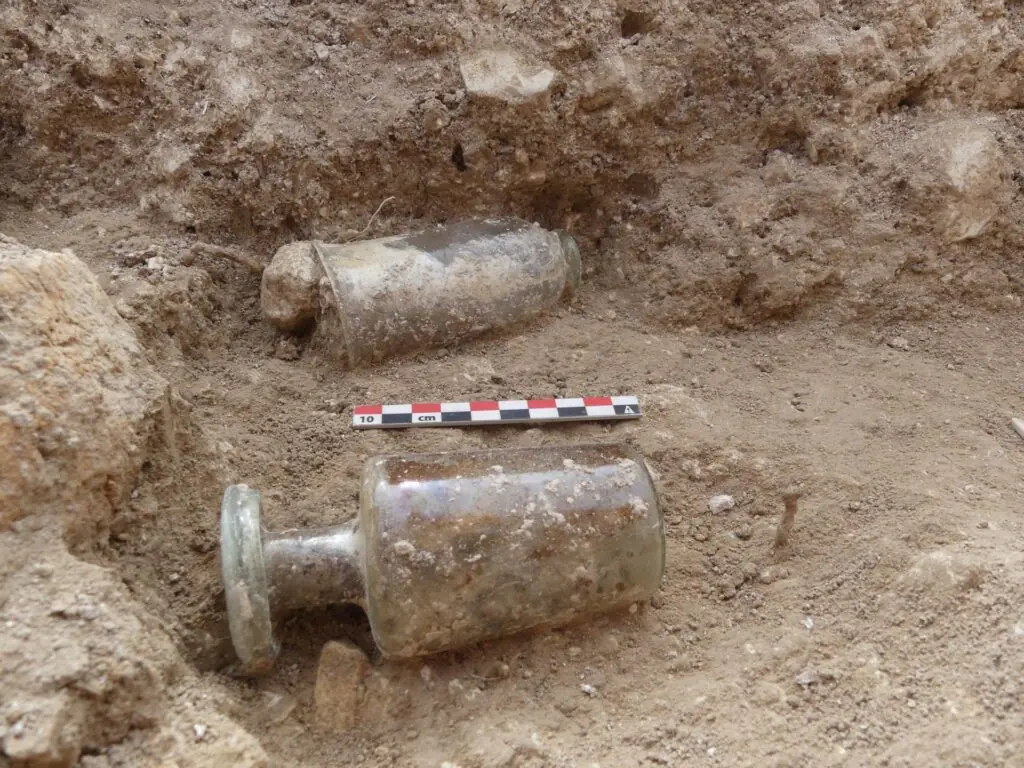
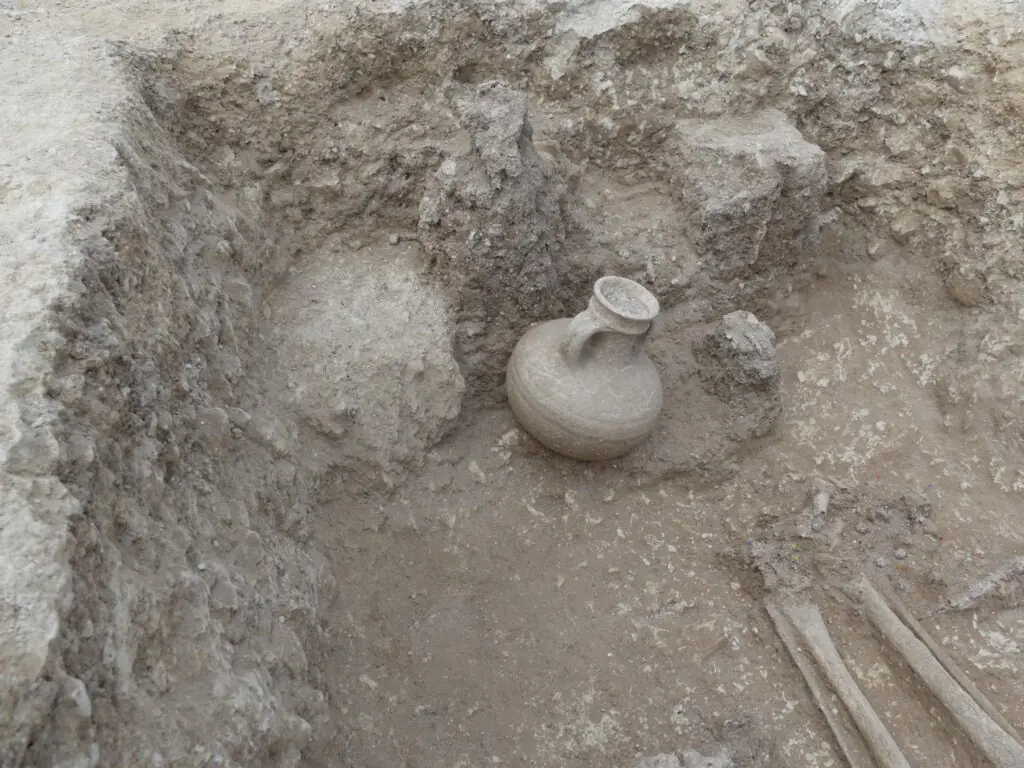
One of the burials contained two cylindrical glass bottles positioned beside the head of the deceased. Archaeologists also recovered other glass and ceramic vessels from the graves, along with an amphora identified as a regional product.
The objects appear to have been deliberately selected and arranged as part of the burial rite rather than discarded accidentally. Their forms and positions may help researchers understand whether food, drink or other substances accompanied the dead during funerary ceremonies.
Glass vessels are especially valuable because they can reveal details about consumption, trade and personal habits that are rarely preserved through skeletal remains alone. Further analysis may determine whether residues survive inside any of the containers and clarify how they were used before being placed in the graves.
A rural community outside Augustobona
La Rivière-de-Corps lies only a few kilometers from Troyes, known during the Roman period as Augustobona. The excavation shows that the surrounding countryside was actively occupied and organized rather than serving simply as empty land beyond the urban center.
Archaeologists identified enclosures and other features associated with rural activity around the burial area. These remains fit into a broader picture of farms and small settlements that supported Roman towns across northern Gaul through agriculture, craft production and local exchange.
The graves therefore offer a more personal perspective on this rural landscape. Instead of showing only fields, boundaries and settlement structures, they preserve evidence of the people who lived there and the rituals used to bury their dead.
Centuries of occupation at the same site
The Roman burials represent only one phase in a much longer sequence. Later activity altered the organization of the site, and by the medieval and early modern periods the area had been reshaped by new boundaries, agricultural features and property systems.
Historical sources from the eighteenth century describe orchards and a dovecote surrounded by ditches, while nineteenth-century cadastral records indicate that much of this earlier arrangement later disappeared.
That long history helps place the Roman graves within a landscape that was continually reused and transformed. Yet the small burial group remains one of the excavation’s most direct links to individual lives.
The glass bottles, ceramics and amphora were placed beside three people who died near Augustobona roughly 1,700 years ago. Their names are lost, but the objects buried with them still preserve traces of how a small Late Roman community marked death in the countryside beyond the city.