
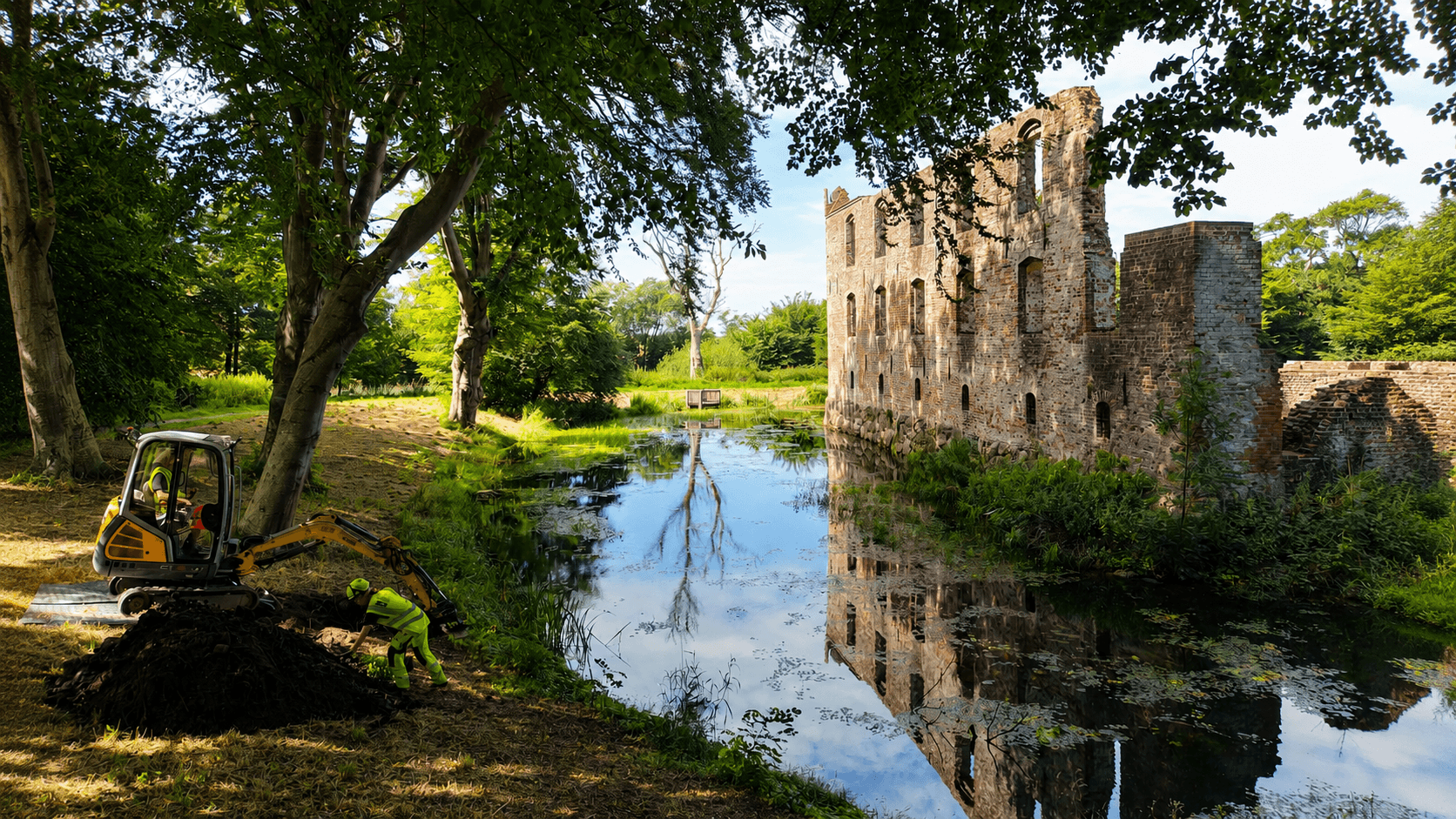
Worked wooden piles uncovered at the entrance to Denmark’s Trøjborg Castle may belong to a former gatehouse. Tree-ring dating could reveal whether they formed part of the medieval fortress or the Renaissance castle built over it centuries later.
Archaeologists from Museum Sønderjylland encountered the timbers while monitoring construction at the protected castle ruin near Visby in southern Denmark. The excavation was not initially intended to investigate the castle’s architecture but formed part of a project to protect the ruins from fluctuating water levels.
The remains appeared during the installation of a new overflow pipe near the outer entrance to the castle island. They consist of shaped oak piles supported by smaller stakes made from alder wood.
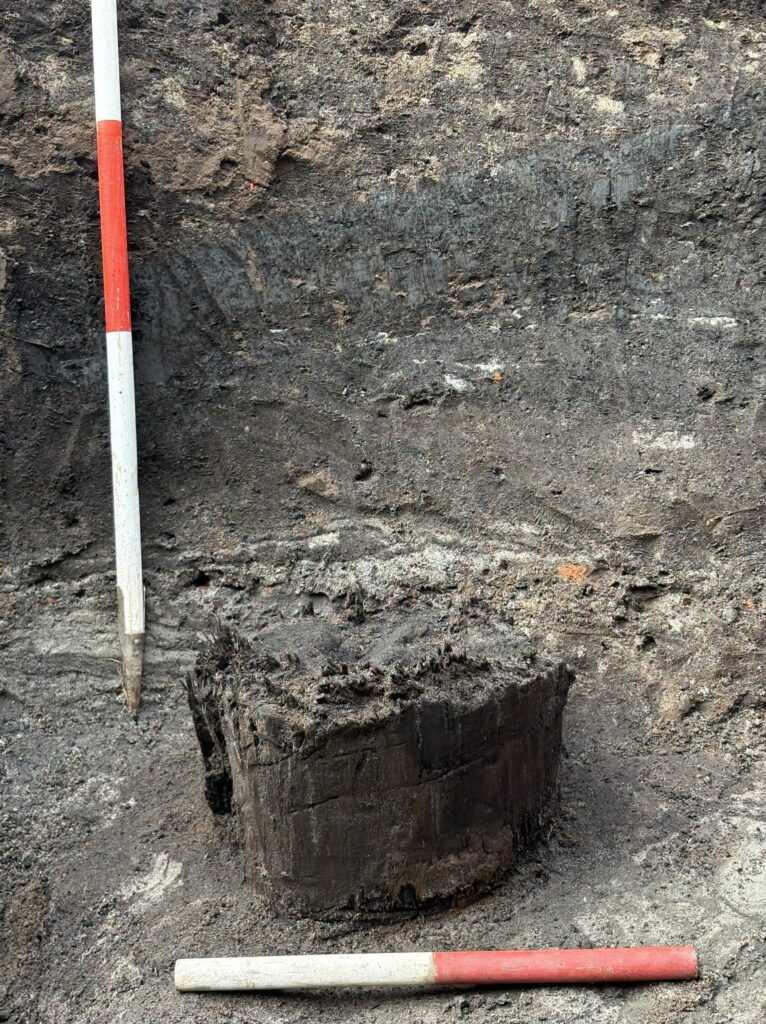
Their position suggests that they may represent the piled foundations of a gatehouse, according to the museum. However, the interpretation remains preliminary, and the timbers have not yet been assigned to a specific period in Trøjborg’s long building history.
Samples of the oak have now been submitted for dendrochronological analysis. By comparing their growth-ring patterns with established regional sequences, researchers may be able to determine when the trees were felled.
Medieval fortress or Renaissance entrance?
The earliest castle at Trøjborg was built during the first half of the 14th century on an artificial island measuring approximately 30 by 30 metres. Surrounded by a moat, it included a central tower measuring about 13 metres on each side, with walls approximately four metres thick, as well as a smaller adjoining building.
Trøjborg entered the possession of Queen Margaret I in 1407 and was later pledged to the bishopric of Ribe. The property passed to the Danish Crown following the Reformation before coming under the control of the Rantzau family.
Peter Rantzau began transforming the site around 1580. The medieval stronghold was demolished and replaced by a Dutch Renaissance-style castle with four wings arranged around a small central courtyard. Four stair towers stood at the courtyard’s corners, while access was provided through a gate and drawbridge.
The Renaissance complex did not rest exclusively on the medieval island. According to the Danish Agency for Culture and Palaces, part of it was erected on new timber piling driven into the former moat. This overlap explains why the newly discovered entrance foundations cannot yet be attributed confidently to either construction phase.
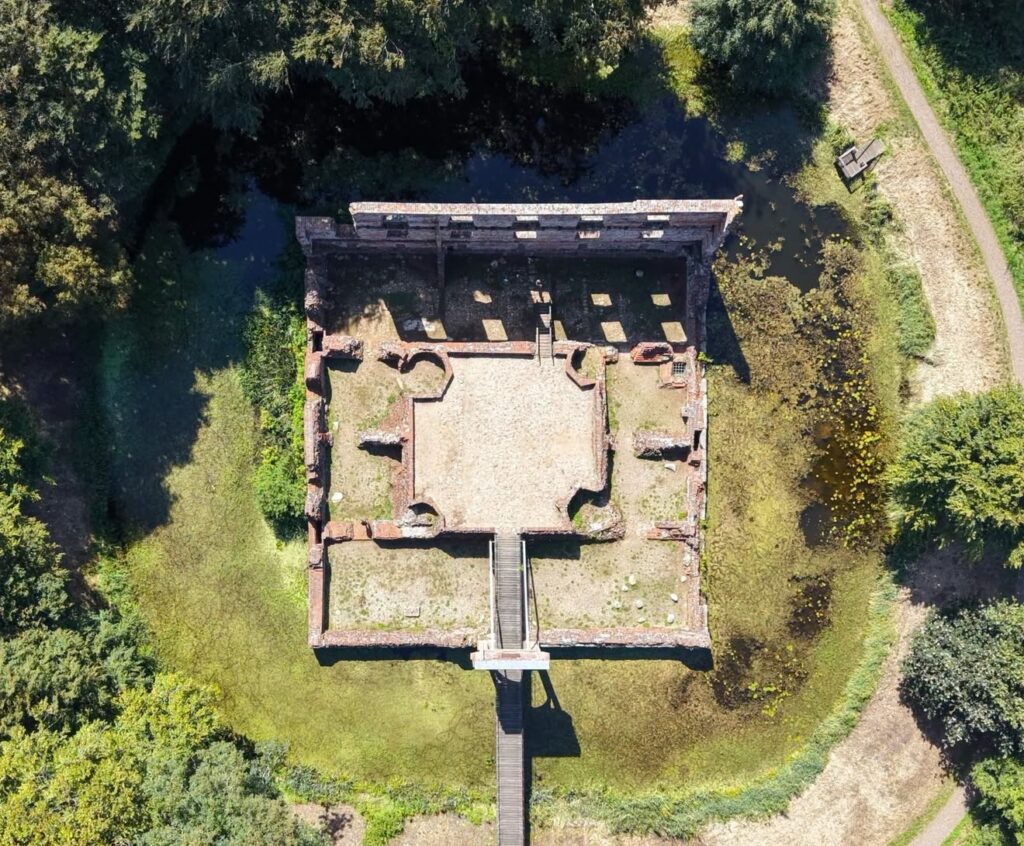
By the middle of the 19th century, the castle had fallen into serious disrepair. Demolition began in 1854 but was never completed, leaving sections of the cellar level and southern façade standing as the ruins visible today.
A discovery made while protecting the ruins
The construction work that exposed the piles is part of a wider climate-adaptation project. Trøjborg’s surviving masonry is itself supported by oak piles, and its stability depends on maintaining suitable water conditions around the foundations.
If the water in the inner moat drops too low, the submerged timber can dry out and deteriorate. If it rises too high, parts of the castle ruin may be flooded. Managing the moat has become more pressing as dry periods have grown more frequent, while prolonged summer droughts are also revealing buried structures at historic sites elsewhere in Europe.
The new system will allow water to be transferred from a nearby pond during dry conditions. A sluice and overflow pipe will release excess water when the level becomes too high.
Although digging is normally prohibited at protected ancient monuments in Denmark, the work was authorized because it is necessary for Trøjborg’s long-term preservation. Museum Sønderjylland supervised the excavation on behalf of the archaeological authorities and recorded the exposed remains.
The project is being conducted jointly by Tønder Municipality and the Danish Agency for Culture and Palaces. The dating results from the oak piles may now clarify whether the construction work has exposed part of the entrance to the vanished medieval fortress or foundations associated with its Renaissance replacement.
Cover Image: Climate-adaptation work beside the moat at Trøjborg Castle in southern Denmark, where construction exposed wooden piles that may belong to a former gatehouse. Credit: Museum Sønderjylland