
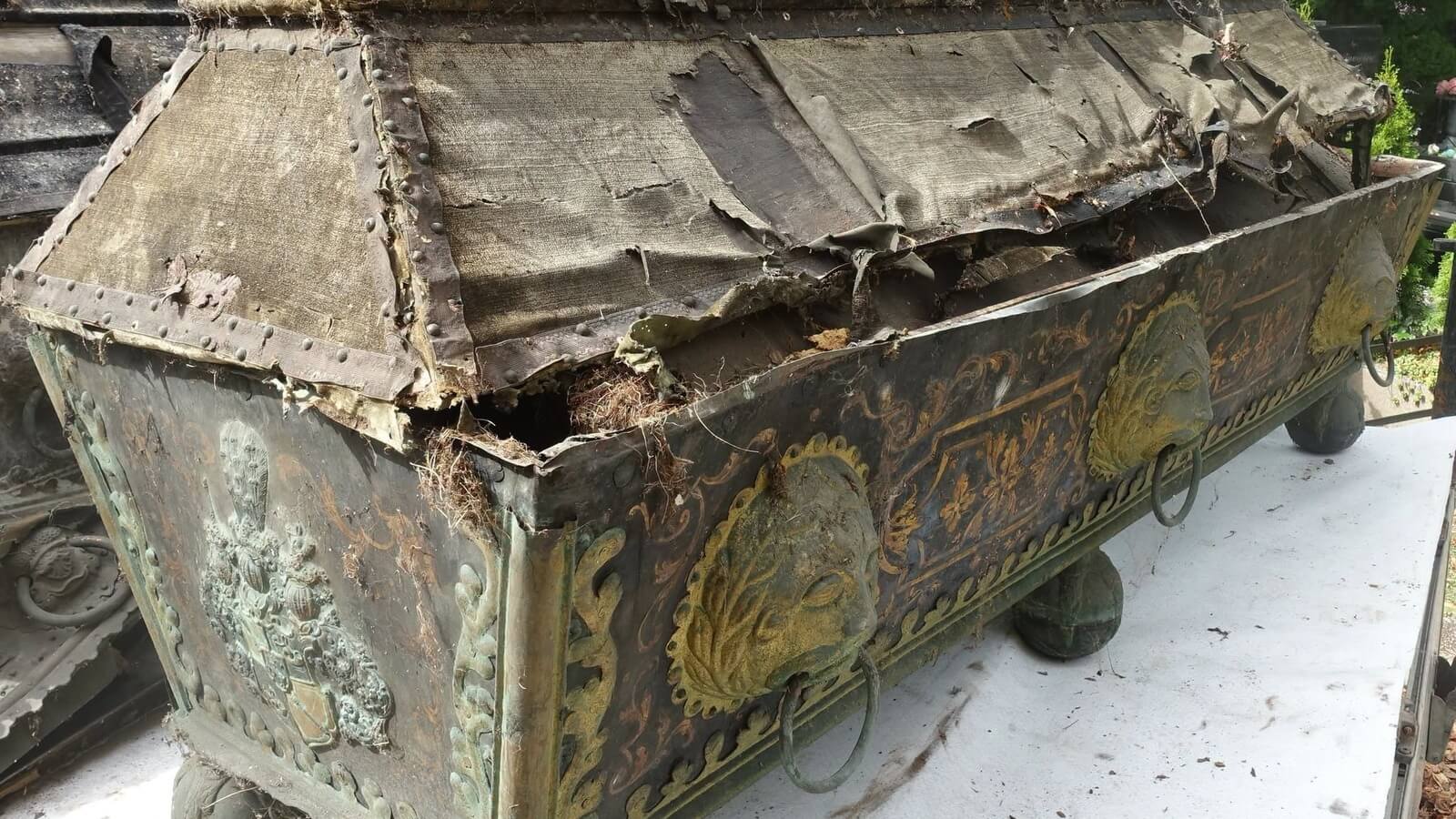
18th-century aristocratic sarcophagi belonging to the von Hochberg family have been identified among more than 25 historic coffins and funerary objects documented inside another family’s mausoleum in southwestern Poland. Researchers linked eight burials to named members of the dynasty, including the man who transformed Książ Castle into a Baroque residence.
The burials were examined on August 28 during preparations to restore the von Kramst family mausoleum at the municipal cemetery in Świebodzice, Lower Silesia. The building bears the name of a prominent local family of industrialists, yet the coffins occupying its upper level belonged to a different dynasty.
A preliminary study of inscriptions, dates and heraldic decoration linked eight of the burials to the von Hochbergs, who controlled Książ Castle and its estates for centuries.
Among them was Count Konrad Ernst Maximilian von Hochberg, who commissioned the castle’s first major Baroque reconstruction.
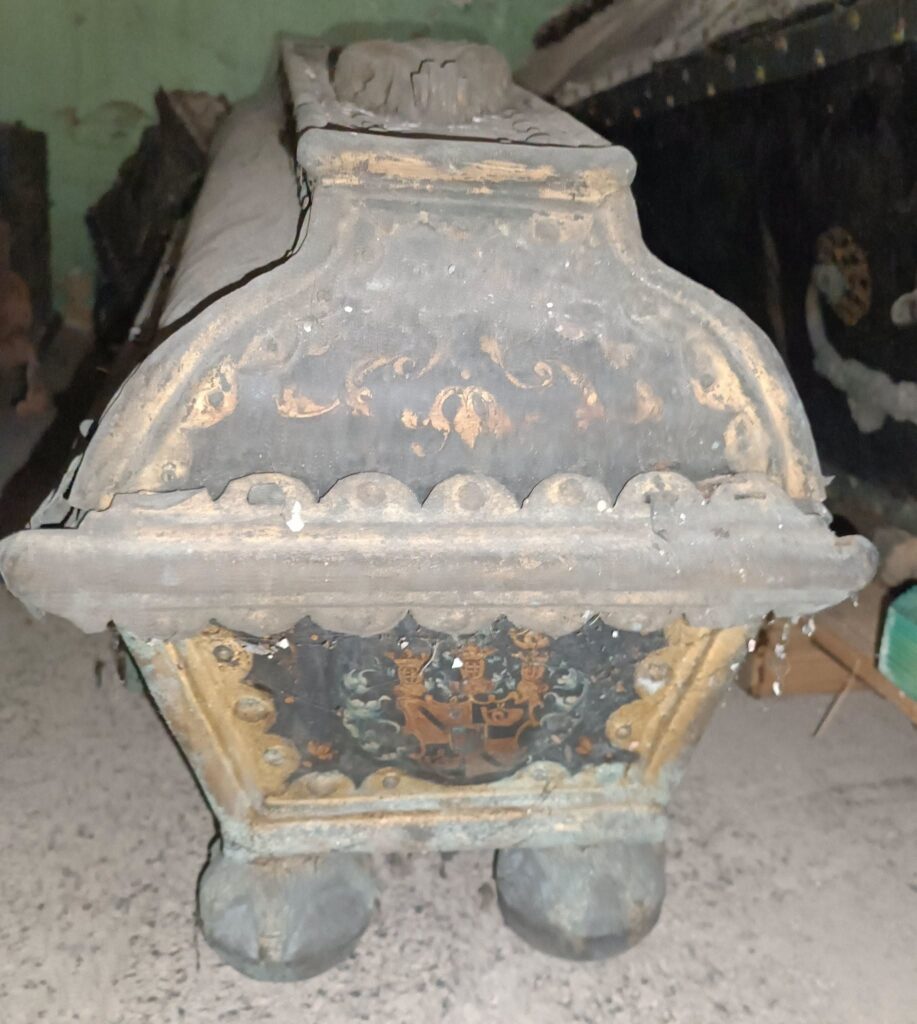
More than 25 coffins and sarcophagi documented
Świebodzice City Hall commissioned the work to produce the architectural and conservation records needed before restoration of the mausoleum begins. Staff from the Wałbrzych branch of the Lower Silesian Provincial Conservator of Monuments supervised the movement and securing of the objects.
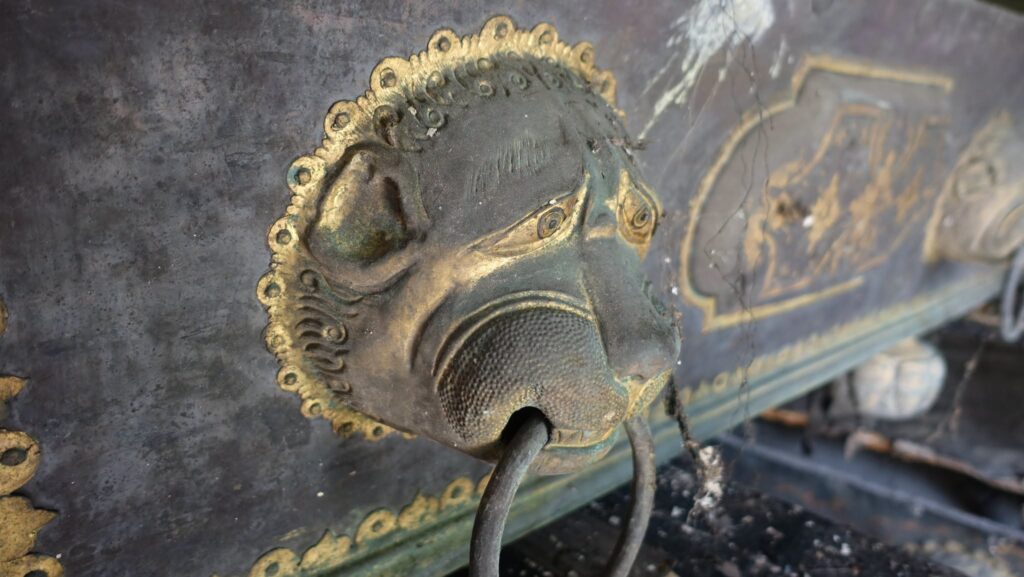
The team recorded more than 25 funerary objects in varying states of preservation. They ranged from decorated Baroque metal sarcophagi to damaged wooden coffins dating from the 19th century.
The von Hochberg burials occupied the upper part of the structure. The remains of the von Kramst family, for whom the mausoleum was built, were located in its burial crypt.
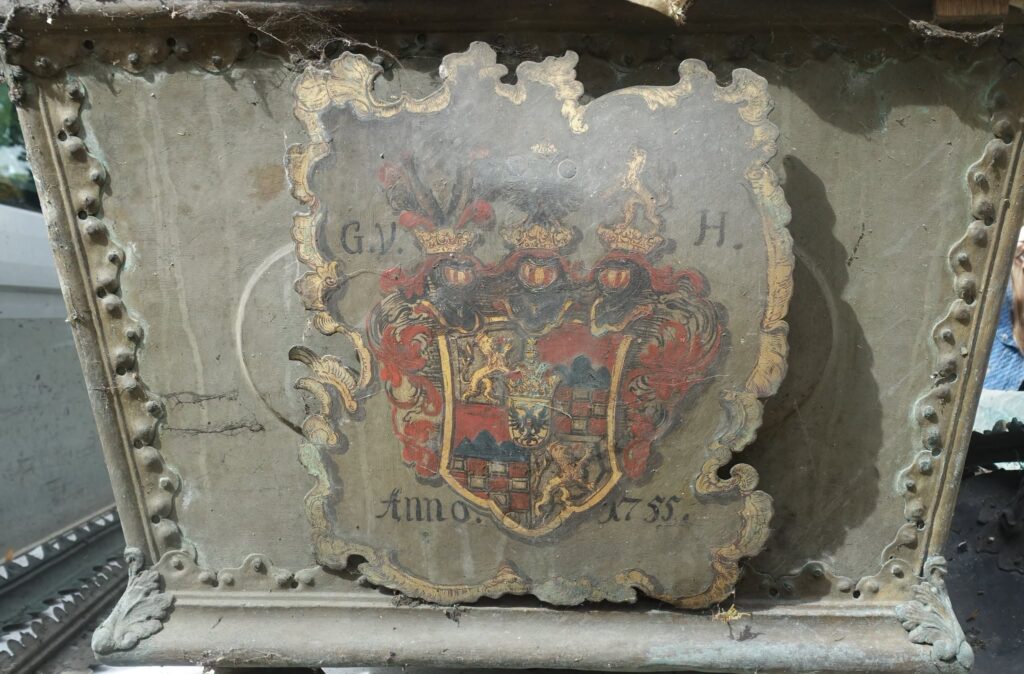
Dr. Kamil Pawłowski of the monument protection office used historical and heraldic evidence to identify eight members of the von Hochberg family. One sarcophagus, for example, carries the coats of arms of both the von Hochberg and von Flemming families.
The identified burials include Konrad Ernst Maximilian; his second wife, Agnes Helene von Hochberg, born von Flemming; and his third wife, Christiane Dorothea von Hochberg, born into the Reuss von Plauen family.
Several of the sarcophagi belonged to children. Carl Heinrich Ludwig von Hochberg was born on May 23, 1712, and died only four days later. Another son of Konrad and Agnes Helene, whose name has not been established, died on August 5, 1721—the same day as his mother.
The team also identified Heinrich Ludwig Carl von Hochberg, who died in 1755; Hans Heinrich VI von Hochberg, who lived from 1768 to 1833; and Hans Heinrich XII, who died at four months old in 1835.
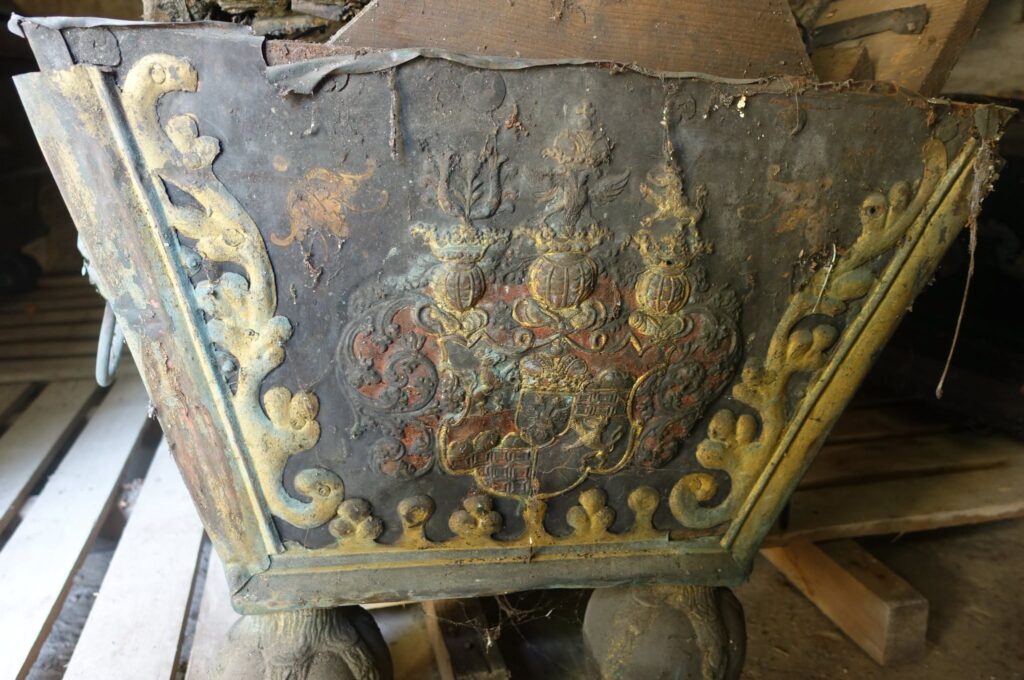
The identities of the people buried in the remaining coffins have yet to be established.
The man who gave Książ its Baroque character
According to the official history of Książ Castle, Konrad Ernst Maximilian played a defining role in the appearance of the residence today. During the reconstruction carried out principally between 1722 and 1732, three wings were added around the medieval tower. The project also created an elegant eastern façade and the castle’s ceremonial courtyard.
He expanded the family library, assembled scientific instruments and developed collections devoted to art and natural history.
Książ remained in von Hochberg hands for more than four centuries, from 1509 until the Nazi regime confiscated the property in 1941. Wartime construction, the dispersal of its collections and the subsequent occupation of the castle by Soviet troops stripped away much of the family’s material legacy.
The identification of Konrad’s sarcophagus therefore carries particular historical weight. The changes he commissioned remain visible in the castle’s Baroque rooms, courtyard and Maximilian Hall.
The burials were moved in 1955
Early reports suggested that the von Hochberg coffins might have been placed in the von Kramst mausoleum during the final days of the Second World War. Local historical research points to a later and more firmly documented explanation.
Rafał Wietrzyński, a historian from Świebodzice, cited parish records documenting the transfer of 15 von Hochberg coffins from the crypt beneath St. Nicholas Church to the municipal cemetery in June 1955. The move took place while repairs were being carried out at the church.
The transfer was also described in a history of the St. Nicholas parish published in 2004 by the late priest and historian Krzysztof Moszumański. Drawing on parish documents now held by the Archdiocesan Archive in Wrocław, Moszumański wrote that the Hochberg coffins were deposited in the von Kramst family crypt.
The presence of the Hochberg burials at the cemetery was therefore not an entirely new discovery. The 2026 work produced a systematic inventory, secured the damaged funerary objects and linked eight burials to named members of the family.
The 1955 record also challenges the suggestion that the sarcophagi were moved secretly as the Second World War came to an end.
What further examination could reveal
The sarcophagi and coffins have been secured while architectural planning and conservation work continue. Their condition varies considerably, and restoring the entire group is likely to require a long-term effort.
The contents may preserve more than human remains. Fragments of clothing, flowers and other organic materials traditionally placed with the dead could survive inside some of the coffins.
Osteological and paleopathological examinations could provide evidence of age, physical condition, injuries and chronic disease. Teeth may retain information about diet, while isotope analysis and any surviving DNA could help researchers examine family relationships and aspects of the individuals’ lives.
The value of genetic evidence has already been demonstrated by DNA analysis of a medieval double burial in Poland, which established that the two people placed in the same grave were not close relatives.
The next stage of the investigation will focus on the unidentified coffins and the remains preserved inside them. Researchers will also need to determine whether every von Hochberg burial entered the mausoleum during the documented transfer from St. Nicholas Church in 1955.
Cover Image: A damaged metal sarcophagus associated with the von Hochberg family, documented inside the von Kramst mausoleum in Świebodzice, Poland. Credit: Lower Silesian Provincial Conservator of Monuments