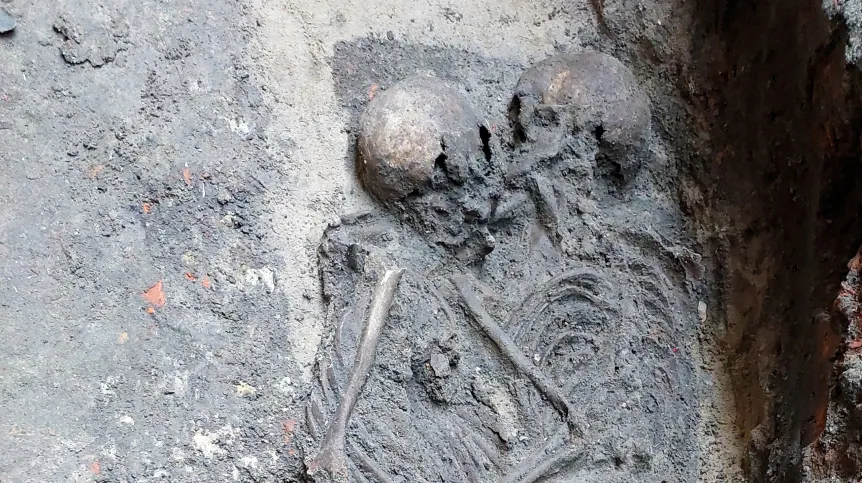
A rare same-sex medieval burial beside a cathedral wall in southern Poland is forcing archaeologists to rethink one of the oldest assumptions about people buried together: that closeness in death usually means family.
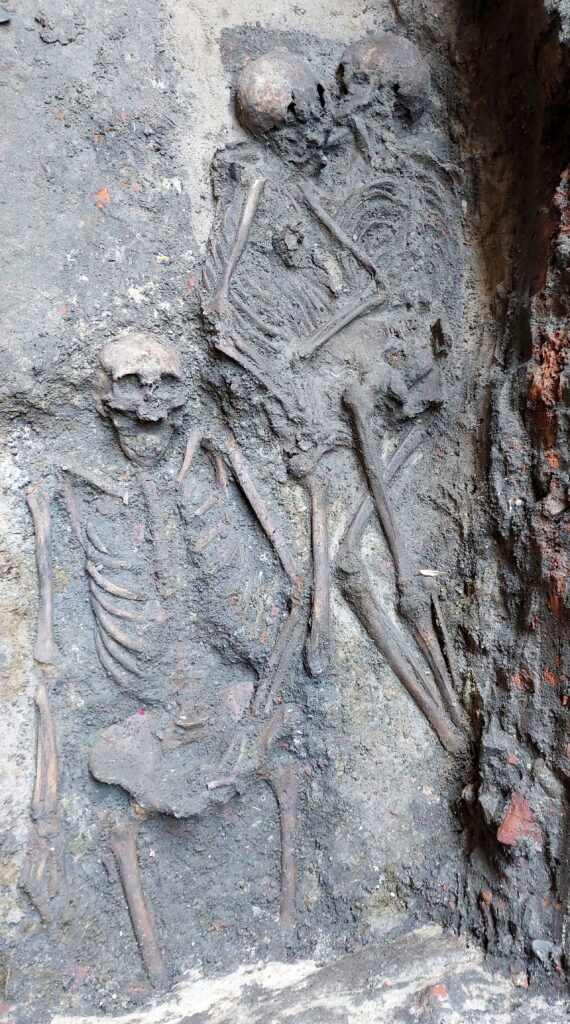
In Opole, near the Cathedral of the Exaltation of the Holy Cross, researchers found the remains of two adults placed in a single medieval grave. They lay unusually close. One body followed the expected Christian burial position. The other had been placed in a more atypical posture, creating the visual impression of an embrace.
For a time, the arrangement alone raised the most obvious questions. Were they relatives? A married couple? Victims of the same sudden crisis?
Ancient DNA has now changed the story.
A new study published in Journal of Archaeological Science: Reports shows that both individuals were genetically female and were not closely related. Researchers say the burial is the first genetically confirmed same-sex double burial known from medieval Poland.
A grave too careful to dismiss
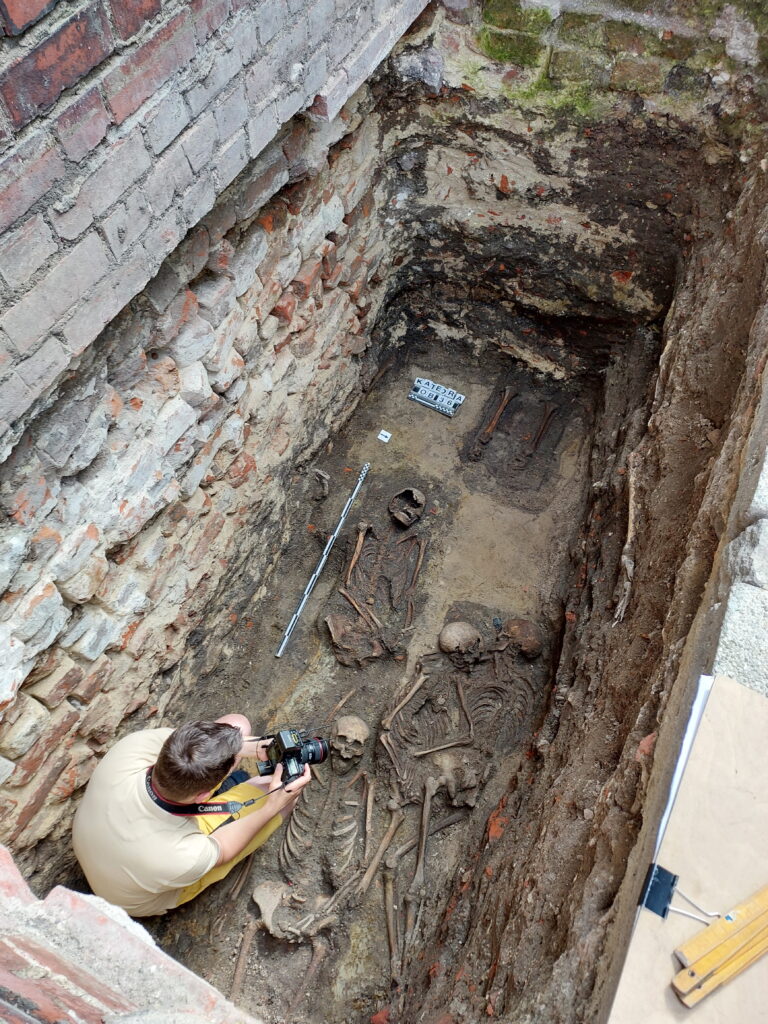
The burial was discovered during archaeological work near the walls of Opole’s medieval cathedral, one of the city’s most important religious landmarks. In the Christian Middle Ages, adults were usually buried individually, so a shared grave already stood out.
Yet nothing about the burial suggested haste or disorder. There were no signs of violence on the bones. The grave did not appear to have been filled chaotically. Nor did it resemble a mass burial caused by epidemic, panic, or battlefield death.
That matters. Unusual medieval burials can easily be pushed toward dark explanations: exclusion, fear, punishment, or emergency. The Opole grave does not fit comfortably into those categories. The two people appear to have been placed together deliberately, in a setting that carried religious and social significance.
A burial near a cathedral wall was not a neutral location. In medieval towns, proximity to sacred space often reflected status, belonging, or a community’s wish to keep the dead within a protected spiritual landscape.
DNA answered what the bones could not
The poor preservation of the skeletons made it difficult to determine biological sex through anatomy alone. Both individuals were estimated to have died at around the age of 40, but the bones could not provide all the answers.
Researchers from the Ludwik Hirszfeld Institute of Immunology and Experimental Therapy in Wrocław, Kiel University, and the University of Opole turned to ancient DNA analysis. Genetic material taken from the bones showed that both individuals were female.
The kinship result was just as important. The two women were not close relatives. The study excluded relatedness up to the third degree, meaning they were not sisters, mother and daughter, or close cousins.
That finding cuts through one of archaeology’s most common shortcuts. When two adults are buried together, especially in a careful arrangement, the first explanation is often family. The Opole grave shows why that assumption can be too narrow.
Two women, one grave, no simple answer
The relationship between the two women remains unknown. The researchers do not claim that they were lovers. Nor does the term “same-sex burial” prove anything about sexual orientation, gender identity, or how the women would have understood themselves.
In this study, “same-sex” refers to biological sex as determined by genetic analysis.
That distinction is important, but it does not make the discovery less striking. Two unrelated women were buried together in a way that suggests meaningful closeness. Their connection mattered enough for someone to place them in the same grave.
They may have belonged to the same religious community. They may have lived in the same household. They may have shared work, property, care, or obligations within one of the small social networks that shaped medieval urban life.
Medieval people did not live only inside nuclear families. They moved through guilds, parish communities, neighborhood ties, confraternities, households, and systems of mutual dependence. Some of those relationships could become powerful enough to shape burial choices.
The Opole grave may preserve one such bond.
A challenge to old readings of medieval burials
Double burials are known from medieval Poland. Archaeologists have documented graves of spouses, mothers with children, and other likely relatives. In many cases, body position has been used to infer emotional or familial ties.
But without DNA, those interpretations remain vulnerable. A shared grave can suggest kinship, but it cannot prove it. A close embrace can suggest affection, but it cannot define the relationship.
The Opole burial is different because it combines archaeological context with genetic evidence. The result is not a solved love story. It is something more careful and perhaps more interesting: proof that medieval burial closeness could exist outside close biological kinship.
That changes the question. Instead of asking only who these women were to each other by blood, researchers can now ask what kinds of social bonds medieval communities considered worthy of preserving in death.
A medieval bond still without a name
The women buried at Opole left no written explanation. Their names are unknown. No inscription tells us why they were placed together. The grave offers a gesture, not a confession.
Still, the gesture is hard to ignore.
Around 800 years ago, two women were buried side by side beside a cathedral in medieval Poland. They were not close relatives. They were not thrown into the earth in haste. Their grave was not careless. Someone, or some community, decided that they belonged together.
That decision now survives as one of the most unusual burial discoveries from medieval Poland. It also shows how ancient DNA can do more than identify ancestry. It can expose the limits of modern assumptions about the past.
The Opole grave does not give us the name of the relationship between the two women. It gives us something more elusive: evidence that medieval closeness could be chosen, remembered, and carried into death.
Cover Image: Ancient DNA identified the Opole Cathedral grave as Poland’s first genetically confirmed same-sex medieval burial, containing two unrelated women buried together. Credit: Dr. Magdalena Przysiężna-Pizarska / University of Opole