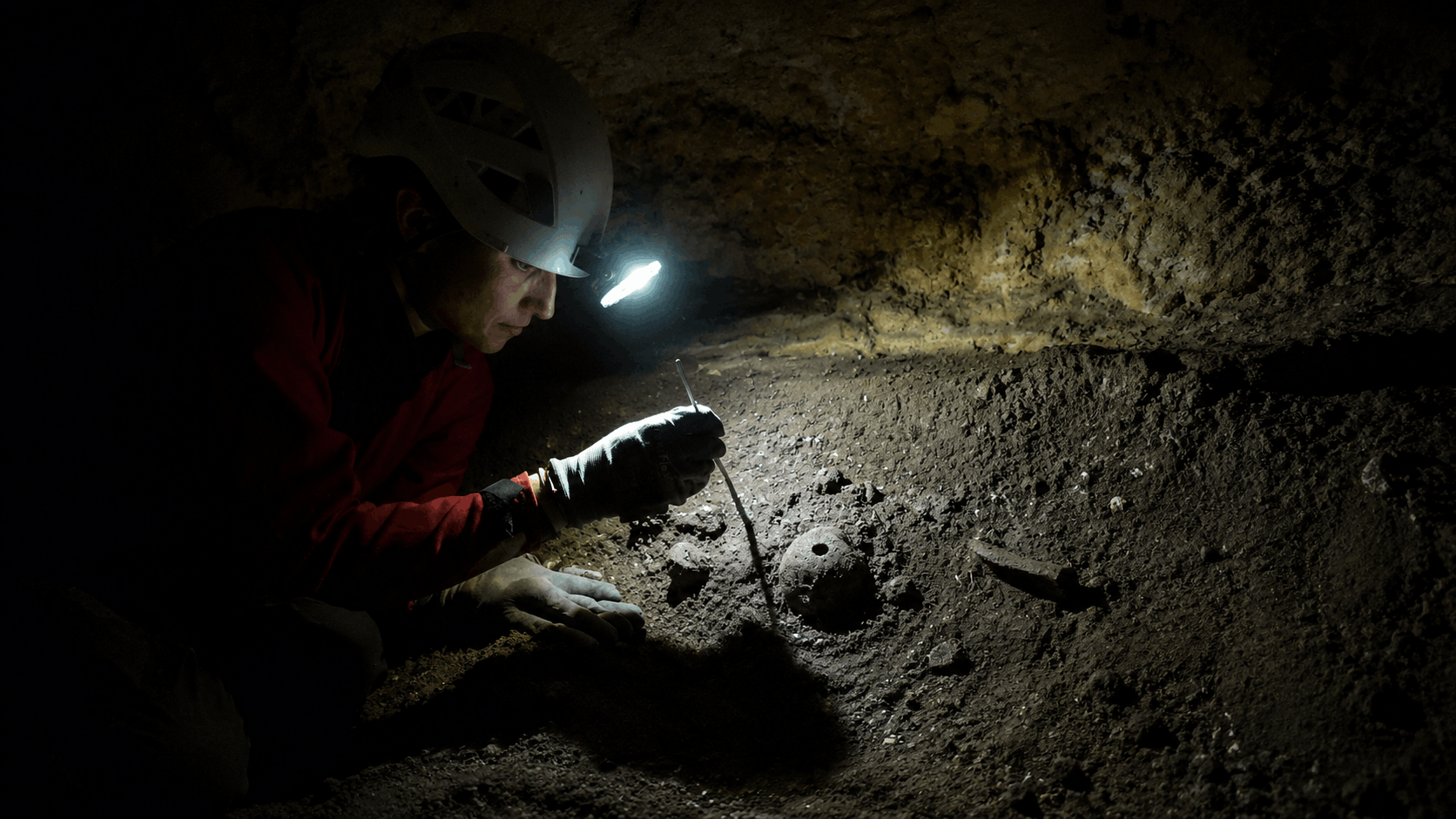
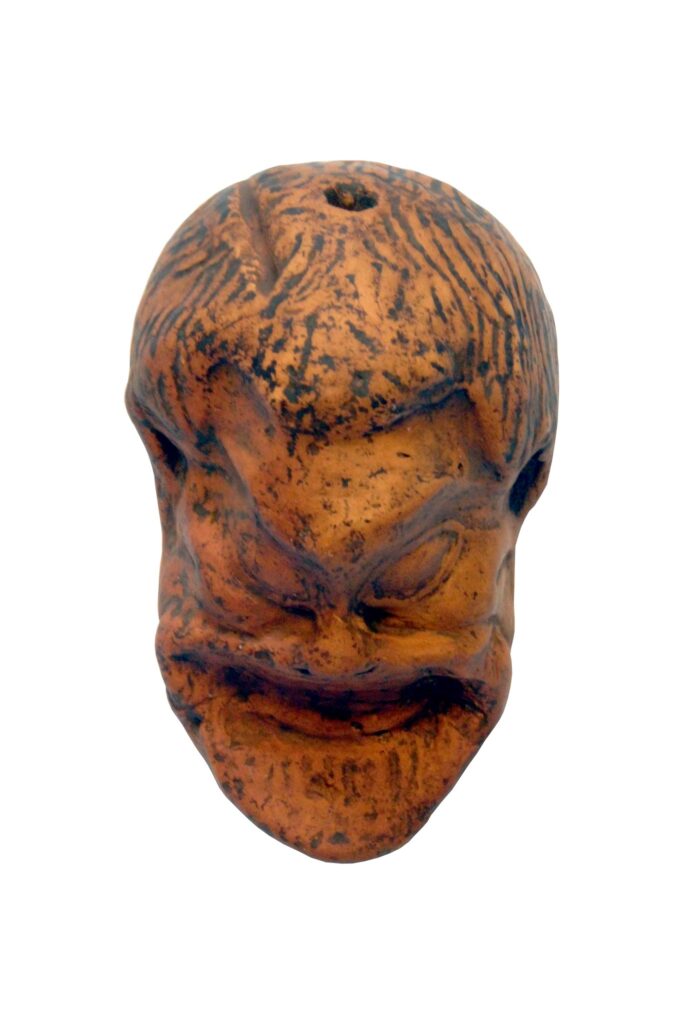
A terracotta face linked to ancient Greek theatre has emerged from a hidden chamber inside a cave on Croatia’s Pelješac Peninsula, offering archaeologists a rare glimpse into the ritual world of the Illyrians more than 2,000 years ago.
The discovery was made in Crno Jezero cave during excavations carried out between April 23 and May 4, 2026, by archaeologists from the Archaeological Museum of Dubrovnik Museums. The artefact, dated to the 4th or 3rd century BC, is a hollow terracotta head representing a Greek theatrical mask. A small hole suggests it may once have been hung on a wall, possibly as part of a ritual display rather than ordinary decoration.
A Greek theatrical face inside an Illyrian cave
The find is striking because Greek theatre masks were closely associated not only with performance, but also with the cult of Dionysus, the god of wine, ecstasy, transformation, and dramatic ritual. In Crno Jezero, that connection becomes even more intriguing because the mask was found in a cave where wine-related vessels and votive offerings point to ritual activity.
Archaeologist Domagoj Perkić, head of the Archaeological Museum of Dubrovnik Museums, has raised the possibility that the cave sanctuary may have been connected to Dionysus or to a local Illyrian deity with similar traits. He stressed, however, that the interpretation remains cautious. The artefacts do not give a simple answer, but they do point to a ritual space where Greek religious imagery and local Illyrian practice may have overlapped.
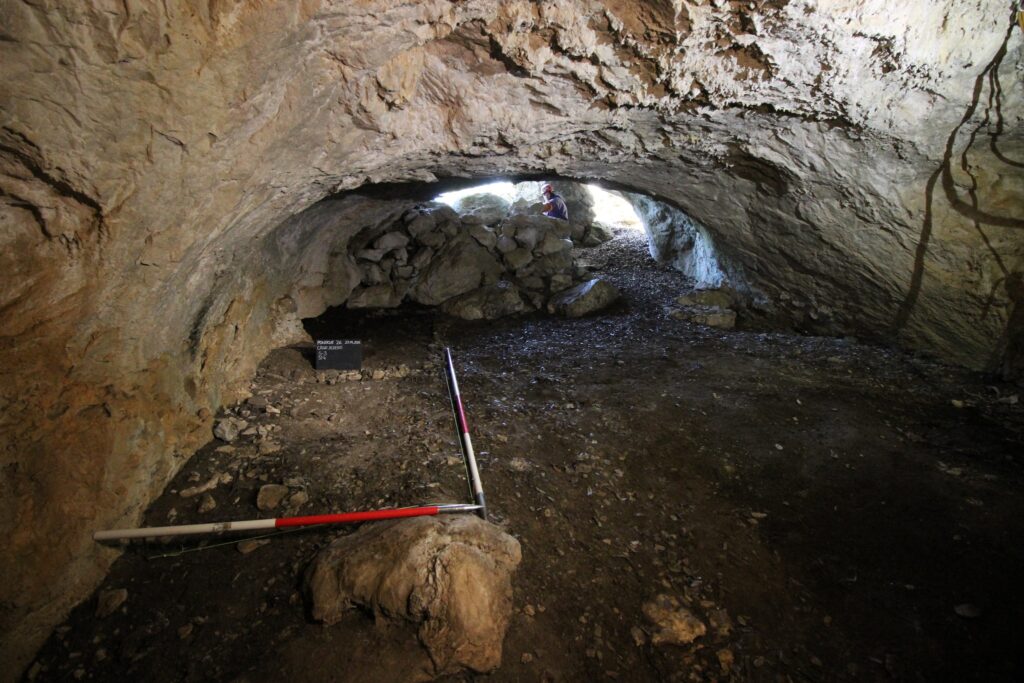
A blocked chamber preserved the ancient scene
Many of the most important objects were found in a hidden, previously blocked-off part of the cave. That protected position helped preserve the material in unusually good condition, allowing archaeologists to study a sanctuary deposit that had remained largely undisturbed for centuries.
This is what gives the discovery its strongest narrative force. Crno Jezero was not simply a cave where an isolated object appeared. It was a place that changed meaning over time. Earlier investigations showed that the cave had been used across thousands of years, beginning as a shelter or seasonal refuge during the Bronze Age. Later, between about 1012 BC and 481 BC, it became a burial place. Radiocarbon analysis of human remains confirmed that the cave functioned as a necropolis for more than five centuries.
After the burial phase ended, the cave appears to have taken on a new role. From the late 4th century BC until around the middle of the 1st century BC, archaeologists believe Crno Jezero served as an Illyrian sanctuary.
Wine vessels, miniature offerings, and ritual power
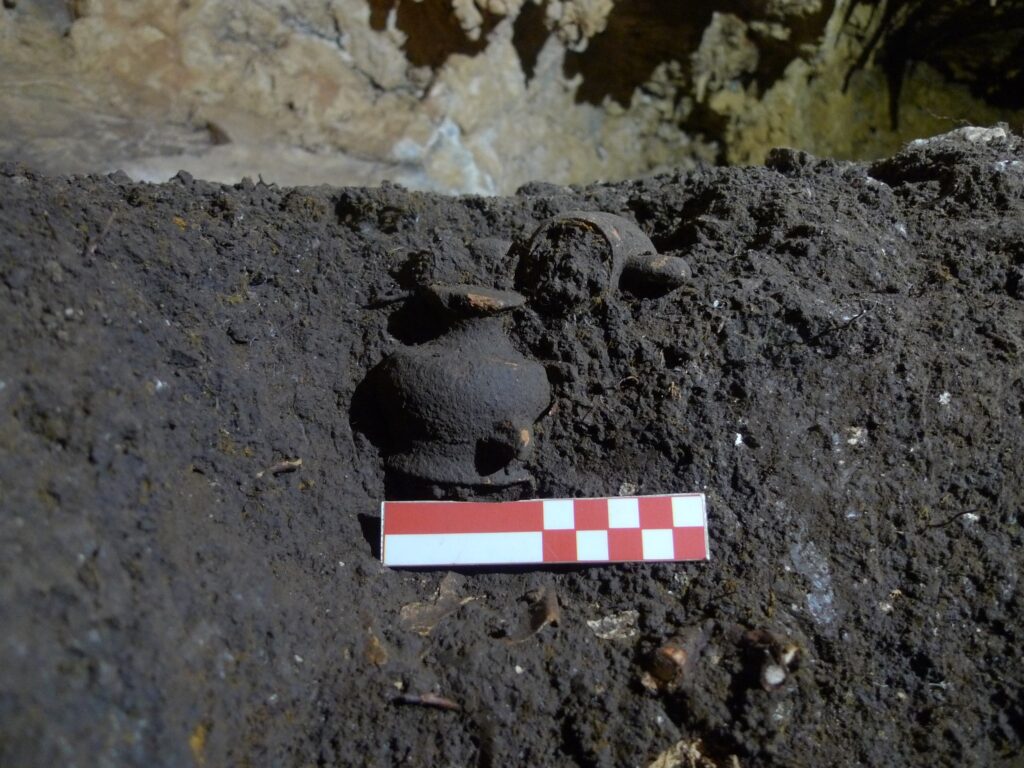
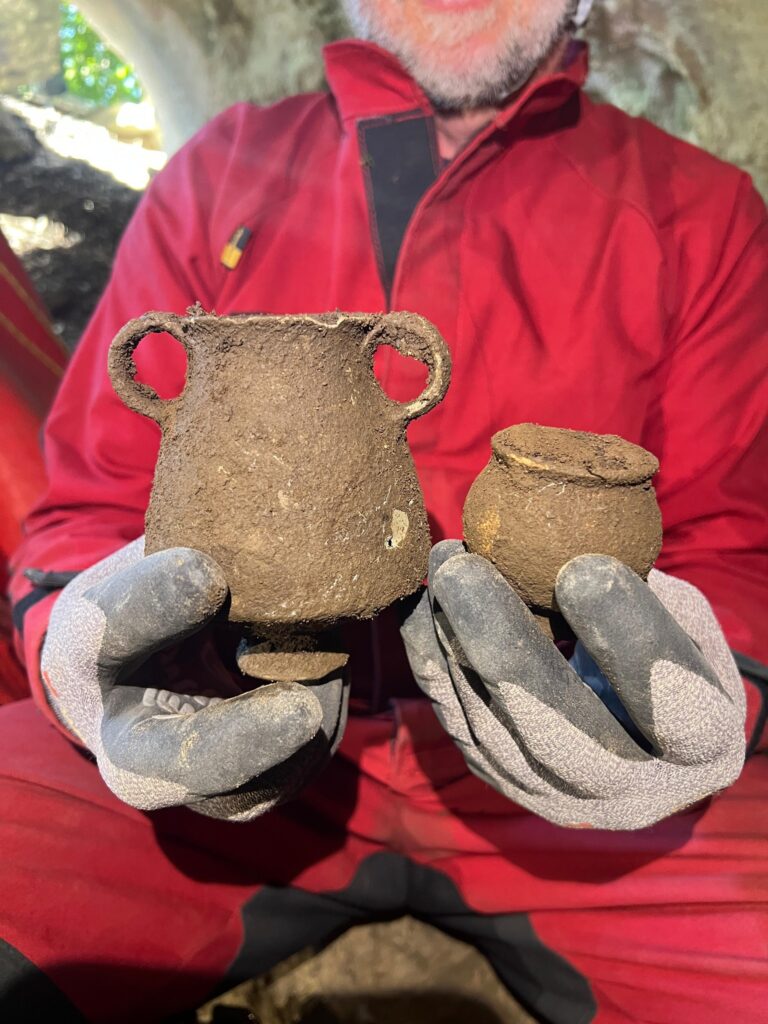
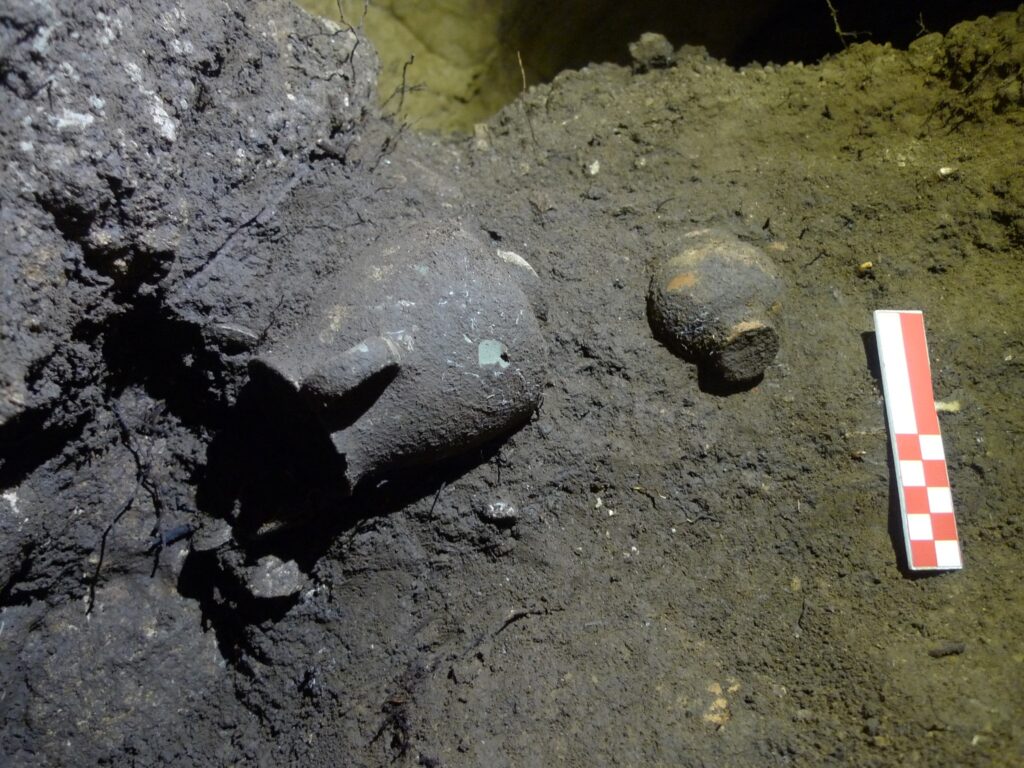
The mask was not the only object suggesting ritual activity. Archaeologists have also identified miniature vessels, including Greek amphorae, bowls, and drinking cups, along with locally made ceramics. Such objects are often interpreted as votive offerings, items deliberately deposited during ceremonies rather than used in ordinary domestic life.
The presence of fine Greek pottery is especially important. In the eastern Adriatic, imported Greek vessels were not just containers. They could signal status, wealth, and contact with the wider Mediterranean world. In a sanctuary setting, amphorae and drinking cups also point toward ceremonial drinking, possibly involving wine. That makes the Dionysian association of the terracotta mask more than a decorative detail.
The pattern is not unique to Crno Jezero. Nearby Nakovana Cave, also on the Pelješac Peninsula, is one of the best-known Illyrian cave sanctuaries in Dalmatia. Excavations there revealed large quantities of Hellenistic pottery, including drinking vessels, in a ritual setting. Scholars have long discussed the possibility that wine and Dionysian-style rites played a role in that sanctuary as well.
Three sanctuaries near Dubrovnik
Crno Jezero now joins a small but important group of Illyrian sacred sites in the wider Dubrovnik region. Alongside it are Spila in Nakovana and Vilina Cave above the Ombla spring. Together, these sites allow archaeologists to compare local religious traditions with the growing influence of Greek material culture on the eastern Adriatic coast.
Vilina Cave is especially relevant because excavations there produced miniature Iron Age votive vessels belonging to local handmade pottery traditions. This suggests that Illyrian ritual practice was not simply borrowed from Greece. Instead, Greek objects, local ceramics, and older sacred landscapes seem to have formed a mixed religious world.
That is why the Crno Jezero mask matters. It does not prove that Greek theatre was performed inside the cave. Nor does it identify the deity worshipped there with certainty. But it gives archaeologists a rare image from a ritual environment where theatre, wine, imported Greek objects, and Illyrian belief may have met.
More than two millennia later, the terracotta face still carries that ambiguity. It looks Greek. It was found in an Illyrian sanctuary. And it came from a dark, protected part of a Croatian cave where offerings, burials, and ritual memory had accumulated over generations.