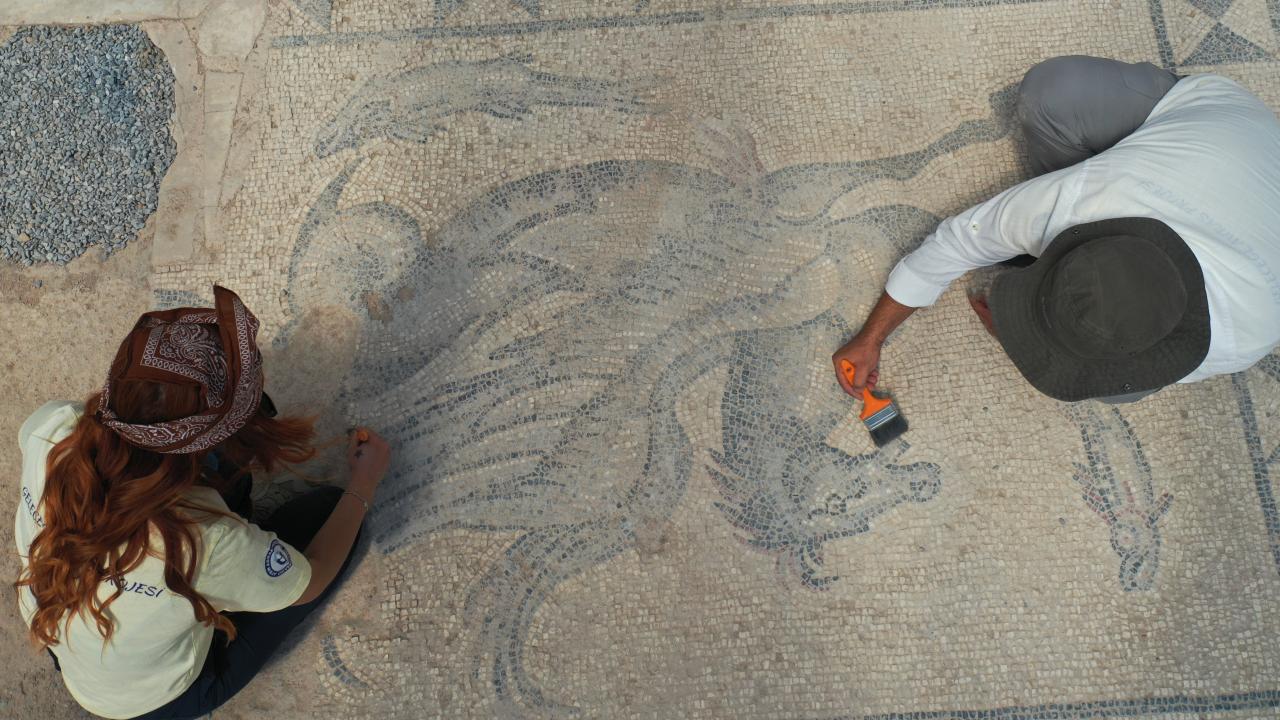
Archaeologists excavating the ancient city of Tralleis in western Türkiye have uncovered an exceptionally well-preserved Roman floor mosaic depicting a hippocampus, the mythical sea horse associated with Poseidon.
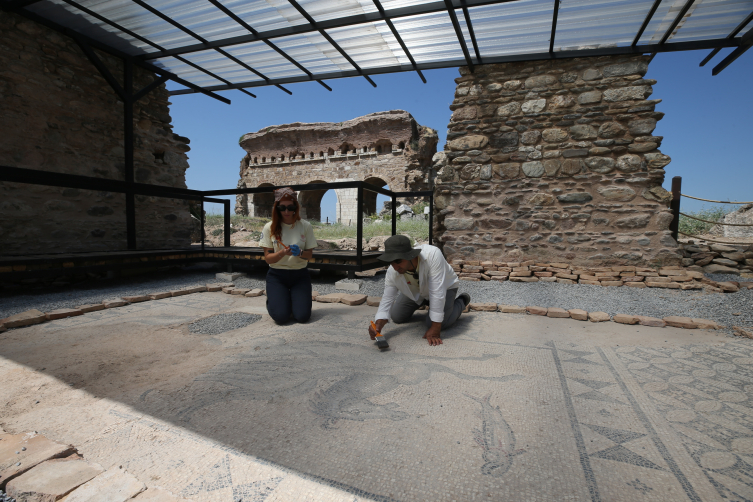
Dating back nearly 2,000 years, the mosaic was discovered in a newly excavated hall within the northern section of the city’s monumental bath-gymnasium complex. Significant parts of the composition have survived in remarkably good condition beneath the remains of a later Byzantine workshop.
Excavations at Tralleis, located about two kilometers from the modern center of Aydın, are being directed by Prof. Murat Çekilmez of Aydın Adnan Menderes University.
A Roman Hall Beneath a Byzantine Workshop
When archaeologists first investigated the area, they identified architectural remains belonging to a Byzantine-period workshop. Further excavation beneath these later occupation layers revealed the decorated floor of an earlier Roman hall.
According to Çekilmez, the discovery of the mosaic changed the team’s understanding of the space. What initially appeared to be a Byzantine working area had been established above a much older section of the bath-gymnasium.
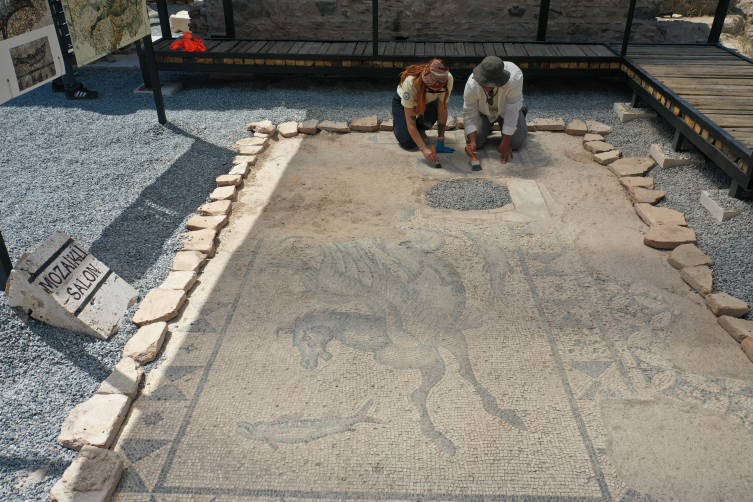
The surviving design features a hippocampus, a mythological creature represented with the forequarters of a horse and the tail of a fish. In Greek and Roman art, hippocampi belonged to the marine world of Poseidon and were often depicted alongside sea gods, nymphs and other aquatic beings.
They also appeared pulling Poseidon’s chariot across the sea.
The presence of such imagery inside a bath-gymnasium was particularly appropriate. Water shaped both the practical function and visual identity of Roman bathing complexes, where marine creatures and sea deities frequently appeared in mosaics, frescoes and sculpture.
A Public Center for Education and Exercise
The mosaic was not created for a private residence. It decorated a hall within one of Tralleis’ most important public institutions.
Roman bath-gymnasiums combined bathing, exercise, education and social activity. Young people could receive instruction while also participating in athletic training, reflecting the close relationship between physical and intellectual development in ancient civic life.
Çekilmez believes that some rooms within the Tralleis complex may have been used for teaching and other intellectual activities. He described the building as an important educational center where children received instruction from an early age.
Tralleis itself was known in antiquity for producing writers, physicians and other learned specialists. The bath-gymnasium may therefore have played an important role in the city’s broader educational and cultural life.
Previous excavations in the complex also uncovered a large swimming pool associated with athletic activity. Together with the newly discovered hall, the pool provides a clearer picture of how the enormous public building functioned during the Roman Imperial period.
Remarkably Preserved After Centuries of Reuse
The condition of the mosaic makes the discovery especially important.
Ancient floor mosaics were often damaged when buildings were abandoned, rebuilt or converted to new purposes. Later occupants could cut through decorated surfaces, construct walls across them or remove valuable materials for reuse elsewhere.
At Tralleis, however, parts of the hippocampus mosaic remained largely undamaged beneath the Byzantine occupation. The later layers may have inadvertently helped protect sections of the Roman floor from further destruction.
The mosaic offers archaeologists more than a chronological marker for the hall. It also preserves evidence of the visual environment created inside the complex and shows how mythology was incorporated into a building devoted to bathing, education and exercise.
Çekilmez said the imagery indicates that the hall was actively used during the Roman Imperial period. It may also help researchers better understand the daily life and cultural preferences of the people who used the complex.
A New Highlight for Ancient Tralleis
Tralleis developed on a plateau overlooking the Meander Valley and became an important urban center during the Hellenistic and Roman periods. Its position near major regional routes contributed to its prosperity, while its public buildings reflected the wealth and status of the city.
Among its most recognizable surviving monuments is the massive vaulted structure known locally as the “Three Eyes,” part of the extensive bath-gymnasium complex.
Archaeologists will continue documenting and conserving the newly uncovered mosaic. Further excavation may reveal additional sections of the design and clarify the original dimensions and function of the hall.
The excavation team ultimately hopes to protect the area and open it to visitors.
Created for a Roman public building, covered by a Byzantine workshop and hidden for centuries, the mythical sea horse of Tralleis has now returned to view nearly two millennia after it was first laid into the floor.
Cover Image: Archaeologists uncover the exceptionally well-preserved 2,000-year-old mosaic depicting Poseidon’s mythical sea horse at ancient Tralleis in western Türkiye. Credit: AA