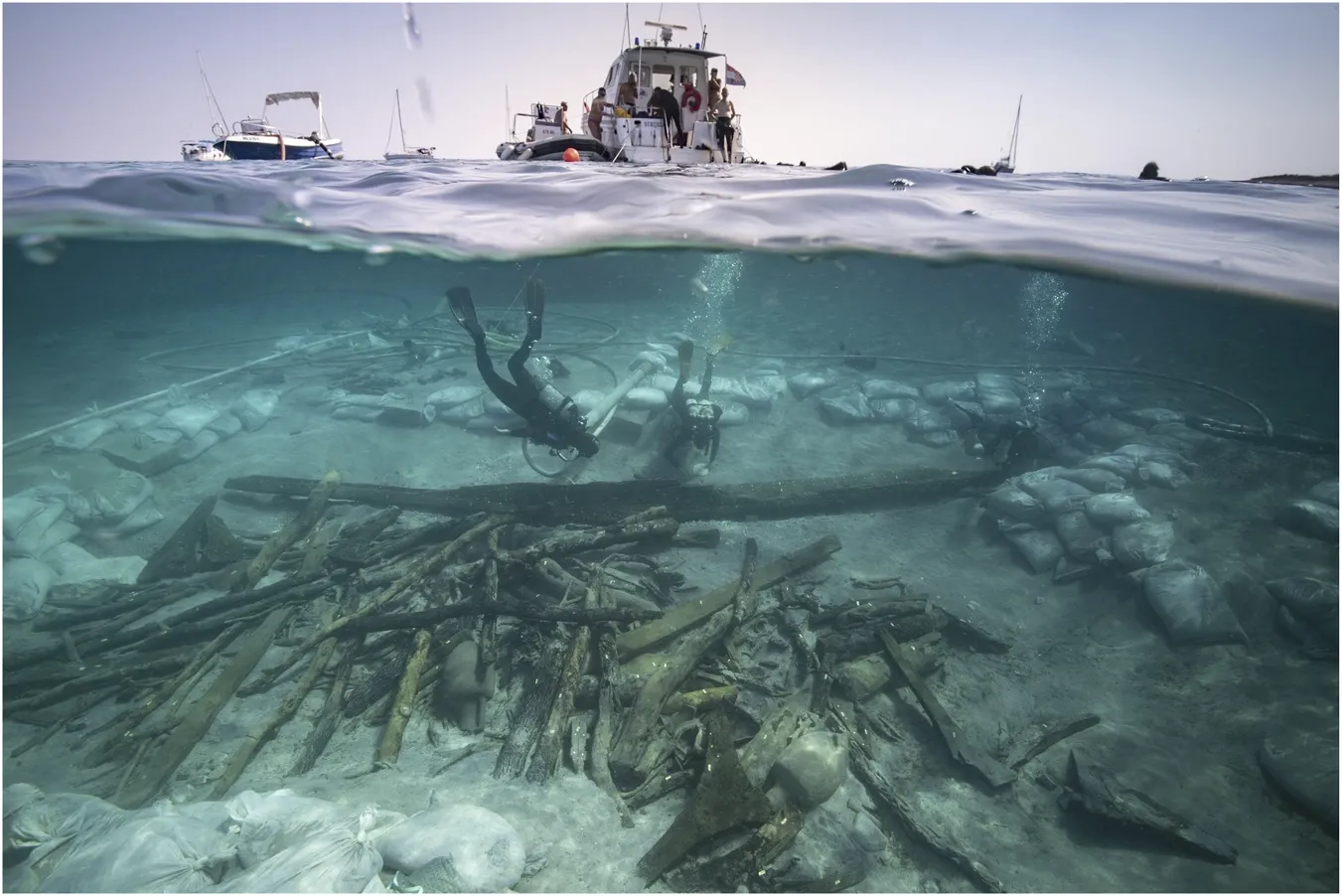
A Roman-era shipwreck off the coast of Ilovik Island is offering a rare, close-up look at how ancient shipbuilders protected their vessels against the constant stress of the sea.
By combining chemical analysis with pollen research, scientists have reconstructed not only the materials used on the ship, but also the environments it moved through and the repairs it likely underwent more than 2,000 years ago.
A Merchant Vessel Preserved in the Adriatic
The wreck, known as Ilovik–Paržine 1, dates to around 170 BC and lies just four meters below the surface in the Adriatic Sea. Discovered in 2016, the site preserved fragments of amphorae, ballast stones, and sections of the wooden hull, placing it firmly within the expanding maritime trade networks of the Roman Republic.
What sets this ship apart is not only its preservation, but the information locked within a largely overlooked feature: its protective coating.
How Roman Shipbuilders Engineered Waterproof Hulls
Surviving the sea required more than solid timber. Ancient shipbuilders developed waterproof coatings designed to seal hulls, repel water, and slow biological decay.
Analysis of the Ilovik–Paržine 1 hull revealed a thick organic layer applied both inside and out. The primary ingredient was pine-derived pitch, produced by heating conifer wood in low-oxygen conditions to create a dense, water-resistant substance widely used in ancient shipbuilding.
This was not a simple coating. It was a carefully prepared material engineered for durability.
Chemical Evidence of High-Temperature Processing
Using gas chromatography–mass spectrometry and infrared spectroscopy, researchers identified molecular markers associated with abietic acid, confirming the use of conifer resin.
More revealing were traces of high-temperature treatment. Certain compounds present in the samples only form when resin is heated above 300°C, indicating that Roman shipbuilders were deliberately refining raw materials to enhance performance rather than applying them in their natural state.
The coating also carried signs of long-term degradation. Its molecular structure reflected prolonged exposure to seawater and microbial activity, offering a timeline of environmental stress.
In one sample, researchers detected beeswax mixed into the pitch. Known in ancient sources as zopissa, this combination would have improved flexibility and made the coating easier to apply, pointing to a practical understanding of material behavior.
Pollen Evidence Maps the Ship’s Movements
While chemistry revealed composition, pollen analysis revealed geography.
Pitch, by its nature, traps microscopic particles from the surrounding environment. By examining pollen grains embedded within the coating, researchers reconstructed the landscapes associated with the ship’s construction and subsequent repairs.
The results pointed to a range of Mediterranean ecosystems, including oak forests, coastal shrublands, and wetland environments.
Crucially, the pollen signatures varied between layers. This indicates that the coating was not applied in a single event, but renewed multiple times using materials sourced from different regions.
Some of these botanical traces align with the environment around Brundisium, a major Roman port and shipbuilding hub. Others point toward the eastern Adriatic coast, including areas of modern Croatia. The ship appears to have been maintained across multiple locations during its operational life.
Layers of Repair Reveal a Working Life at Sea
Detailed analysis identified four to five distinct coating phases. Each layer represents a separate moment of intervention, likely tied to maintenance stops or necessary repairs during voyages.
Taken together, these layers preserve a record of material choices, repair strategies, environmental exposure, and shifting sources of supply. The coating effectively documents the ship’s operational history, capturing decisions made over time rather than a single moment of construction.
Evidence of Knowledge Exchange Across the Mediterranean
The presence of beeswax in the coating suggests possible influence from Greek shipbuilding traditions, which were well established in southern Italy during the Roman Republic.
This detail points to a broader pattern. Shipbuilding knowledge was not confined to a single region, but circulated across Mediterranean networks, shaped by interaction between different maritime cultures.
In that sense, the coating reflects not only technical practice but also the movement of ideas.
A New Way of Reading Ancient Shipwrecks
The Ilovik–Paržine 1 study highlights a shift in archaeological methodology. Rather than focusing only on visible structures such as hull remains or cargo, researchers are increasingly extracting data from microscopic and chemical traces.
This approach allows for a more complete reconstruction of how objects were used, maintained, and adapted over time.
Here, a thin layer of ancient pitch has revealed the technical decisions, environmental conditions, and regional connections that defined the ship’s life.
More Than a Wreck
The Ilovik–Paržine 1 vessel is not simply a preserved artifact from the past. It is a record of continuous use, shaped by maintenance, repair, and adaptation as it moved through the Mediterranean world.
What survives is not just the structure of the ship, but the accumulated knowledge that kept it afloat.
Charrie-Duhaut A, Couillebault Q, Miholjek I and Boetto G (2026) Adhesive coatings in naval archaeology: molecular and palynological investigations on materials from the Roman Republican wreck Ilovik–Paržine 1 (Croatia). Front. Mater. 13:1758862. doi: 10.3389/fmats.2026.1758862
Cover Image Credit: View of the excavation of the bow area of the Ilovik-Paržine 1 shipwreck. In the foreground, the cargo of logs and amphoras can be seen. Archaeologists are working near the structure of the bow complex (Adriboats © L. Damelet, CNRS/CCJ). Charrie-Duhaut A, et. al., 2026