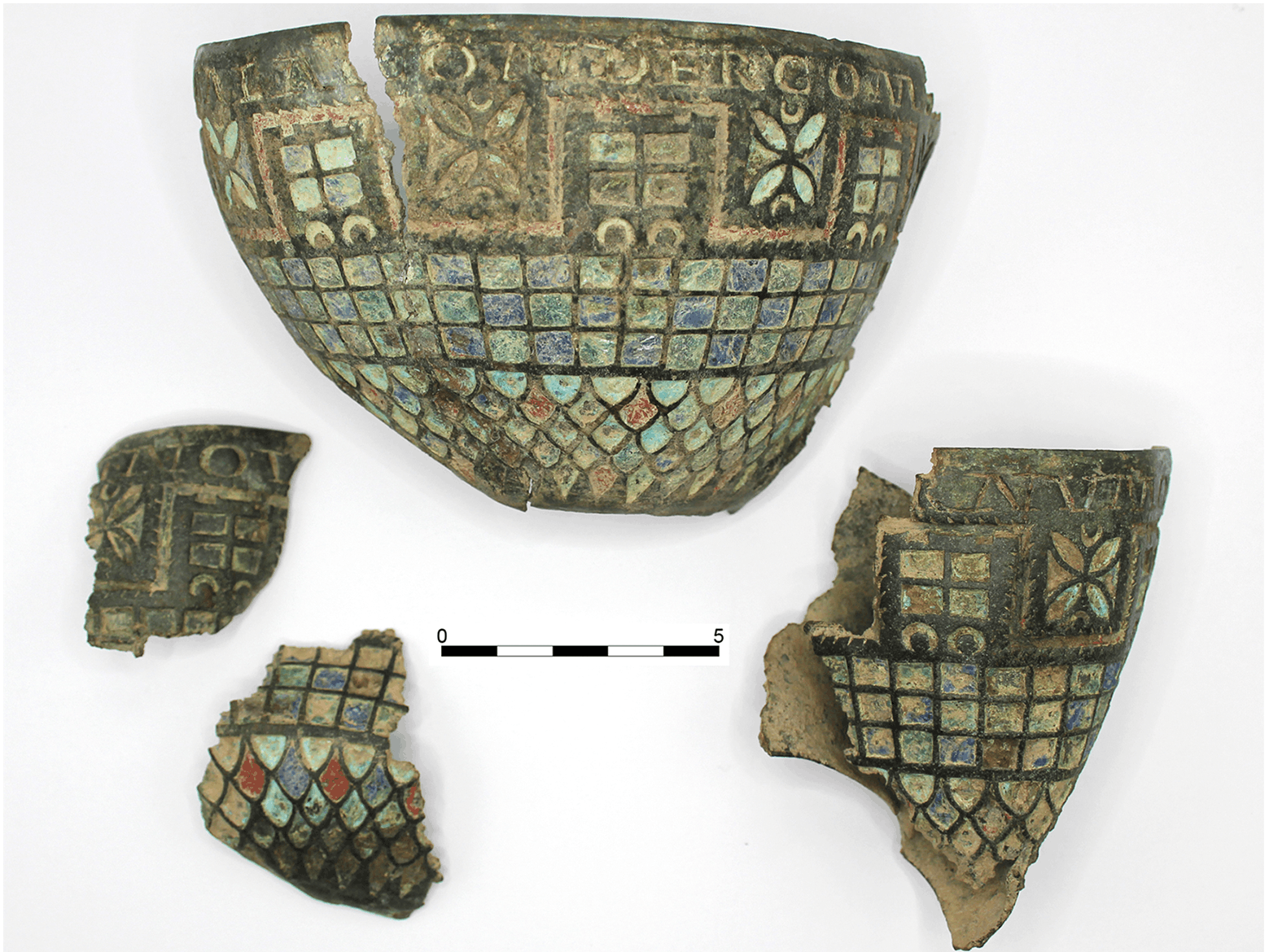
A Roman soldier may have carried this small bronze cup nearly 2,000 kilometers across the empire. Now found in central Spain, the object—known as the Berlanga Cup—is doing something rare in archaeology. It does not just tell us where it was made. It hints at who carried it, where he served, and what he chose to remember when he came home.
This is not just an artifact. It is a personal trace of movement across Rome’s vast world.
A Rare Object That Shouldn’t Be Here
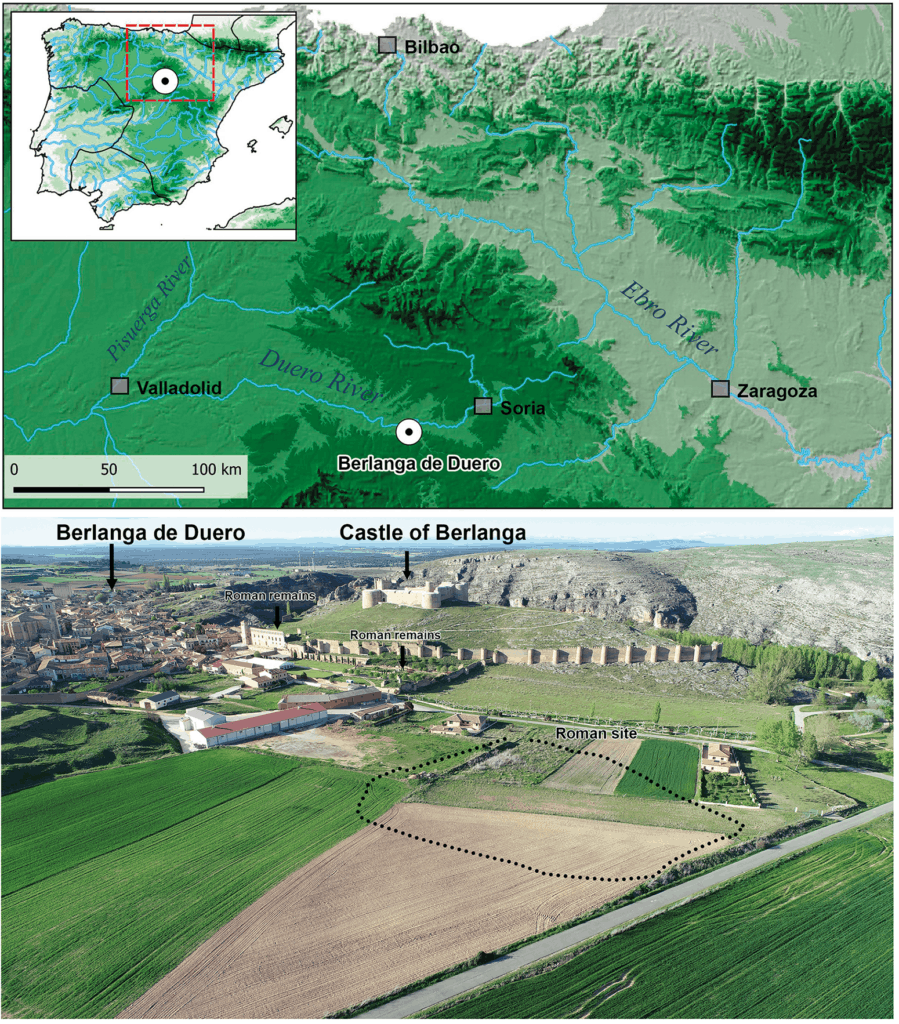
The cup was discovered near Berlanga de Duero, in Spain’s Soria province. It dates to the 2nd century AD and belongs to a very small group of enamelled bronze vessels often referred to as “Hadrian’s Wall pans.”
Only a handful of these objects exist.
But this one immediately stood apart.
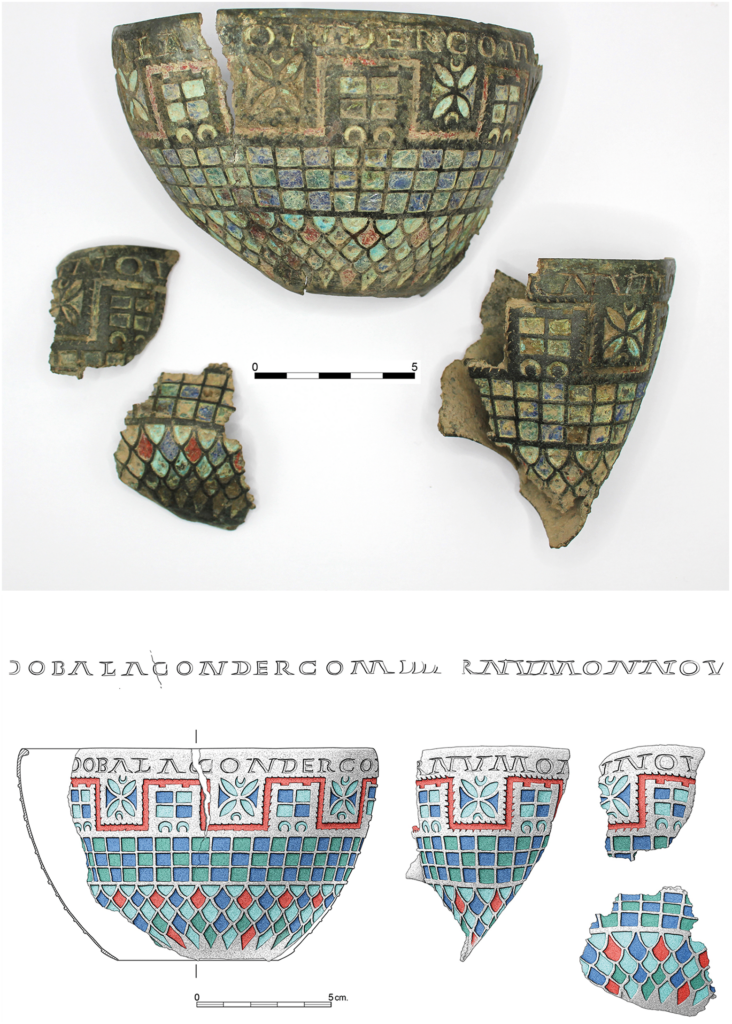
Its inscription lists a sequence of forts from the eastern sector of Hadrian’s Wall—including Cilurnum, Onno, Vindobala, and Condercum. The names are not random. They follow the real geographic order along the Wall.
That detail changes the picture.
It suggests direct familiarity with the frontier. Not second-hand knowledge. Not decorative guesswork. Someone knew this landscape.
The Frontier Behind the Names
Built under Hadrian in the early 2nd century AD, Hadrian’s Wall marked the northern edge of Roman Britain. It stretched across the island as both a barrier and a controlled zone of movement.
But the Wall was never just stone.
It was a lived environment, staffed by auxiliary troops drawn from across the empire. Among them were soldiers from Hispania, including units recruited in regions not far from where the cup was eventually found.
This is where the story tightens.
The object appears in Spain. The inscription belongs to Britain. The connection between the two is unlikely to be accidental.
A Soldier’s Keepsake?
Scholars increasingly view these vessels not as ordinary items, but as prestige objects tied to military service. Some may have been acquired during deployment. Others perhaps marked the end of service.
The Berlanga Cup fits that pattern—but adds distance to it.
Finding such an object nearly 2,000 kilometers from the Wall strongly suggests it traveled with its owner. Most likely, a soldier returned home after serving on the frontier and brought this cup with him.
A quiet souvenir. Or something more symbolic.
Evidence supports that possibility. Units such as the Cohors I Celtiberorum—recruited from central Spain—are known to have served in Roman Britain during this period.
The geography lines up. The timeline fits.
Not a Standard Product
For years, archaeologists debated whether these “Wall pans” were produced as coordinated sets.
This discovery pushes against that idea.
The Berlanga Cup’s inscription is unique. No other known example records this exact sequence of eastern forts. That suggests customization—objects made for individuals, not mass-produced in uniform series.
Each one may have reflected a specific experience.
That matters. It shifts these vessels from decorative curiosities into something closer to personal documents.
Science Confirms the Link
The material tells the same story.
Using portable X-ray fluorescence and lead isotope analysis, researchers traced the metal to sources in Britain, likely in regions such as Wales or northern England. In other words, the cup was almost certainly produced near the frontier it describes.
Its decoration also fits known Roman techniques. Bright enamel in red, green, blue, and turquoise forms geometric patterns and stylized architectural shapes—often interpreted as symbolic references to the Wall itself.
When first recovered, the object was fragmented and partially deformed. A detailed 3D reconstruction has since restored its form, revealing a vessel about 11.3 cm wide and nearly 8 cm tall.
That reconstruction did more than fix the shape.
It allowed researchers to digitally “unroll” the surface, making the inscription easier to read—and confirming the sequence of forts.
The Place It Was Found
The cup did not come from a controlled excavation. It was initially recovered as a chance find at La Cerrada de Arroyo, just outside Berlanga de Duero.
Its significance only became clear later.
Subsequent surveys revealed buried structures in the area, likely part of a Roman rural settlement or villa complex. Pottery, glass fragments, and building remains dated between the 2nd and 4th centuries AD point to sustained occupation.
So the cup was not lost in isolation.
It likely belonged to someone living there—possibly the same individual who carried it back from Britain.
A Small Object, A Wide Empire
The Berlanga Cup does something unusual. It compresses distance.
Britain and Hispania, frontier and homeland, service and return—they all meet in a single object.
It shows how the Roman Empire functioned not just through control, but through movement. Soldiers traveled far from home, lived in unfamiliar environments, and sometimes came back carrying fragments of those experiences.
This cup is one of those fragments.
And with its reference to forts in the eastern sector of Hadrian’s Wall—something no other known example preserves—it fills a gap that had remained open for decades.
A small object. But a precise one.
De Pablo Martínez R, De Luis Mariño S, Garcia Sanchez J, Montero Ruiz I, Aparicio Resco P. The Berlanga Cup. New Evidence of Hadrian’s Wall Pans Found in Hispania Citerior (Spain). Britannia. Published online 2026:1-28. doi:10.1017/S0068113X26100701
Cover Image Credit: Berlanga Cup. Photograph: Roberto De Pablo. Credit: De Pablo Martínez et al. 2026, Britannia