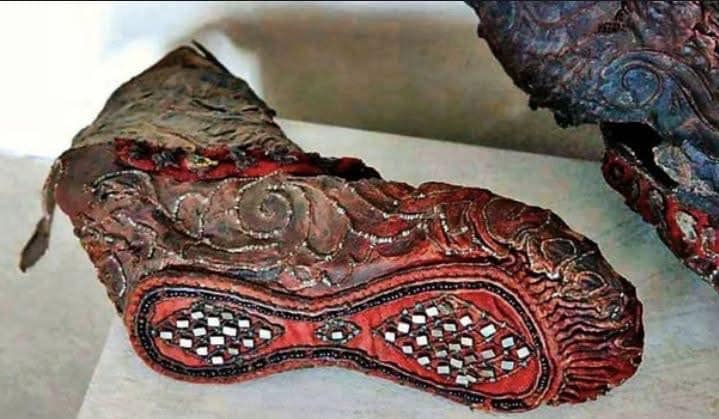
A remarkably preserved 2,300-year-old Saka boot discovered in the frozen burial mounds of the Altai Mountains is offering rare insight into the craftsmanship, fashion, and social identity of ancient Eurasian steppe nomads. Decorated with beads, crystals, and metallic ornaments, the striking red leather footwear stands among the most extraordinary organic artifacts recovered from the famous Pazyryk kurgans.
Unlike most ancient leather objects—which typically deteriorate within decades—the Saka boot survived for more than two millennia thanks to the unique preservation conditions inside the frozen tomb. Archaeologists say the artifact reveals both the technical sophistication of steppe artisans and the cultural importance of decorated clothing within Saka society.
Frozen Burial Mounds of the Altai
The ancient footwear was uncovered during archaeological investigations in the Altai Mountains of Central Asia, a region renowned for its frozen burial mounds belonging to the Pazyryk culture. These kurgans are widely associated with the Saka nomadic groups who dominated vast areas of the Eurasian steppe during the Iron Age.
Pazyryk kurgans were carefully constructed funerary monuments. Deep pits were dug into the ground and fitted with wooden burial chambers where the deceased were placed alongside personal belongings. Jewelry, weapons, horse equipment, clothing, and food offerings were commonly arranged around the body.
After the burial ceremony, the chamber was sealed beneath heavy layers of stone and earth. Over centuries, groundwater infiltrated the mound and froze in the region’s severe climate. This process unintentionally created an ice-filled environment that preserved organic materials rarely found intact in archaeological contexts.
Permafrost: Nature’s Archaeological Time Capsule
The exceptional preservation of the Saka boot is largely due to the permafrost conditions of the Altai Mountains. In most archaeological sites, organic materials such as leather, textiles, and wood quickly decompose. Frozen environments, however, dramatically slow this process.
Inside the Altai kurgans, burial chambers effectively became natural freezers. As a result, archaeologists have recovered an extraordinary range of organic artifacts from the region—including textiles, wooden objects, horse harnesses, and even tattooed human remains.
Such discoveries have transformed scholarly understanding of life among ancient nomadic societies, providing rare evidence of their clothing, craftsmanship, and daily practices.
Intricate Craftsmanship and Decorative Detail
The Saka boot itself demonstrates impressive technical skill. Crafted from soft red leather, the footwear is adorned with a complex arrangement of decorative elements.
Researchers observed that the shoe is embellished with black beads, pyrite crystals, metallic foil, and small glass beads, arranged into intricate patterns. These ornaments reveal a high level of artistic sophistication and suggest that decorated clothing played an important role in steppe social identity.
One particularly unusual feature lies on the underside of the footwear.
The sole of the boot is also decorated with geometric patterns created from pyrite and dark beads—an extremely rare detail in ancient footwear. Because the bottom of shoes is typically hidden, the presence of decoration there has intrigued archaeologists.
Some scholars suggest that the ornamented sole may have been designed to be visible while the wearer sat or knelt on the ground, a common posture in nomadic communities gathered around campfires or inside tents.
If so, the decorated sole may have served as a subtle status symbol, signaling prestige or social position within the group.
A Boot for Daily Life—or Burial Rituals?
Despite the remarkable preservation of the artifact, researchers continue to debate how the Saka boot was originally used.
One possibility is that it belonged to a woman of elevated status within the Saka community. The elaborate decoration and fine craftsmanship suggest the wearer may have been part of the tribal elite.
Another hypothesis proposes that the footwear was produced specifically for funerary rituals. The nearly pristine condition of the sole and the minimal signs of wear could indicate that the boot was created as part of burial attire rather than everyday clothing.
Both interpretations remain under discussion as scholars continue to analyze the artifact and other finds from the Altai kurgans.
A Symbol of the Pazyryk World
Today the extraordinary Saka boot is preserved in the collection of the State Hermitage Museum in St. Petersburg, where it remains one of the most famous artifacts associated with the Pazyryk culture.
More than two thousand years after it was placed inside a frozen tomb, the delicate red leather footwear continues to illuminate the artistry, symbolism, and cultural sophistication of the nomadic societies that once roamed the vast landscapes of the Eurasian steppe.
Cover Image Credit: Kyrgyz American Foundation via Facebook