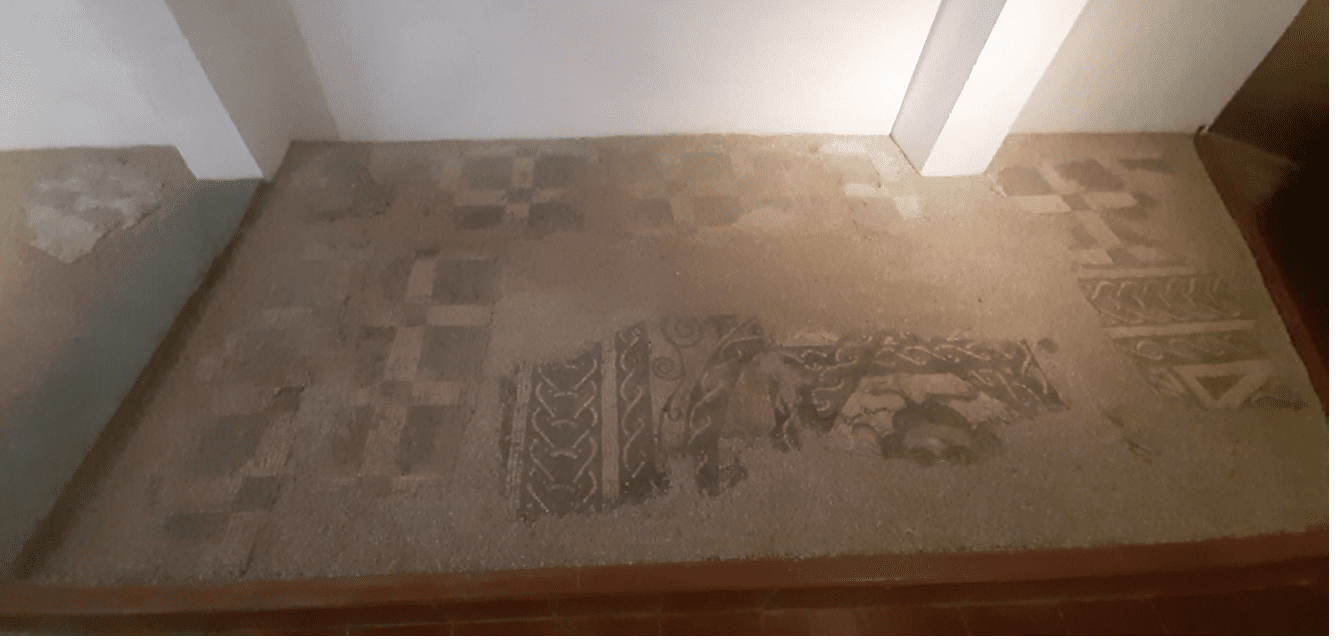
Fragments of two Roman mosaics depicting Hercules and Medusa are offering new insight into the artistic culture of Roman Lusitania, the province that once covered much of present-day Portugal.
The mosaics, now preserved in museums in the Alentejo region, originally decorated elite Roman residences connected to the ancient city of Pax Iulia—modern-day Beja. Although only portions of the original floors survive, the imagery and craftsmanship provide a rare window into how Roman mythology, symbolism, and social identity were expressed inside private homes in the western provinces of the empire.
Researchers recently reexamined the mosaics as part of a broader study of Roman mosaic fragments originating from the territory of Pax Iulia, focusing on their iconography, archaeological context, and the complex history of their preservation.
Pax Iulia and the Roman Landscape of Southern Portugal
During the Roman period, Pax Iulia served as the capital of the Conventus Pacensis, an administrative district of Roman Hispania that covered large areas of southern Lusitania. The fertile countryside surrounding the city supported numerous agricultural estates and prosperous villa complexes connected by Roman roads and trade routes.
Owners of these villas often decorated reception rooms and courtyards with elaborate mosaic pavements. These decorative floors were not simply ornamental; they conveyed wealth, education, and cultural sophistication. Mythological scenes in particular allowed elite homeowners to display familiarity with the shared artistic language of the Roman Mediterranean.
Archaeological surveys across Portugal have documented more than 160 sites containing Roman mosaics, and the number may now approach two hundred as excavations continue. Many pavements, however, were removed during the nineteenth and early twentieth centuries in attempts to protect them from damage, meaning numerous fragments are today preserved in regional museums rather than at their original locations.
The Hercules Mosaic: A Hero in an Unusual Pose
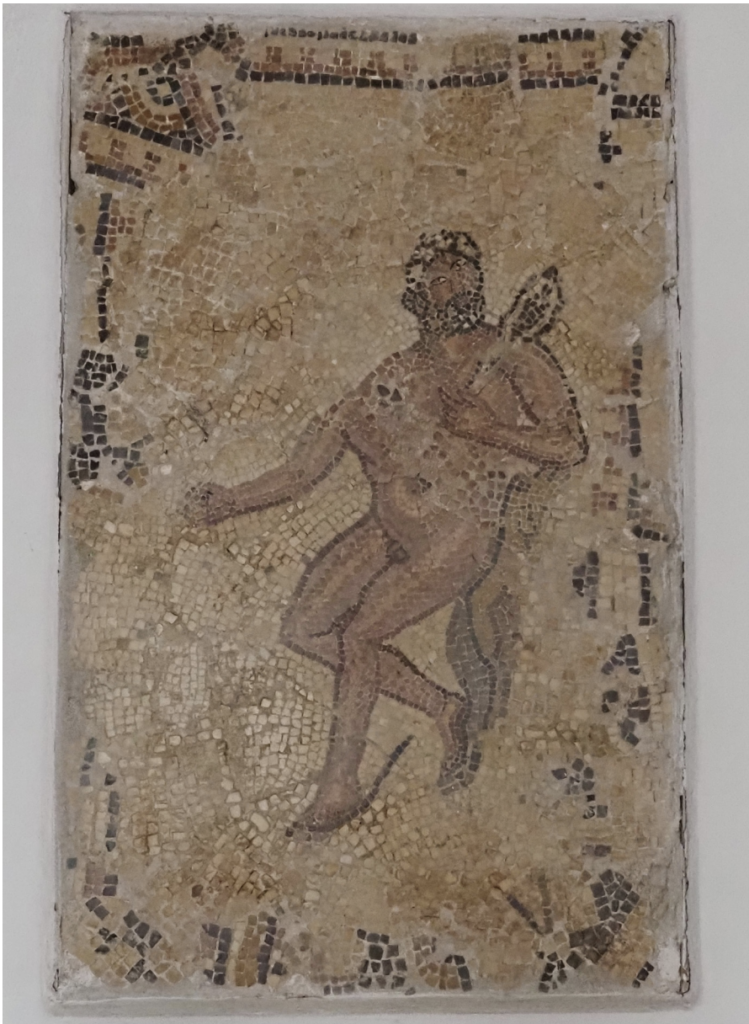
One of the most intriguing pieces from the Pax Iulia territory is a small panel known as the Mosaic of Hercules, discovered in Beja near the Convent of Nossa Senhora da Conceição.
Measuring roughly 1 meter by 0.63 meters, the mosaic shows the legendary hero in a three-quarter pose gripping his characteristic club. Draped across his shoulders is the skin of the Nemean lion, a direct reference to the first of the famous Twelve Labors of Hercules.
Yet the figure’s stance is striking. Hercules appears slightly off balance, with one leg bent and his body leaning forward. Scholars interpret this unusual posture as a possible depiction of a drunken Hercules—a theme occasionally encountered in Roman art but rarely documented in Portugal.
Across the Roman world, artists sometimes portrayed the hero in moments of weakness or intoxication, emphasizing the tension between human vulnerability and heroic virtue. Such imagery carried philosophical meaning: strength and moral excellence, the Roman concept of virtus, were achieved through overcoming human frailty.
Comparable scenes appear in mosaics discovered in Spain, southern France, and North Africa, where Hercules is sometimes accompanied by satyrs or the god Mercury.
For Roman villa owners, displaying such imagery inside the home was not merely decorative. Mythological scenes functioned as cultural statements, reflecting ideals of strength, resilience, and cultivated identity.
Medusa and the Protective Power of Myth
A second mosaic fragment studied by researchers comes from the Roman villa of Monte do Meio, near São Brissos in the Beja region.
The surviving section preserves the upper portion of Medusa’s head, recognizable by the snakes twisting through her hair and the intense gaze typical of Roman Gorgon imagery.
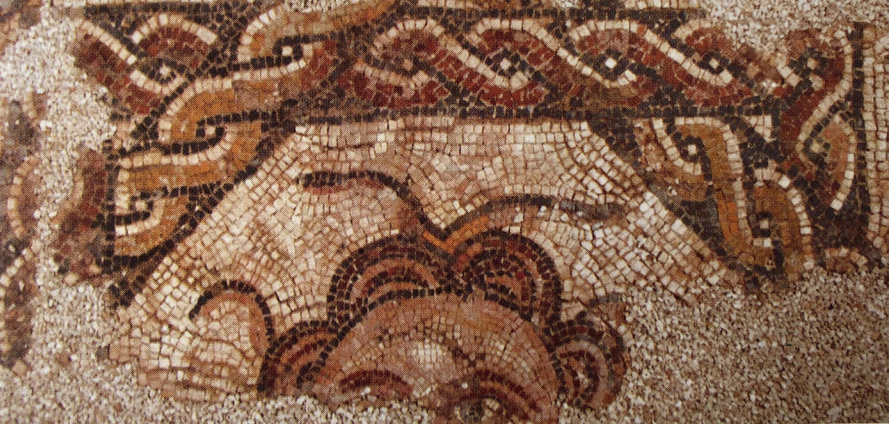
Earlier interpretations had suggested the figure might represent the Roman deity Vertumnus, but stylistic and iconographic analysis now clearly identifies the figure as Medusa, the only mortal among the three Gorgons of Greek mythology.
In Roman art, Medusa’s image frequently served an apotropaic purpose—that is, it was believed to ward off evil influences. Placing her face at the center of a mosaic floor symbolically protected the household and its inhabitants.
The original pavement where the fragment was discovered likely featured a geometric composition organized around an eight-pointed star created by intersecting squares, framed by plant motifs and ornamental borders.
The Challenge of Preserving Portugal’s Mosaic Heritage
The history of these mosaics also reflects the complicated legacy of archaeological conservation in Portugal.
During the nineteenth and early twentieth centuries, excavations often prioritized recovering visually striking artifacts rather than carefully documenting their archaeological context. Mosaic fragments were frequently detached from their original floors and transferred to museums, sometimes even distributed as gifts to collectors or curators.
Systematic restoration methods only began to develop in the mid-twentieth century, particularly after major discoveries at the Roman villa of Torre de Palma, which prompted collaboration with Italian conservation specialists.
Today, conservation work on Portuguese mosaics is largely carried out by the Conímbriga Mosaic Restoration Workshop, where specialists stabilize fragments and restore pavements recovered from archaeological excavations across the country.
Windows into Roman Domestic Life
Although the Hercules and Medusa panels represent only small sections of much larger floors, they illuminate the cultural world of Roman elites living in Lusitania nearly two thousand years ago.
Inside these villas, mythological figures, geometric patterns, and symbolic imagery transformed everyday domestic spaces into carefully curated environments that communicated identity, learning, and status.
In this sense, the mosaics of Pax Iulia are more than decorative remnants of the Roman past. They reveal how the inhabitants of Roman Portugal engaged with a shared Mediterranean artistic tradition while adapting it to local tastes and social ambitions.
Abraços, M. F., & Wrench, L. N. C. (2025). Study of two Roman mosaics from the area of influence of the Pax Iulia civitas (Conventus Pacensis) housed at the Regional Archaeological Museum of Beja and the Museum of Archaeology of the Castle of Vila Viçosa (Alentejo): Mosaic documentation, restoration and conservation procedures. Journal of Mosaic Research, 18, 1–13. https://doi.org/10.26658/jmr.1813596
Cover Image Credit: The “Mosaic of Medusa”, Museum of Archaeology of the Castle of Vila Viçosa, ©Fundação Casa de Bragança. Credit: Abraços & Wrench, 2025