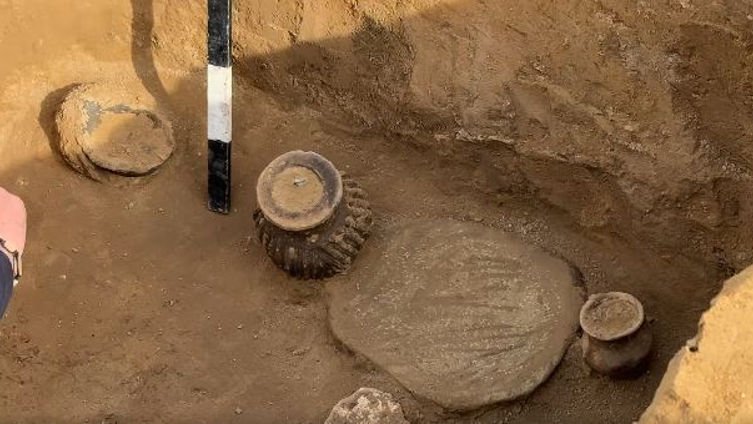
A 2,300-year-old Scythian tomb has been uncovered beneath a burial mound near Gura Bîcului in eastern Moldova. Inside the burial chamber, researchers found ceramic vessels, arrowheads, beads, a knife with its sheath, a rare incense burner, and a worked stone that may have served as a small ritual altar.
The discovery was made in a tumulus necropolis near Gura Bîcului, in the Anenii Noi district. Dated to the 3rd century BCE, the tomb is linked to the Scythian cultural horizon and offers new evidence for funerary practices in the Lower Dniester region during the Late Iron Age.
A Burial Chamber Beneath the Tumulus
The tomb consists of an entrance shaft, a burial chamber, and a passage known as a dromos. This layout suggests a carefully prepared funerary space rather than a simple grave. The architecture points to a deliberate arrangement in which the body, grave goods, and ritual elements were placed within a defined setting.
The objects found inside the chamber bring together two sides of Scythian life. The arrowheads and sheathed knife recall the martial world often associated with Scythian communities. The incense burner, beads, ceramic vessels, and worked stone point instead to a more ceremonial layer of the burial.
Rare Incense Burner and Ritual Stone Draw Attention
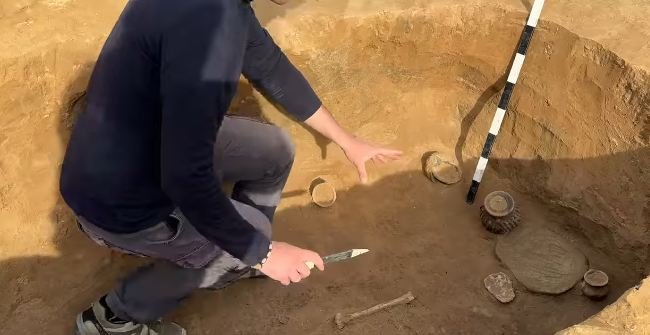
One of the most striking finds is the ceramic incense burner recovered from the burial chamber. Objects of this kind can be linked to scent, smoke, purification, or symbolic acts performed during ancient funerary rites.
The worked stone found nearby adds another important detail. According to the excavation team’s preliminary assessment, the object may have functioned as a small altar. Its exact purpose will require further study, but its presence alongside the incense burner strengthens the idea that the tomb was not furnished only with weapons and personal belongings.
There is a quieter but more revealing story here. Scythians are often remembered as mounted warriors of the Eurasian steppe, associated with arrows, mobility, and frontier landscapes. The Gura Bîcului tomb brings another side of that world into view: ritual practice, symbolic objects, and the treatment of the dead.
Scythian Traces Near the Dniester
Gura Bîcului’s location near the Dniester basin gives the discovery wider archaeological importance. In antiquity, this region formed part of a contact zone between steppe groups north of the Black Sea and local settled communities.
For that reason, the tomb is not only the burial of one individual. It also forms part of a broader picture of Scythian presence in Moldova and the cultural landscape of the Lower Dniester during the Late Iron Age.
Further analysis of the human remains, ceramics, and grave goods may clarify the identity of the person buried there. Age, sex, health, and social status could become clearer as the study continues.