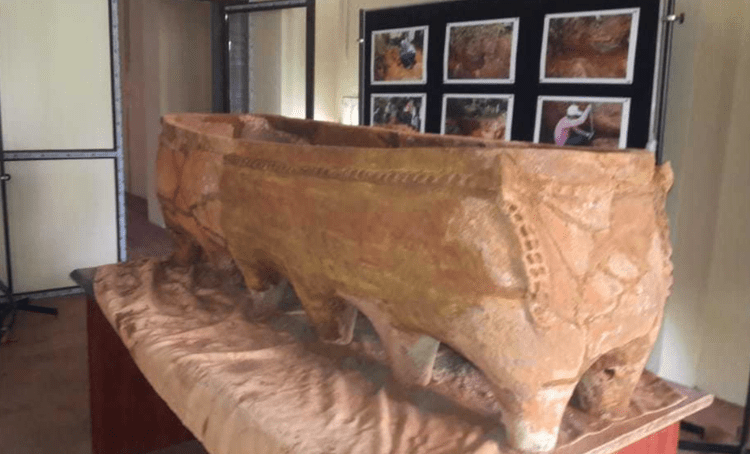
In the crowded urban sprawl south of Chennai, history has surfaced in the most unexpected way. Beneath roughly two meters of soil in Pallavaram, archaeologists have uncovered a 2,300-year-old terracotta sarcophagus resting on twelve carefully crafted legs — a discovery that is reshaping our understanding of early historic cultures in southern India.
A Rare Megalithic Burial Structure
The burial structure was discovered during excavations led by the Archaeological Survey of India (ASI). Measuring approximately 170 centimeters in length, 45 centimeters in width, and about 50 centimeters in depth, the baked clay coffin immediately stood out for its unusual design.
Instead of resting flat on the ground, the sarcophagus is supported by twelve distinct terracotta legs — a feature rarely documented in South Indian burial archaeology.
According to ASI Superintending Archaeologist Amv Subramanyam, the find provides compelling evidence of a settled and technologically skilled community in the 3rd century BCE. The craftsmanship suggests not only advanced ceramic production but also a sophisticated approach to funerary architecture.
“This terracotta coffin indicates the presence of an organized society with the capability to produce complex burial containers,” Subramanyam noted.
Rethinking Early Historic Tamil Nadu
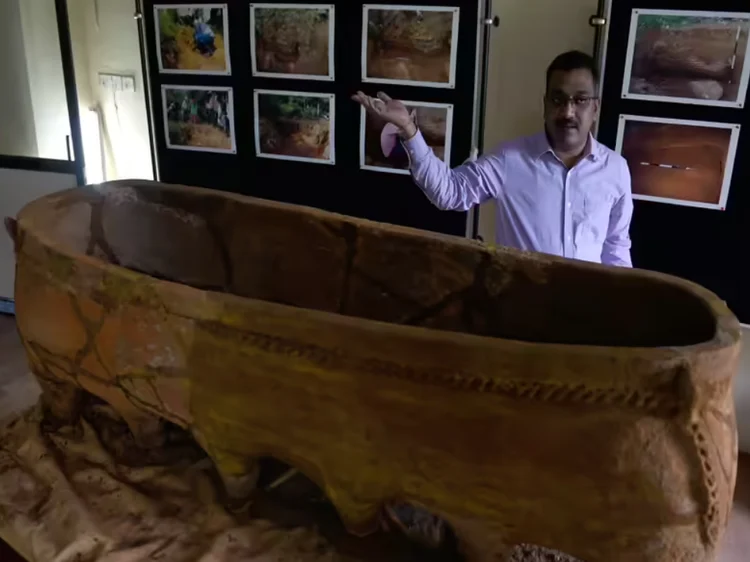
The sarcophagus is believed to date to around the 3rd century BCE, a period marked by expanding trade networks and cultural exchange across southern India. The elaborate construction challenges outdated assumptions that communities in the region were predominantly nomadic.
Instead, the twelve-legged coffin supports the idea of a structured, socially organized population with defined burial customs — possibly reflecting hierarchy, ritual symbolismor status distinctions within the community.
The find also reinforces Pallavaram’s long-standing archaeological importance. More than a century ago, British archaeologist Alexander Rea documented another ancient coffin in the Pallavaram hills, indicating the site’s deep historical layers. However, systematic excavations were delayed for years due to land disputes, only resuming after a court ruling cleared the way late last year.
Scientific Analysis and Future Research
To establish the coffin’s precise chronology, ASI plans to conduct thermoluminescence dating — a method particularly suited for fired ceramics. Further laboratory analysis may reveal insights into burial rituals, material sourcing, and technological techniques used in early historic Tamil Nadu.
The discovery underscores both the archaeological richness of Pallavaram and the urgent need for careful preservation amid rapid urban development.
As excavations continue, researchers hope this remarkable twelve-legged sarcophagus will illuminate not only how people in southern India buried their dead — but how they organized their lives more than two millennia ago.