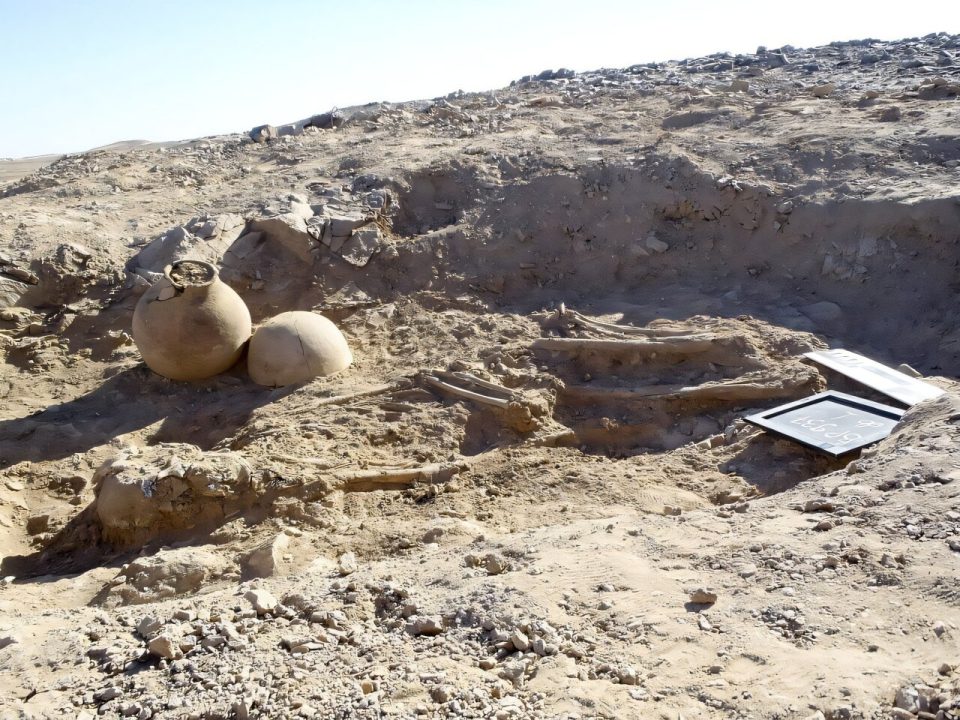
A 4,000-year-old grave uncovered in Sudan’s remote Bayuda Desert is offering new insights into Kerma burial customs and the region’s ancient environment. The discovery, made by Polish archaeologists, sheds light not only on funerary practices but also on daily life in a semi-desert landscape that once looked very different from today.
The excavation is being carried out by a team from the Polish Centre of Mediterranean Archaeology, led by Henryk Paner. Their interdisciplinary findings were recently published in Azania: Archaeological Research in Africa.
A Kerma Period Burial in a Little-Studied Landscape
Located in central Sudan, the Bayuda Desert remains one of the least systematically studied regions of the country. Although some limited excavations took place in the mid-20th century, large-scale archaeological research only began in the 21st century.
One of the graves uncovered by the Polish team dates to the Kerma period (c. 2500–1500 BC), associated with the powerful Nubian Kingdom of Kerma. The burial pit was shallow and irregular in shape, its form influenced by the rocky ground.
The deceased was laid on his back, with his head facing east, slightly angled north. His legs were sharply bent to the right, with the feet resting on the pelvic bones—a position characteristic of earlier Kerma burials.
Ceramics, Rituals, and Funeral Fire
Behind the body, archaeologists found two handmade ceramic vessels: a medium-sized spouted jug placed close to ground level and an inverted bowl. The jug contained charred plant remains, fragments of animal bones coprolites, and beetle parts.
Because the vessel itself showed no signs of burning, researchers believe these materials were intentionally placed inside after being exposed to fire elsewhere. The animal bones may represent leftovers from a funeral feast that were symbolically consigned to flames rather than consumed.
In Kerma burials, pottery was more than a simple container. It could serve as a social or individual marker. The team suggests that deliberately puncturing, inverting, or otherwise altering vessels may have symbolically “deactivated” them—an act consistent with ritual practices linked to ancestor veneration and transformation of the dead.
Evidence of a Hard Life—and a Different Climate
Biological and pathological analysis of the skeleton indicates that the man lived under physically demanding semi-desert conditions. Signs of high physical exertion suggest long working hours, a limited diet, and close proximity to animals—perhaps livestock herding or related labor.
Environmental mapping of the cemetery area adds another dimension to the story. Around 4,000 years ago, the landscape appears to have been less arid than today. The burial hill, now set within a harsh desert environment, may once have resembled a savannah, with grasses, shrubs, and scattered trees.
According to Dr. Paner, even a modest grave can provide substantial information when examined through a cross-disciplinary lens. In this case, the burial contributes not only to our understanding of Kerma funerary traditions but also to the reconstruction of ancient climates in northeastern Africa.
Cover image: State of preservation of the skeleton from Grave 1, a Kerma-period burial discovered in Sudan’s Bayuda Desert. Credit: A. Pudło / Badura et al., 2025