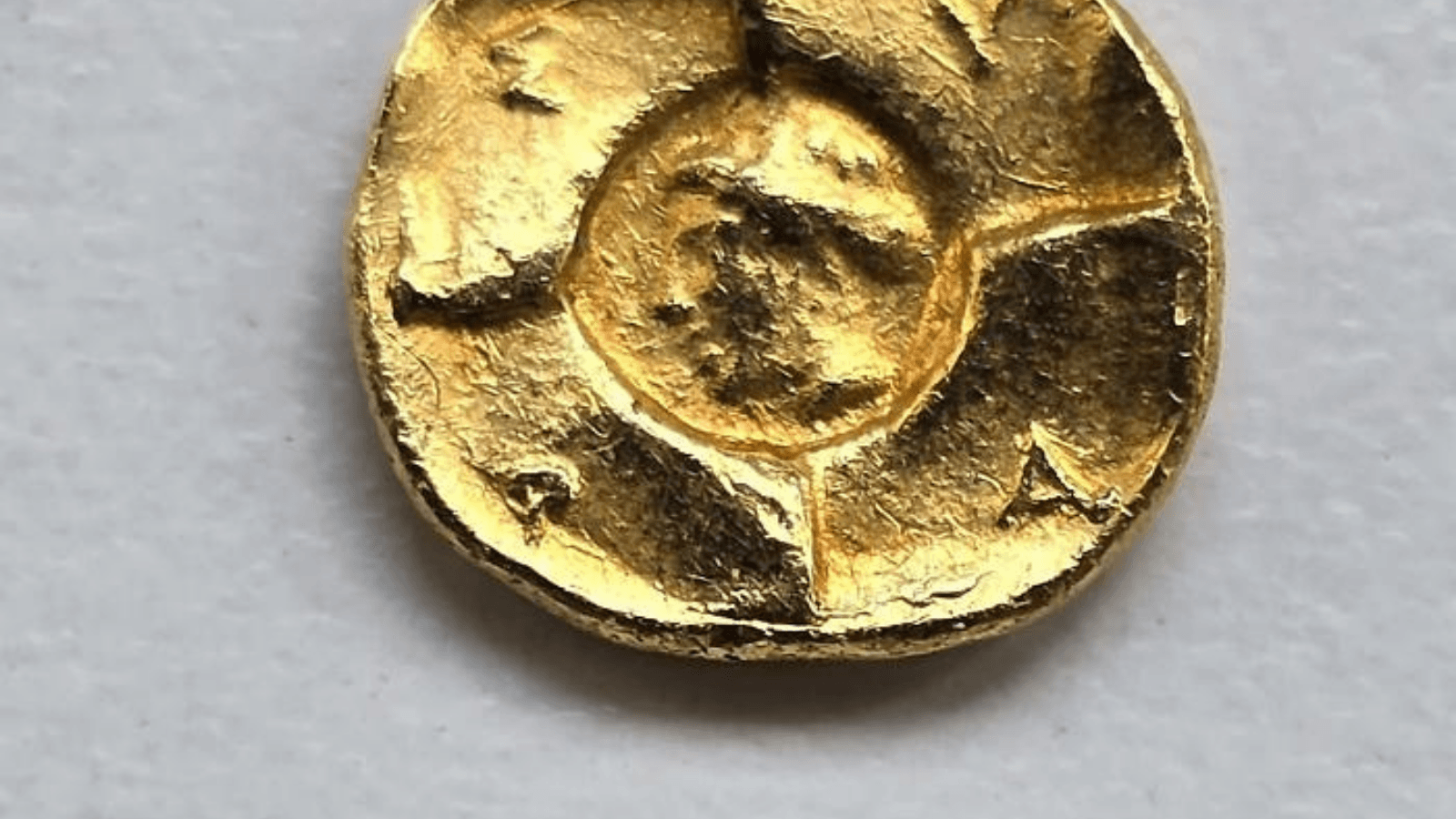
A rare gold coin struck in Syracuse during the Carthaginian invasion of Sicily has been discovered at ancient Akragas, almost exactly where archaeology and history intersect at one of the city’s most turbulent moments.
The coin was recovered during an emergency excavation at the Maddalusa necropolis near modern Agrigento, on Sicily’s southern coast. Archaeologists had been working to recover a Greek-period tile-covered tomb from dunes west of the mouth of the Akragas River when the gold piece came to light.
What makes the find particularly significant is its timing. The coin belongs to a series issued by Syracuse at the end of the 5th century BC, when Greek cities in Sicily were struggling against a major Carthaginian offensive. Akragas itself fell to Carthaginian forces in 406 BC.
The small gold object therefore comes from the same narrow historical window in which one of the wealthiest Greek cities in the western Mediterranean was besieged, captured and profoundly transformed by war.
A Syracusan coin in the territory of Akragas
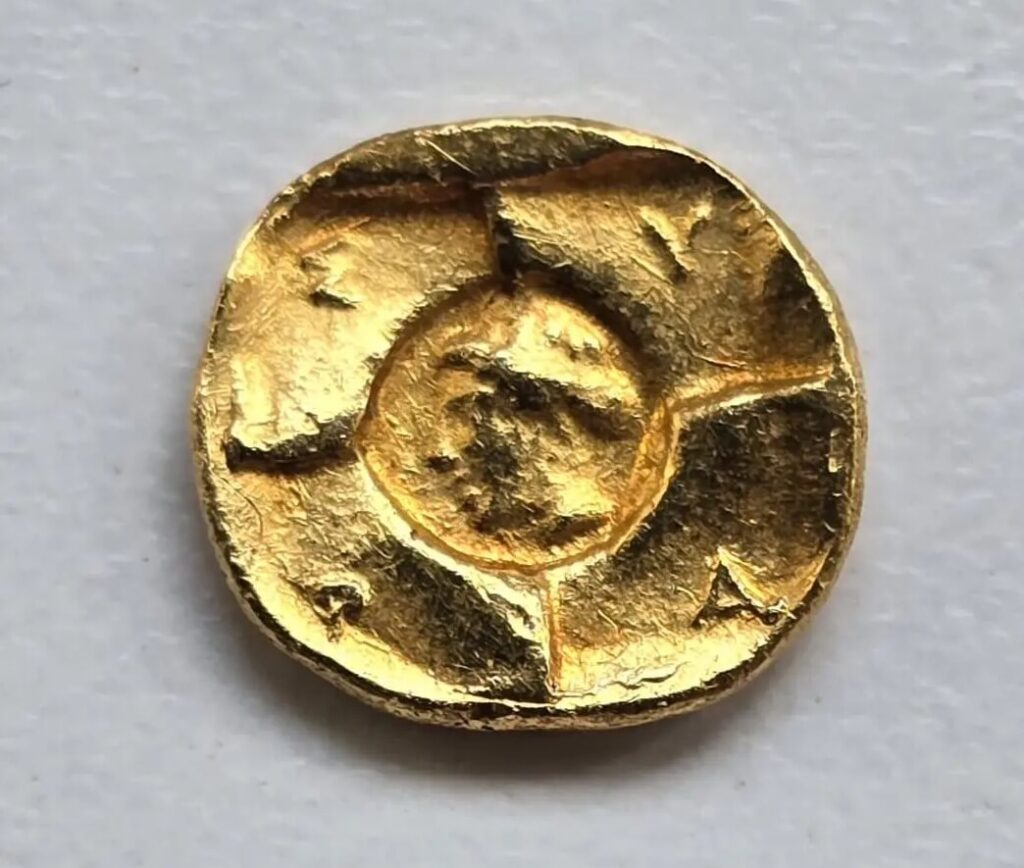
The coin is exceptionally well preserved. On one side is the head of Heracles facing left, wearing the skin of the Nemean Lion. On the other is a four-part incuse square containing a small female head at its center. The letters forming “SYRA” identify the issuing authority as Syracuse.
Numismatic parallels closely match a Syracusan gold denomination known as the 20 litrai, associated with the early rule of Dionysius I and generally dated to around 405–400 BC. Catalogued examples of the type weigh approximately 1.16 grams and show the same Heracles portrait, quadripartite incuse design and abbreviated Syracusan inscription.
Syracuse and Akragas had been allied during the conflict. According to the Sicilian regional authorities, Syracuse produced extraordinary gold issues at this time to support the war effort against Carthage, and the newly discovered coin belongs to that wartime series.
Its discovery at Akragas therefore gives the coin a historical and archaeological context that an isolated specimen without a recorded provenance would not provide.
Sicily was being reshaped by war
By the late 5th century BC, the balance of power in Sicily was changing rapidly.
Carthage launched a major military offensive against the Greek cities of the island beginning in 409 BC. Selinunte and Himera were among the cities overwhelmed during the first campaigns.
Founded by Greek colonists in the early 6th century BC, had grown into a major political and economic center. Its temples and monumental architecture still testify to the wealth accumulated during its classical flourishing.
After a prolonged siege, the city was captured by the Carthaginians in 406 BC. Syracuse subsequently became the principal Greek power resisting further Carthaginian expansion. Dionysius I rose to power there in 405 BC, at the height of the crisis, and would spend much of his long rule alternating between war and uneasy settlements with Carthage.
Against that background, gold coinage was not simply a matter of commerce. Sicilian authorities connect this series with the extraordinary financial demands created by the conflict, placing the newly discovered coin within the wartime economy of Greek Sicily.
The coin’s archaeological context
The official announcement states that the coin was found during the emergency excavation of a Greek-period tomb at Maddalusa, but it does not say that the gold piece was found inside the grave or that it was deliberately deposited as a funerary offering.
Without further excavation data, it would be premature to identify the coin as belonging to the person buried there. It could have reached the area through deliberate deposition, circulation, loss or another process not yet established.
What can be said with considerably more confidence is that the coin comes from an archaeological landscape that was still in use during the same period in which Akragas was experiencing the consequences of the Carthaginian invasion.
A necropolis used until the end of the 5th century BC
Maddalusa was one of the extensive burial areas associated with ancient Akragas.
Archaeological discoveries made there since the 19th century have revealed a necropolis extending for more than three kilometers along the coastal zone and nearby elevated ground. Its earliest burials date to the first quarter of the 6th century BC, close to the first generations of the Greek city, while the cemetery continued to be used until the end of the 5th century BC.
The Syracusan gold issue therefore comes from an archaeological setting directly associated with Akragas during the closing decades of its Classical-period necropolis. More detailed publication of the excavation may eventually clarify exactly how the coin was deposited and whether it had any direct relationship with the nearby burial.
For now, the discovery provides a rare material connection between two closely linked events: Syracuse’s efforts to finance its resistance to Carthage and the upheaval that engulfed Akragas when the city fell in 406 BC.