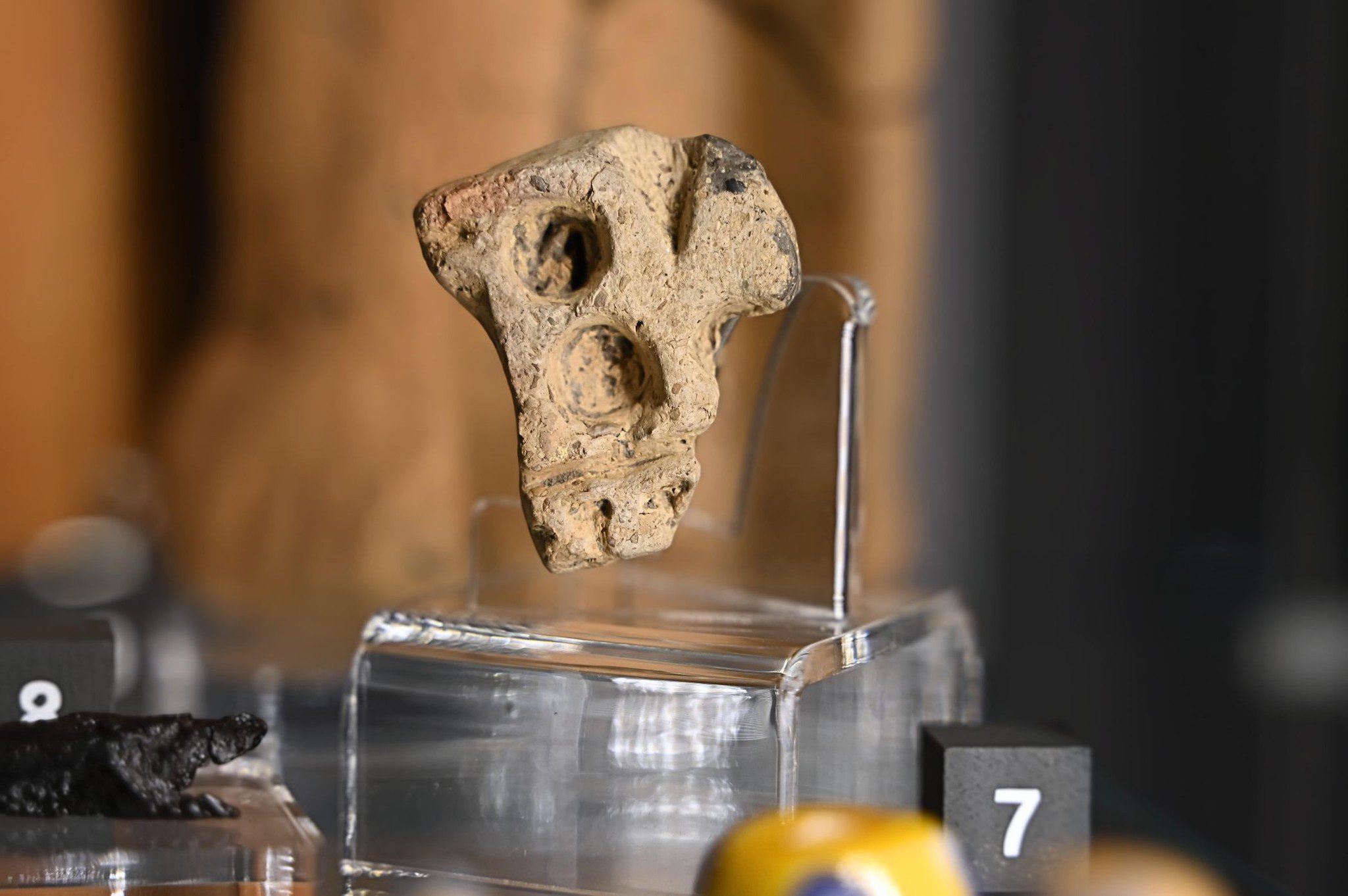
A small clay object unearthed in southeastern Poland may rewrite part of the country’s Early Iron Age story. Archaeologists believe a 2,500-year-old artifact discovered near Jarosław could represent the first pintadera ever identified on Polish soil — a clay stamp likely used to decorate textiles or apply pigment to the human body.
The object was found in 2011 in the village of Nienowice during rescue excavations ahead of construction of the A4 motorway. The dig revealed a settlement dating from the 6th to the 3rd–2nd centuries BCE, first associated with the Pomeranian culture and later influenced by groups linked to the Jastorf cultural sphere.
A Small Object with Big Implications
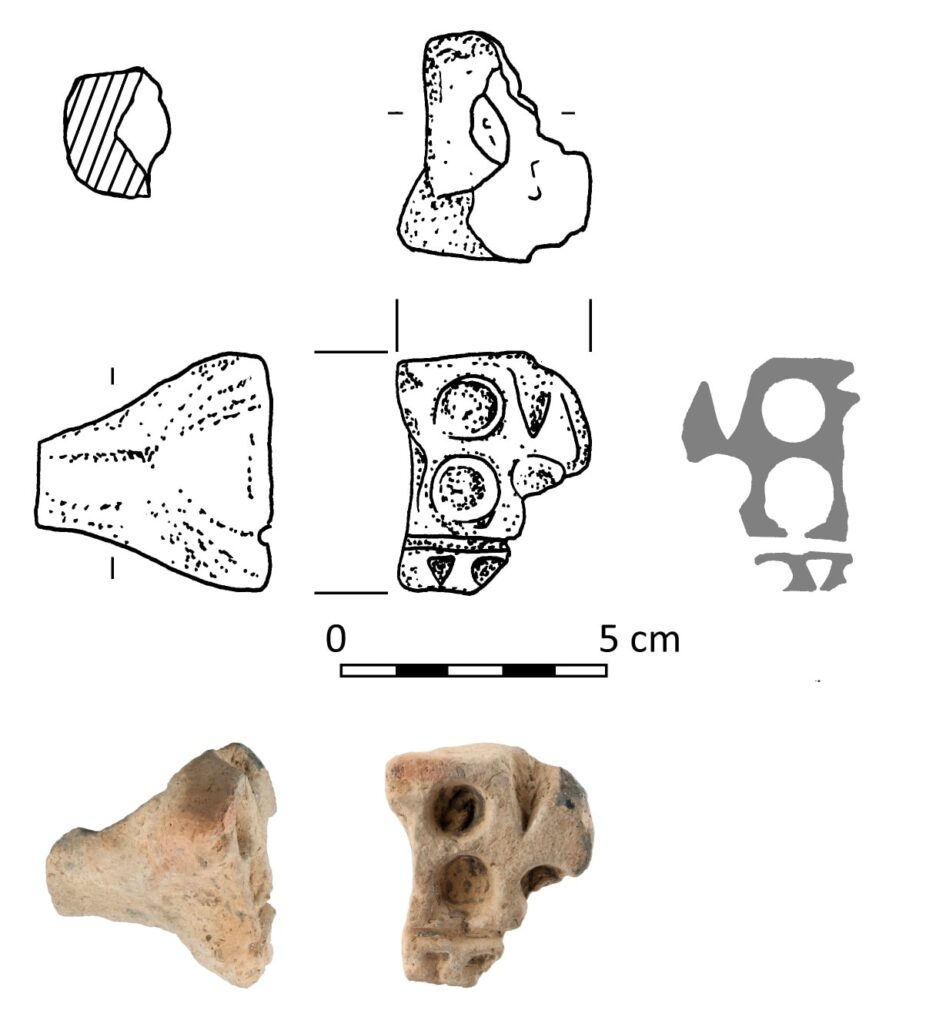
Measuring just 4.3 centimeters high, the artifact takes the form of an irregular clay pyramid with concave sides and a broken handle. Its flat base — decorated with incised lines, triangular motifs, and circular indentations — initially puzzled researchers. Early interpretations suggested it might have belonged to a figurine or a pedestal associated with domestic ritual practices.
However, further study led Dr. Marcin Burghardt of the Muzeum w Jarosławiu Kamienica Orsettich to propose a different explanation: the object closely resembles clay stamps known as pintaderas.
Pintaderas are especially characteristic of communities from the Great Hungarian Plain during the Early Iron Age, often associated with the Vekerzug culture. These objects, typically dated to the 6th and early 5th centuries BCE, are frequently found in female graves alongside pigment containers and cosmetic tools.
Textile Decoration or Body Art?
The Nienowice artifact appears to be a negative-type stamp, meaning it likely created patterned background effects rather than raised designs. According to Dr. Burghardt, it may have been used in a resist-dyeing process. Wax or resin could have been applied to fabric using the stamp, after which the textile would be immersed in dye, leaving geometric motifs visible where the surface resisted coloration.
Such techniques suggest technical knowledge and aesthetic sophistication within Iron Age communities of Central Europe.
Researchers also note that geometric ornamentation carried symbolic meaning in many prehistoric societies. The possibility of ritual or magical use therefore remains open.
Evidence of Long-Distance Connections
If confirmed, this would be the first pintadera identified in Poland. Yet it is not the only sign of broader cultural links at Nienowice. Excavations have revealed yellow glass beads, distinctive spindle whorls, and some of the earliest wheel-made pottery known in Poland — all pointing to active exchange networks connecting southeastern Poland with the Carpathian Basin more than two millennia ago.
Konrad Sawiński, director of the Muzeum w Jarosławiu Kamienica Orsettich, emphasized that discoveries of this kind demonstrate the region’s role as a prehistoric crossroads rather than a peripheral zone.
Today, the artifact is on public display at the museum in Jarosław. As research continues, archaeologists hope to determine its function with greater certainty. Whether a tool of textile production, body decoration, or ritual symbolism, the modest clay stamp from Nienowice is already reshaping perspectives on Poland’s place within ancient European cultural networks.
Cover Image Credit: Muzeum w Jarosławiu Kamienica Orsettich via Facebook