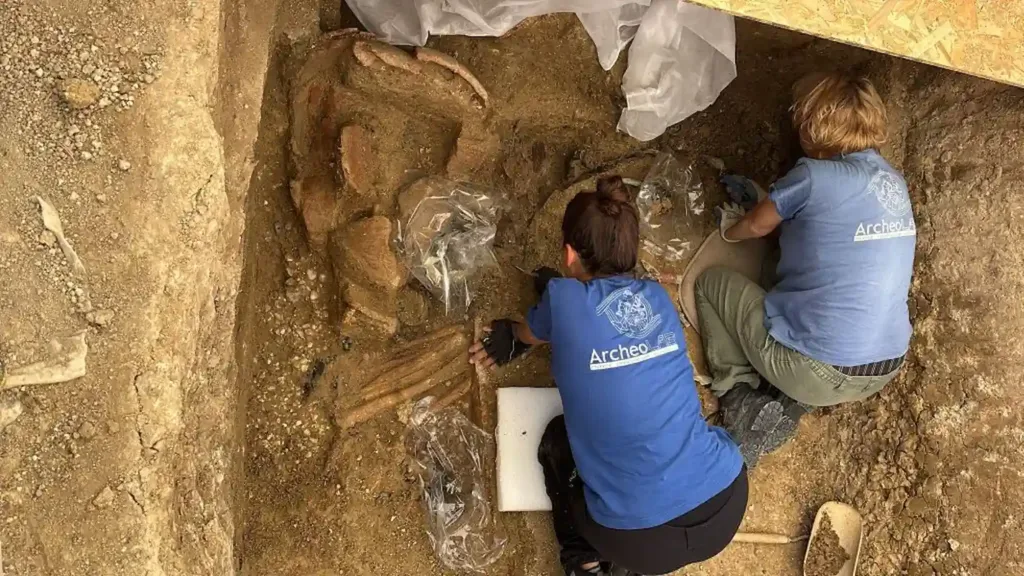
Archaeologists near Sirolo, on Italy’s central Adriatic coast, have uncovered a 6th-century BC Picene funerary complex centered on a high-status male burial with a two-wheeled chariot, weapons, and large bronze vessels still sealed with ceramic lids.
The discovery was announced by the Soprintendenza Archeologia, Belle Arti e Paesaggio for Ancona and Pesaro-Urbino, following preventive archaeology investigations carried out by ArcheoLab in collaboration with the municipality of Sirolo. The work was supported by extraordinary funding from Italy’s Ministry of Culture.
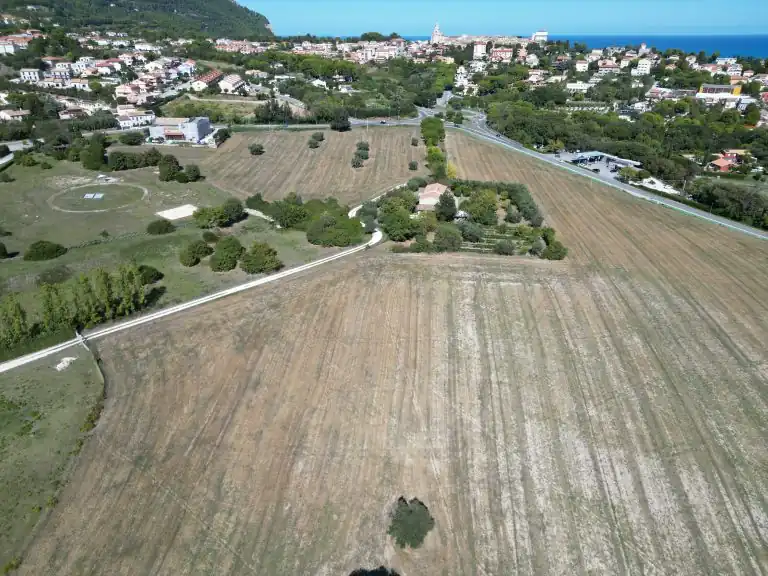
The complex lies near the I Pini necropolis of Sirolo, not far from the famous Queen’s Tomb of the Sirolo-Numana area. For archaeologists, the new find is especially useful because it helps place a warrior tomb discovered in 2020 on Via del Leccio within a wider aristocratic cemetery, rather than treating it as an isolated burial.
A chariot burial at the center of the monument
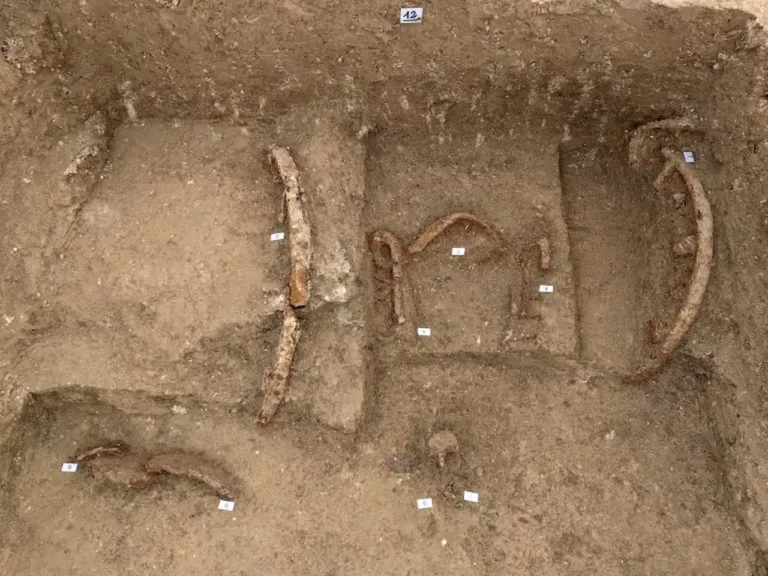
At the center of the newly identified funerary circle, archaeologists found a large male tomb containing the remains of a currus, a two-wheeled chariot probably placed intact inside the burial pit. In Picene and pre-Roman Italian funerary contexts, such vehicles are usually associated with very high rank.
The grave also contained weapons, including a helmet, axe, and other offensive arms. Some finds are still undergoing restoration and study, so their meaning should not be pushed too far yet. Even so, the combination of chariot, weapons, and monumental setting makes the burial one of the clearest recent examples of elite funerary display from the Conero area.
The official statement describes the tomb as “princely,” a term commonly used in Italian archaeology for richly furnished elite graves of the Iron Age. It does not necessarily identify the dead man as a ruler in the later political sense. What the burial shows more securely is that his community invested heavily in presenting him as a person of rank, military identity, and inherited authority.
Sealed vessels and traces of a burial feast
Among the most unusual finds are several large bronze sheet containers recovered from the chariot tomb. They were sealed with ceramic lids and still contained organic material, ceramic fragments, and animal bone remains. According to the excavation team, the contents may preserve traces of a funerary banquet or food offerings placed with the dead.
That interpretation will need laboratory analysis. If residues can be identified, the vessels could offer rare evidence for what was consumed, offered, or deposited during a high-status Picene funeral.
The vessels also fit a broader pattern seen in elite graves across pre-Roman Italy. Banqueting equipment was not simply practical. It helped define status in public and ritual terms. A tomb like this presented the dead man not only as a warrior, but also as someone connected to aristocratic customs of feasting, display, and exchange.
A palisade instead of the usual ditch
The monument’s architecture adds another important detail. Large funerary circles in the Conero and Picene landscape are generally marked by ring-shaped ditches cut into the ground, often with a V-shaped section. At Sirolo, the boundary was different.
Instead of a ditch, archaeologists identified a ring-shaped palisade, visible through a regular sequence of post holes. At the bottom of some of these holes, they found selected ceramic fragments, probably placed there deliberately.
This is one of the strongest parts of the discovery. The tomb is not important only because it was rich. Its enclosure appears to document a different way of building and marking elite funerary space in the Picene necropolis of Conero.
The 2020 warrior tomb gains context
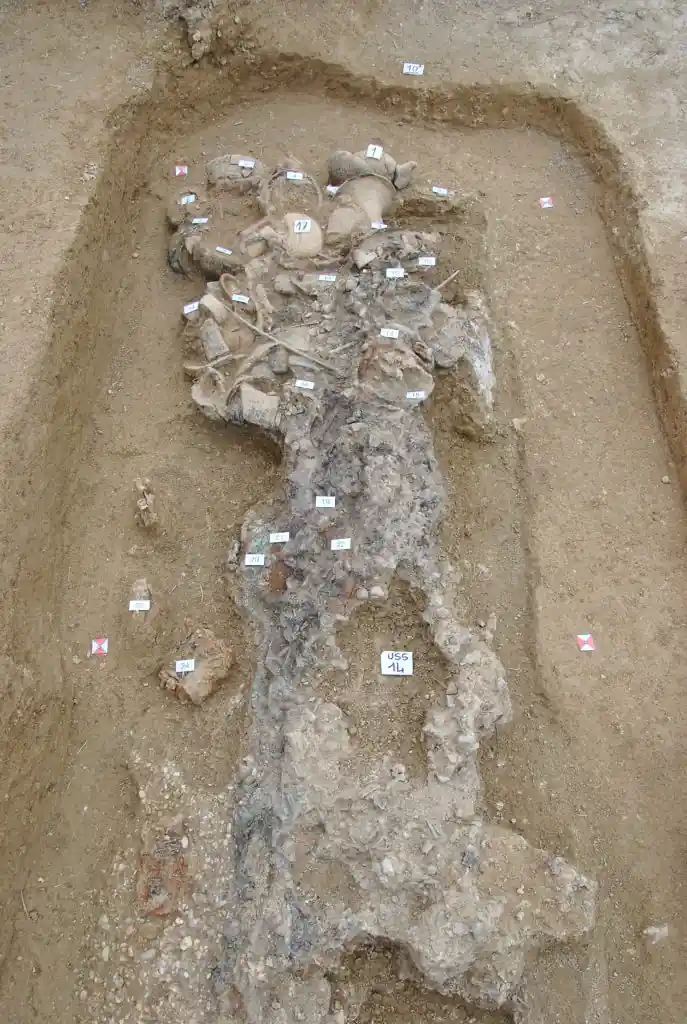
The new complex also changes how the warrior tomb found in 2020 should be read. That man, who lived in the second half of the 6th century BC, had been buried with a helmet, spear, long sword, and dagger. His grave goods also included a bronze oinochoe of Greco-Etruscan tradition and a rare diphros, a folding stool associated with elite status in pre-Roman Italy.
The new excavation suggests that the 2020 burial belonged to a broader family cemetery organized around the central chariot tomb. Stefano Finocchi, scientific director of the excavation, said the find allows archaeologists to observe not a single tomb, but an aristocratic nucleus with hierarchical and symbolic relationships between the burials.
A female burial beside the chariot tomb
Next to the central tomb, archaeologists also uncovered a female burial. The excavation documented traces of textiles, decorations, and footwear with metal elements still in their original positions. Several fibulae were found on the body, at the chest, shoulders, pelvis, and feet, where they had fastened garments and the shroud.
A large fibula with an amber core was found beyond the woman’s head. It may have belonged to a headdress or hairstyle, although that interpretation remains preliminary. The burial points to another side of Picene elite display: female status expressed through dress, ornament, amber, and the careful arrangement of the body.
The Piceni and the Conero elite landscape
The Piceni were one of the main pre-Roman peoples of central Italy. They flourished on the Middle Adriatic side of the peninsula, especially in what is now the Marche region, between the 9th and 3rd centuries BC, before Roman expansion transformed the region.
Much of what is known about Picene society comes from cemeteries. Grave goods such as weapons, fibulae, amber, bronze vessels, imported objects, and chariots provide evidence for status, gender roles, long-distance contacts, and local forms of authority.
The Sirolo-Numana area is already known for the Queen’s Tomb in the I Pini archaeological area, a 6th-century BC Picene burial famous for its exceptionally rich assemblage, including two chariots and more than 1,700 objects.
The new Sirolo complex now adds a male chariot tomb, sealed bronze containers, a nearby female burial, and an unusual palisaded enclosure to this same aristocratic landscape. The finds are still being restored and studied, so the strongest conclusions will come later. For now, the discovery offers a rare view of how Picene elites used burial architecture, weapons, banqueting vessels, clothing, and memory to mark rank in the landscape more than 2,600 years ago.
Soprintendenza Abap Ancona Pesaro Urbino
Cover Image Credit: Archaeologists excavating the chariot tomb within the newly uncovered 6th-century BC Picene funerary complex near Sirolo, central Italy. Soprintendenza ABAP Ancona Pesaro Urbino