For generations, Singapore’s pre-colonial past was often described in modest terms — a quiet fishing settlement before the British arrival in 1819. But beneath the waters of the Singapore Strait, archaeologists have uncovered evidence that tells a dramatically different story.
A mid-14th-century shipwreck, known today as the Temasek Wreck, has yielded approximately 3.5 tonnes of Chinese ceramics, including the largest recorded cargo of Yuan dynasty blue-and-white porcelain ever recovered from a documented wreck site. The findings strongly suggest that Singapore — then known as Temasek — was already a thriving regional trading hub at the height of maritime Asia.
The full academic analysis, published in the Journal of International Ceramic Studies, provides the most comprehensive study to date of the cargo and its implications.
A Ship Lost at the Peak of the Yuan Dynasty
Excavated between 2016 and 2019 in Singapore waters, the wreck represents the earliest documented shipwreck found in the region. Although no hull remains survived — likely destroyed by marine organisms and currents — the ceramic cargo remained largely intact in fragmentary form.
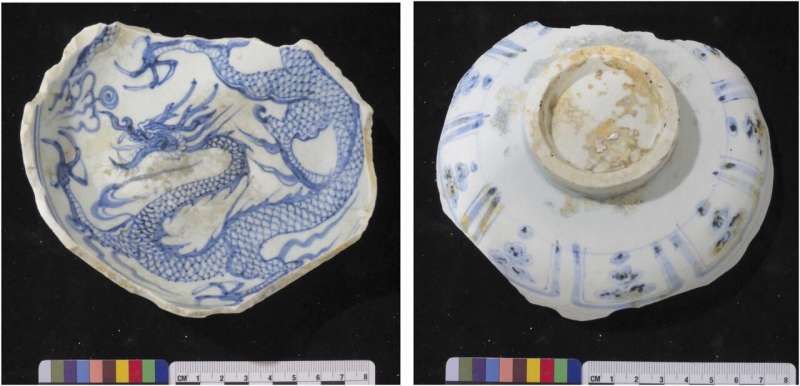
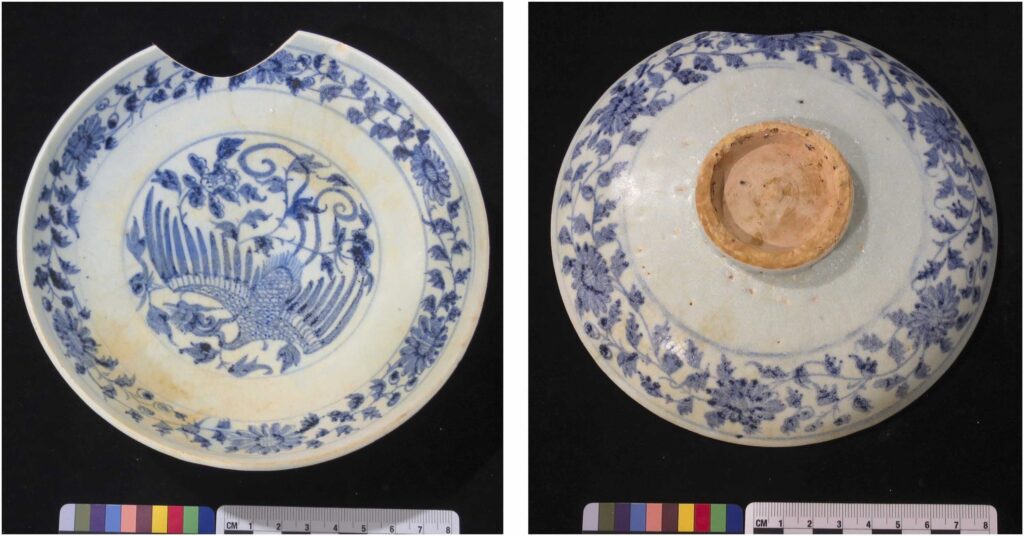
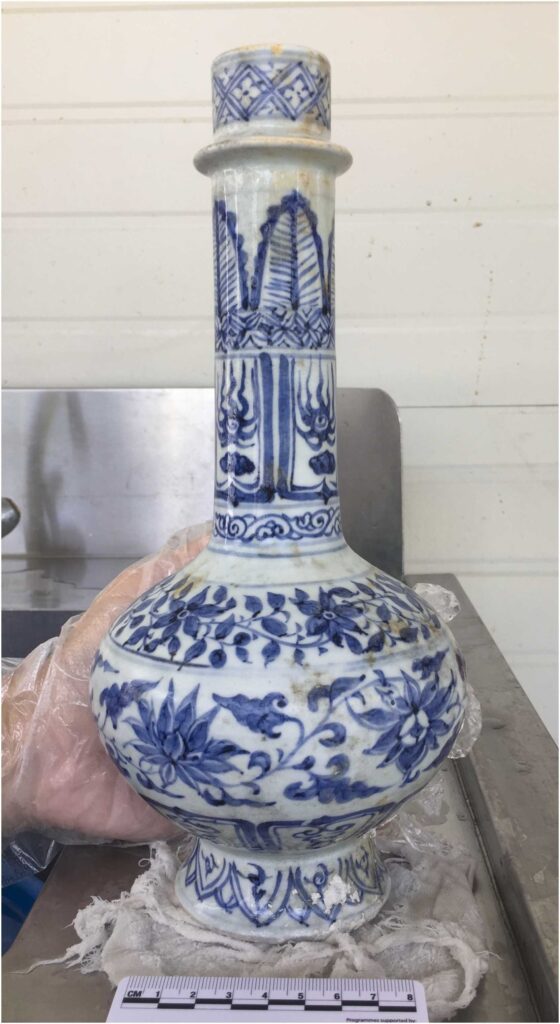
Among the most striking discoveries were 136 kilograms of rare Yuan blue-and-white porcelain, comprising more than 2,350 shards and several nearly complete vessels. This volume exceeds that recovered from any other documented shipwreck worldwide.
The decorative repertoire offers crucial chronological clues. Bowls frequently feature the motif of mandarin ducks swimming in a lotus pond, a design associated with the Yuan imperial kilns at Jingdezhen during a narrow window of production. The motif gained popularity after 1340, when imperial restrictions eased, but production appears to have halted around 1352 amid Red Turban rebellions.
This allows scholars to date the vessel’s final voyage to roughly 1340–1352, placing it squarely within the Yuan dynasty’s most dynamic phase of maritime trade.
More Than Blue-and-White: A Diverse Ceramic Cargo
While blue-and-white porcelain has captured public imagination, it represented just 3.9% of the total cargo by weight. The majority consisted of other high-quality ceramic traditions.
Longquan celadon, produced in Zhejiang province, accounted for approximately 44.5% of the cargo. These green-glazed dishes and bowls, some decorated with carved dragons, peonies, and double-fish motifs, were among the most desirable exports of the era.
Another significant component was qingbai (or shufu) ware from Jingdezhen. Once thought to have been reserved for official or imperial use due to the presence of the characters “shufu” (Privy Council), this cargo demonstrates that such ceramics were also exported commercially. In fact, qingbai/shufu ware constituted more than 12% of the total cargo.
The ship also carried Dehua whiteware, greenware likely from Fujian provincial kilns, and large quantities of stoneware storage jars and small-mouth jars from Cizao, probably used to transport commodities such as wine.
Together, the assemblage presents a snapshot of 14th-century Chinese export production at a single moment in time — effectively a maritime time capsule.
Was Temasek the Destination?
Perhaps the most consequential question concerns the ship’s intended destination. Was it bound for the Indian Ocean markets of India and the Middle East, where Yuan blue-and-white porcelain is well documented?
The evidence suggests otherwise.
Large blue-and-white dishes measuring 40–50 cm — commonly found in Turkish and Middle Eastern collections — are conspicuously absent from the Temasek cargo. The largest dishes recovered measure under 35 cm.
Moreover, many ceramic types from the wreck have direct parallels in terrestrial archaeological sites across Singapore, including Fort Canning. Identical motifs, vessel forms, glass beads, and other artifacts have been recovered from land excavations.
Crucially, no Yuan blue-and-white porcelain has been found in northern Sumatra or along the eastern shores of the Melaka Strait and Bay of Bengal in comparable contexts.
Taken together, these clues point to a strong conclusion: Temasek itself was the likely primary destination.
If correct, this suggests that 14th-century Singapore was not merely a stopover port, but an affluent urban center capable of absorbing high-value Chinese luxury ceramics — and possibly redistributing them regionally.
A Chinese Junk in Southeast Asian Waters
Although the wooden hull has vanished, circumstantial evidence indicates the ship was probably a Chinese junk. The cargo is overwhelmingly Chinese, and the limited non-ceramic artifacts — such as an inkstone and metal fragments — do not contradict that origin.
Southern Chinese ports such as Quanzhou are considered likely points of departure, given the ceramic production centers involved and the well-established maritime trade networks of the era.
Rewriting Singapore’s Early History
The implications extend far beyond maritime archaeology.
The Temasek Wreck anchors Singapore firmly within the 14th-century global trade network that linked China, Southeast Asia, and beyond. It provides material proof that Temasek functioned as a vibrant entrepôt during the Yuan dynasty — centuries before colonial accounts begin.
Rather than a peripheral fishing village, the archaeological record now reveals a cosmopolitan port-city engaged in sophisticated commercial exchange.
The sea floor has delivered what historical narratives long overlooked: Singapore’s role as a key node in medieval Asian trade.
Flecker, M. (2025). The Temasek wreck ceramics cargo: Yuan blue-and-white porcelain, celadon and other ceramics found in Singapore waters. Journal of International Ceramic Studies, 1, 100013. https://doi.org/10.1016/j.joics.2025.100013
Cover Image Credit: Flecker, 2025, Journal of International Ceramic Studies