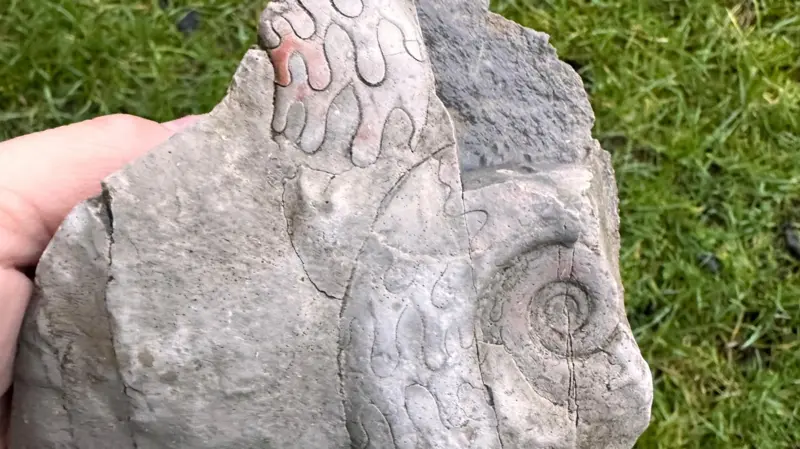
What began as routine countryside work turned into a window onto a vanished ocean.
An Unexpected Find in the Peak District
Rangers working for the National Trust have uncovered remarkably well-preserved marine fossils embedded in an ordinary dry stone wall in England’s Peak District.
The fossils date back around 340 million years, to the Carboniferous period, when much of central Britain lay beneath a warm, shallow tropical sea.
The discovery was made in the White Peak region of Staffordshire and immediately stood out for one reason: the level of preservation is exceptional.
Rare Goniatites Preserved in Limestone
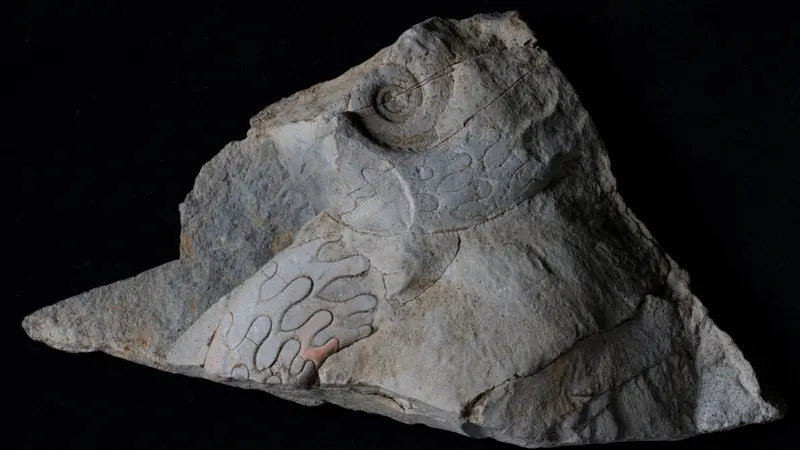
The fossils belong to goniatites, extinct marine animals related to modern squid and octopus. These shelled cephalopods flourished long before dinosaurs appeared and are rarely found with such clarity.
According to National Trust staff, fossils are common in Peak District limestone—but almost always fragmented. Intact specimens with clearly visible surface patterns are extraordinarily rare.
“I Thought Someone Had Drawn Them”
Ranger David Ward, who witnessed the discovery, described his initial reaction in an interview with the BBC:
“At first I thought someone had drawn on the rock.”
The fine, wavy markings etched into the stone appeared almost artificial. Only after closer inspection did it become clear that the patterns were natural fossil impressions, preserved with striking precision over hundreds of millions of years.
Because of the fossils’ condition, the National Trust has chosen not to disclose the exact location of the wall, citing concerns over vandalism and unauthorized fossil hunting.
A Glimpse of Britain’s Tropical Past
The scientific importance of the find has drawn attention from palaeontologists. Dr. Susannah Lydon of the University of Nottingham explained that goniatites thrived at a time when central England was submerged beneath tropical seas rich in marine life.
When these animals died, their shells sank to the seabed and were slowly buried by sediment. Over vast stretches of time, pressure and mineralization transformed them into stone—locking delicate surface details in place.
Dr. Lydon noted that goniatites are often compared to ammonites, a later group of shelled cephalopods famously associated with Britain’s Jurassic Coast.
Why Goniatites Matter to Science
Beyond their visual impact, goniatites play a crucial role in geological research. Because they evolved rapidly and spread widely, they are considered index fossils—key tools for dating rock layers and reconstructing ancient sea levels and climates.
The White Peak specimens therefore contribute not only to local heritage, but also to broader studies of prehistoric ecosystems and Earth’s environmental history.
Fossils as Public Heritage
Dr. Lydon also emphasized the cultural importance of such finds:
Discoveries like this help people understand that the ground beneath their feet has an unimaginably deep history.
The National Trust has confirmed that the fossils will be carefully preserved and used in educational programs, guided walks, and public outreach—turning an accidental discovery into a shared learning resource.
Ordinary Walls, Extraordinary Histories
As erosion and climate change increasingly threaten natural heritage sites, finds like this underscore how much of Earth’s past remains hidden in plain sight.
A simple stone wall, built long after the sea vanished, has revealed traces of life from a world hundreds of millions of years older than humanity itself—a powerful reminder that extraordinary stories can surface in the most unexpected places.
Cover Image Credit: National Trust