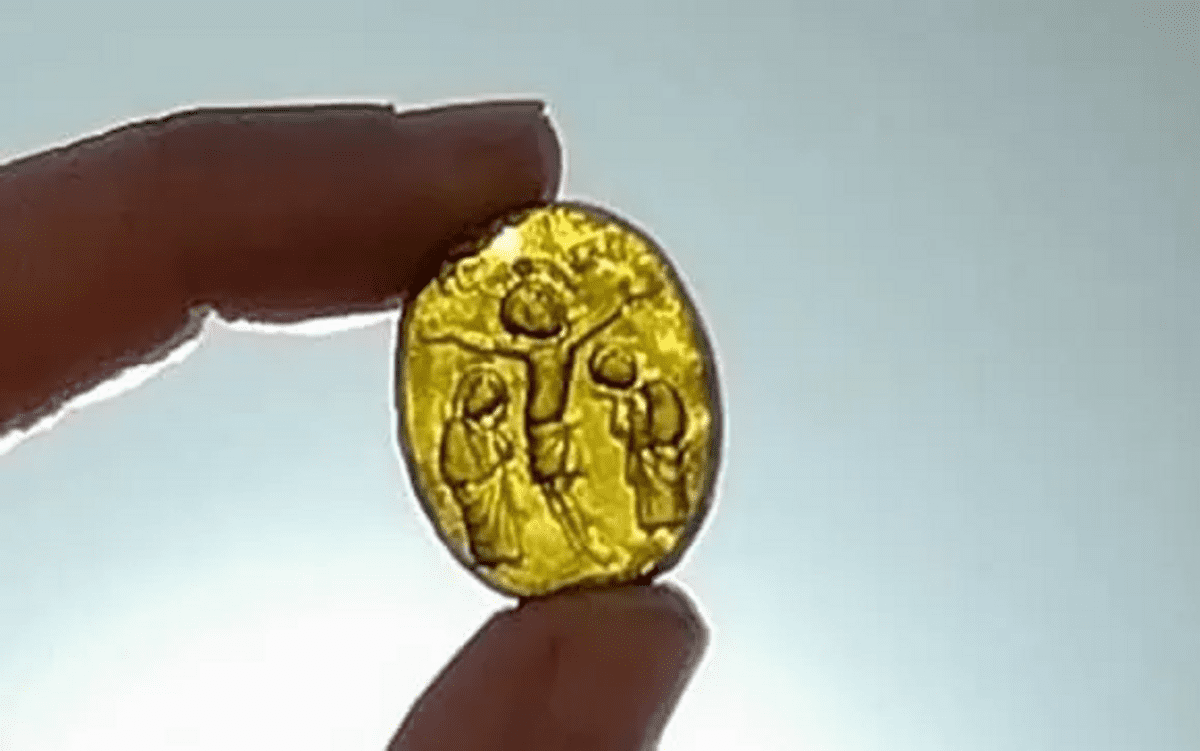
Beneath the future site of the Sizewell C nuclear power station, archaeologists have uncovered an object that feels unexpectedly intimate.
A tiny medieval glass jewel, depicting the Crucifixion, lay hidden in Suffolk soil for centuries.
The find comes from one of the largest archaeological investigations ever carried out in eastern England, revealing not only the jewel but also the remains of a long-abandoned Anglo-Saxon village beneath the modern landscape.
A Small Object with a Powerful Spiritual Message
The jewel measures just under an inch in height. Its translucent light-green glass catches the light easily, but its true weight is symbolic rather than physical.
Cast in relief, it shows Christ on the cross, flanked by the Virgin Mary and St John. Above them appears the Greek inscription “IC XC”, a traditional abbreviation for Jesus Christ.
This iconography immediately signals a connection to Eastern Christian visual traditions.
Venetian Craftsmanship with Byzantine Roots
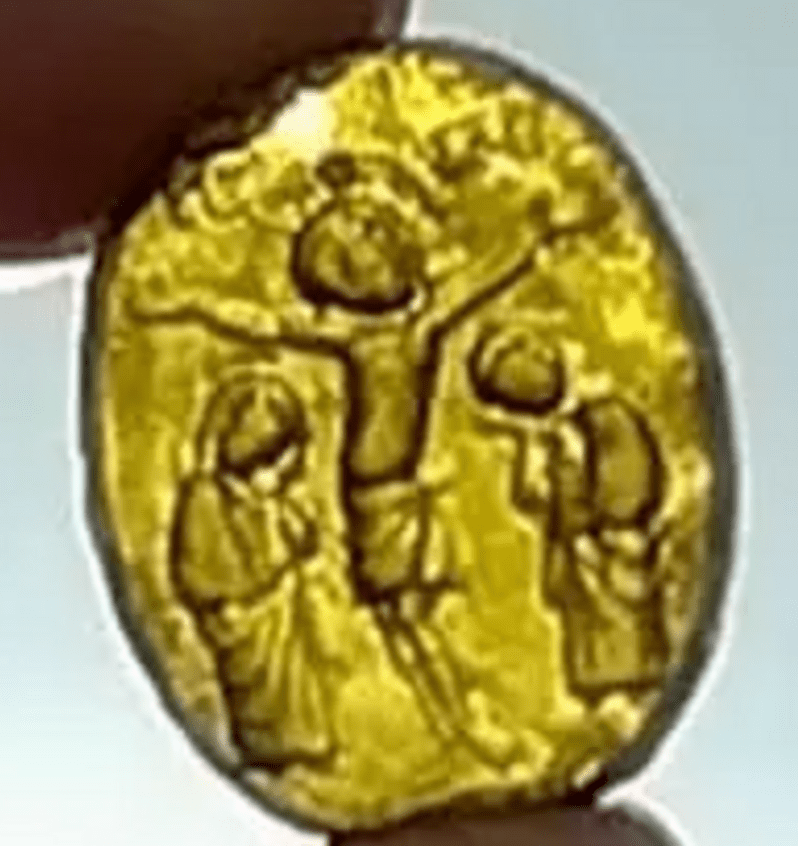
Although discovered in rural England, specialists identify the jewel as a product of 13th-century Venice, one of medieval Europe’s most important glassmaking centres.
According to researchers from Oxford Cotswold Archaeology, the mould used to create the piece was either imported from Byzantium or made by artisans deeply familiar with Byzantine devotional imagery.
The back of the jewel is bevelled, suggesting it was once mounted and worn, most likely as a pendant. When carried on the body, its appearance would have been muted and personal, not decorative or ostentatious.
Why Archaeological Context Matters
More than 200 comparable glass reliefs are known across Europe. What makes the Sizewell jewel exceptional is not rarity alone, but context.
Most similar pieces entered museum collections centuries ago with no reliable findspot, stripped of their social meaning. Even a closely related red-glass example in the British Museum carries unresolved questions about its origin.
At Sizewell, the jewel’s position in the ground allows archaeologists to reconstruct how and where it was used, not just how it looked.
Near Leiston Abbey, Between Sea and Faith
The object was recovered close to the ruins of Leiston Abbey, founded in 1363.
The abbey’s history reflects the instability of the Suffolk coast.
Its canons were forced inland after repeated flooding damaged their earlier, seaside site. Stone from the original Norman buildings was reused, embedding multiple centuries of history into the new monastery’s walls.
The jewel may have been dropped by a visitor, pilgrim, or local worshipper, passing through a landscape already shaped by environmental pressure and religious life.
Not a Pilgrim Souvenir, but a Personal Devotion
Medieval pilgrimage culture often relied on cheap lead badges, mass-produced and openly displayed as proof of travel to major shrines.
This glass jewel tells a different story.
It was not a souvenir. It was private, likely owned by someone of modest means but deep personal faith. Rather than proclaiming a journey completed, it reflects belief carried quietly, close to the body.
An Anglo-Saxon Village Beneath the Modern World
Beyond the jewel, excavations revealed traces of an entire Anglo-Saxon settlement, abandoned long before the medieval period.
Suffolk’s archaeological depth is well known—from Roman infrastructure to monasteries and elite burials such as Sutton Hoo. Its North Sea coastline made it a gateway for exchange, movement, and influence over millennia.
The jewel fits naturally into this layered history.
When Modern Infrastructure Unlocks Human Stories
The Sizewell discoveries demonstrate how modern construction, when paired with carefully managed archaeology, can recover profoundly human moments from the past.
Small enough to rest in the palm of a hand, this green glass jewel carries centuries of faith, craftsmanship, and quiet devotion—now returned to history from beneath one of Britain’s most modern energy projects.
Cover Image Credit: Oxford Cotswold Archaeology.