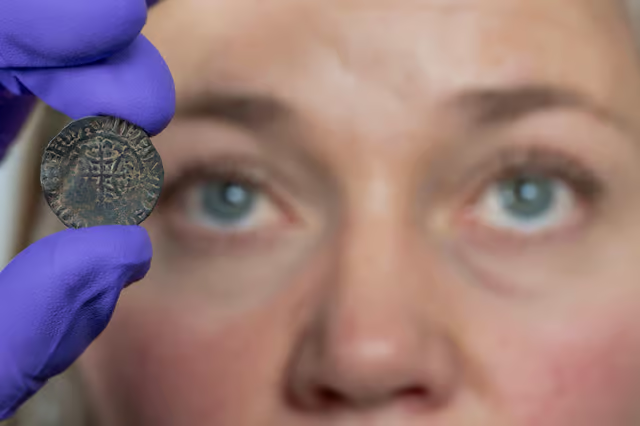
A silver coin struck nearly 900 years ago has emerged as the earliest known example of coinage ever minted in Scotland, following its discovery near Edinburgh by a metal detectorist. The find, uncovered in a wooded area close to Penicuik in Midlothian, is now officially part of the national collection after being allocated to National Museums Scotland.
The small medieval coin dates to the reign of David I of Scotland, who ruled between 1124 and 1153 and is credited with introducing Scotland’s first native coinage. Until now, historians believed that all of David I’s earliest coins were minted outside the Scottish heartland, primarily in Carlisle, then under his control.
A Discovery That Changes the Map of Early Scottish Minting
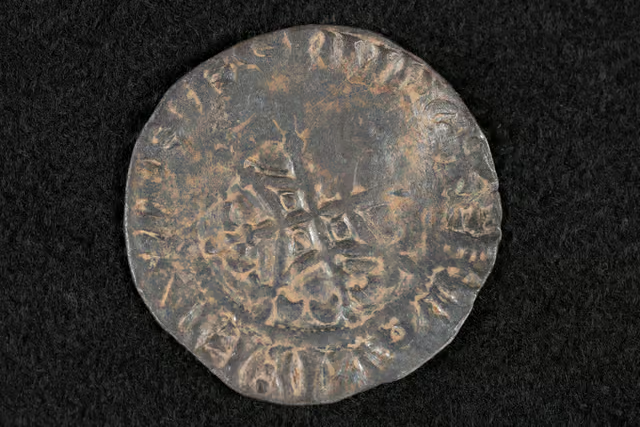
What sets this coin apart is not only its age, but its place of origin. The partially preserved Latin inscription includes the ending ESBVRG, a clear reference to Edinburgh. This confirms that the coin was minted in Edinburgh during the second half of the 1130s, making it the earliest known Scottish coin produced within what was a core centre of the medieval kingdom.
Until this discovery, scholars assumed that the first phase of Scottish coin production took place exclusively in Carlisle, where David I had established control in the 1130s. The Penicuik find demonstrates that minting activity began in Edinburgh earlier than previously documented, reshaping academic understanding of how and where Scotland’s monetary system first developed.
Coins as the Primary Historical Evidence
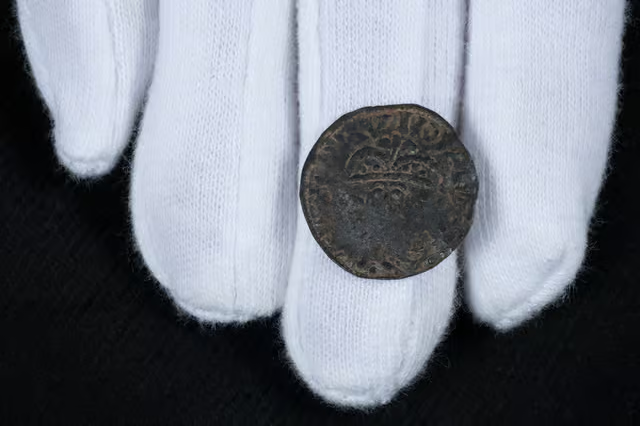
According to Alice Blackwell, Senior Curator of Medieval Archaeology and History at National Museums Scotland, the importance of the coin lies in the extreme scarcity of written records from the period. Medieval Scotland left behind very few documents explaining where coins were produced, how minting was organised, or why designs and locations changed over time.
As a result, the coins themselves serve as the primary historical sources. This newly identified Edinburgh-minted example provides the first tangible proof that early Scottish coinage was not confined to Carlisle, but was already being produced within Scotland’s political core during David I’s reign.
Scotland’s First Coinage and a Transformative King
Before the 12th century, Scotland did not produce its own coins. Any Roman, Viking, or early medieval coins found within its borders were minted elsewhere. David I’s introduction of a native coinage marked a fundamental shift, aligning the kingdom more closely with contemporary European economic systems.
His reign was defined by wide-ranging reforms. Alongside the introduction of coinage, David I founded royal burghs such as Perth, Dunfermline, and Stirling, and reorganised civil and administrative institutions. Later in his reign, Scottish mints operated in several locations, including Perth, Aberdeen, St Andrews, Berwick-upon-Tweed, and Roxburgh. The Midlothian coin, however, belongs to the very earliest phase of this transformation.
From Accidental Loss to National Treasure
Archaeologists believe the coin was likely dropped accidentally by a traveller in the medieval period, eventually becoming buried and forgotten for centuries. It was recovered in 2023 by a metal detectorist, who reported the find to Scotland’s Treasure Trove system in accordance with the law.
In autumn 2025, the coin was formally allocated to National Museums Scotland by the Scottish Archaeological Finds Allocation Panel. Valued at £15,000, the amount was paid to the finder as a reward through the Crown, with the museum covering the cost.
For now, the coin will be used primarily for research, but museum officials have expressed hope that it will eventually go on public display. When it does, it will offer a rare and tangible link to the moment when Scotland first began minting its own money—and to the emergence of Edinburgh as a centre of royal authority and economic life in the medieval kingdom.
Cover Image: The silver coin, dating to the reign of David I, was recovered from woodland near Penicuik in Midlothian and has since been formally allocated to National Museums Scotland following a review by the Scottish Archaeological Finds Allocation Panel. | Neil Hanna / PA Wire