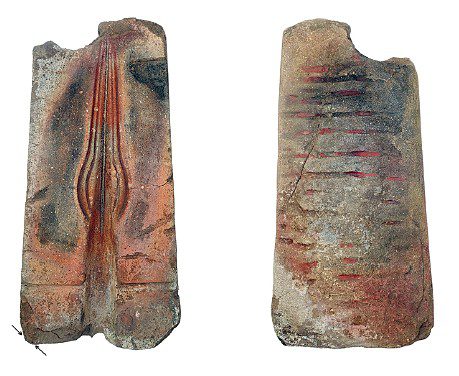
A stone that once lay unnoticed in a village garden in South Moravia has now been identified as a 3,000-year-old casting mould for bronze spearheads — a discovery that sheds fresh light on Bronze Age metallurgy and long-distance connections in Central Europe.
The object was first spotted in 2007 in the village of Morkůvky, when a homeowner noticed a rectangular slab protruding slightly from the ground near the foundations of an old barn. At the time, it appeared to be an ordinary building stone. Only later did specialists from the Moravian Museum recognize its true significance.
A Matrix for Bronze Weapon Production
According to Milan Salaš of the Moravian Museum, the stone is technically known as a casting matrix — a mould used to produce bronze spearheads. On one side of the slab, experts identified a carefully shaped negative impression corresponding to the blade and socket of a spearhead.
The cavity is remarkably well preserved, indicating repeated and intensive use. Archaeologists believe dozens of spearheads may have been cast using this mould, pointing to organized, possibly semi-serial production rather than isolated craftsmanship.
The spearheads produced in this mould belonged to a type common across the Carpathian Basin. Characterized by reinforcing ribs along the blade and a pronounced ridge on the socket, they reflect standardized weapon forms circulating widely during the Late Bronze Age.
Imported Stone from the Carpathians
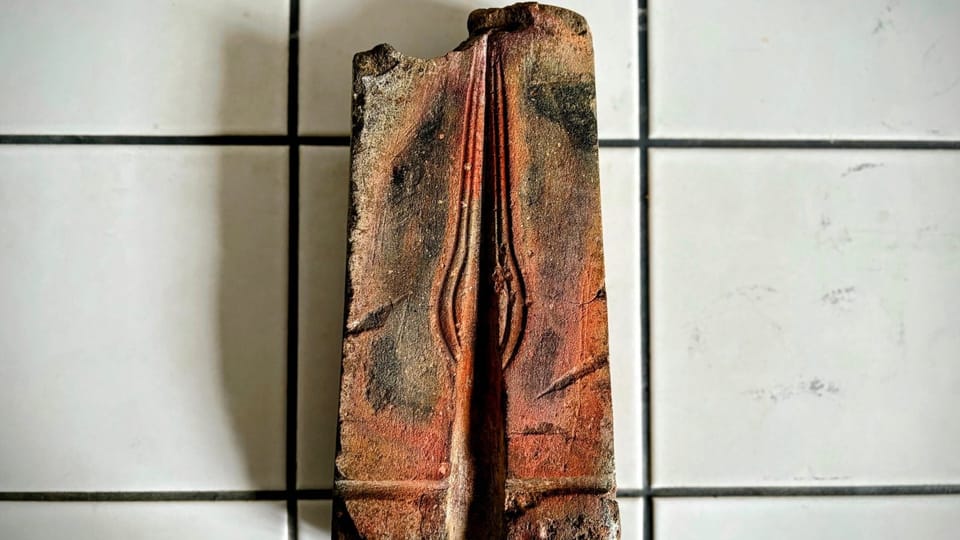
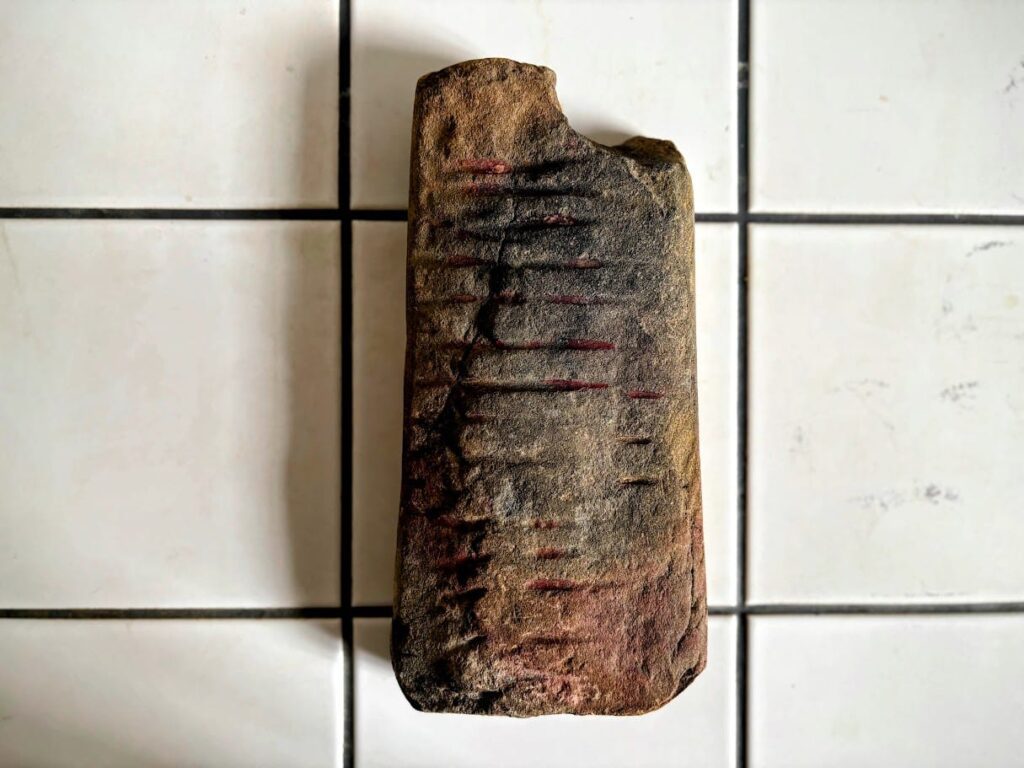
What makes the artefact even more intriguing is its geological origin. Petrographic analysis conducted by Antonín Přichystal from Masaryk University revealed that the stone is volcanic tuff — a material not native to the Czech lands.
The tuff most likely originated from the south-eastern slopes of the Bükk Mountains in eastern Hungary. Transporting such a heavy stone across that distance around 1000 BCE would have required deliberate effort, suggesting established exchange networks linking Moravia with the wider Carpathian region.
This finding aligns with broader archaeological evidence that Late Bronze Age Central Europe was far from isolated. Metal, raw materials, and technological knowledge moved across considerable distances, forming interconnected production zones.
How the Mould Was Used
The casting process was technically sophisticated. Two identical halves of the mould would have been placed together and secured, likely using copper wire. The assembled mould was then positioned upright.
A casting core was inserted into the cavity to create the hollow socket of the spearhead. Molten bronze — an alloy of copper and tin — was poured into the mould. Once cooled, the finished spearhead would be removed and fitted onto a wooden shaft.
Scientific analysis using spectrometry detected traces of copper and tin within the stone, confirming its use in bronze casting.
Weapons and Warriors of the Late Bronze Age
The discovery also provides insight into the martial culture of the period. Warriors in Central Europe around 1000 BCE were equipped with both offensive and defensive gear, including shields, greaves, and bronze helmets.
Salaš notes that their equipment would not have looked out of place in the world described by Homer. In the epic tradition of the Trojan War, warriors are described as carrying two spears into battle — one to throw and one kept in reserve.
While the Moravian mould cannot be directly linked to any specific conflict, it demonstrates that weapon production in the region was systematic and technologically advanced.
A Modest Stone with a Wider Story
At first glance, the rectangular slab may seem unremarkable. Yet its identification fundamentally changes how we understand Bronze Age South Moravia. The artefact reveals not only local manufacturing activity but also participation in broader Carpathian exchange networks.
Three thousand years ago, communities in what is now the Czech Republic were not merely passive recipients of imported goods. They were active producers, adopting and adapting metallurgical techniques that had travelled across regions.