
Archaeologists in Peru have uncovered a 3,800-year-old ritual offering sealed beneath a public building at Peñico, an ancient city that rose after the decline of the Caral civilization.
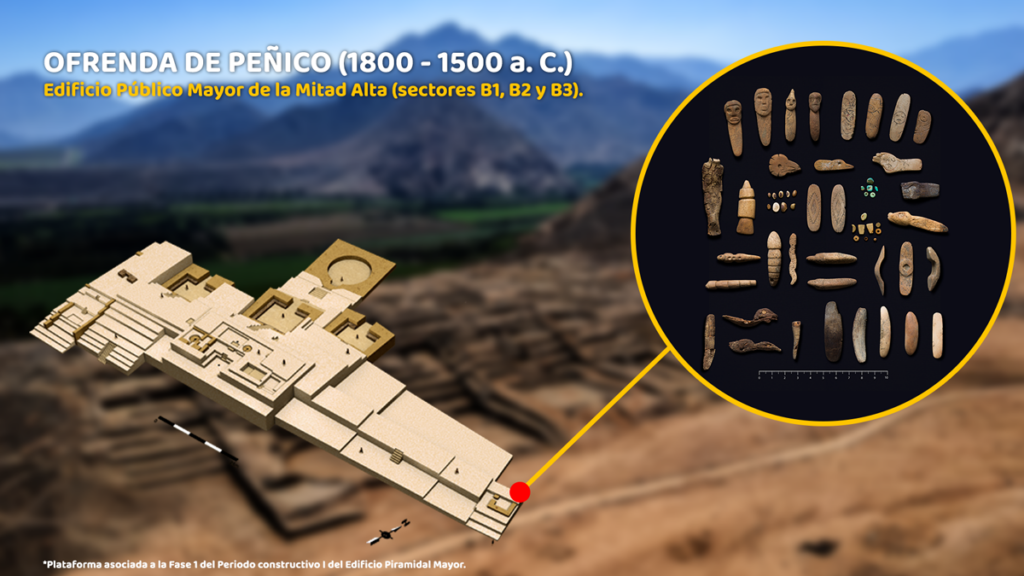
The discovery, announced by Peru’s Ministry of Culture, was made by researchers from the Caral Archaeological Zone, led by archaeologist Ruth Shady Solís. The offering was found in the Major Public Building of Peñico, in Huaura Province, north of Lima, during excavations in an area linked to the construction of a new platform.
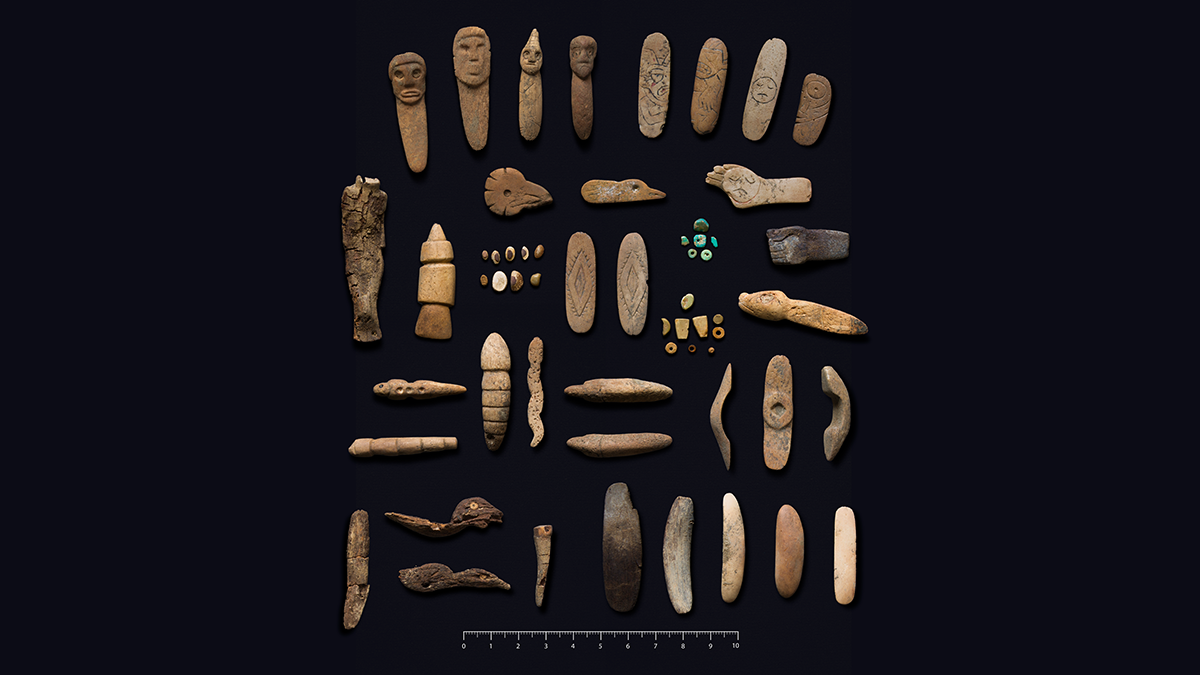
The deposit is small, but its contents are unusually rich. Inside a stone-sealed space only 22 centimeters long, archaeologists found 43 objects made from wood and bone, along with shell pieces, chrysocolla fragments, beads, and small objects still under study.
A Tiny Deposit Sealed With Stone
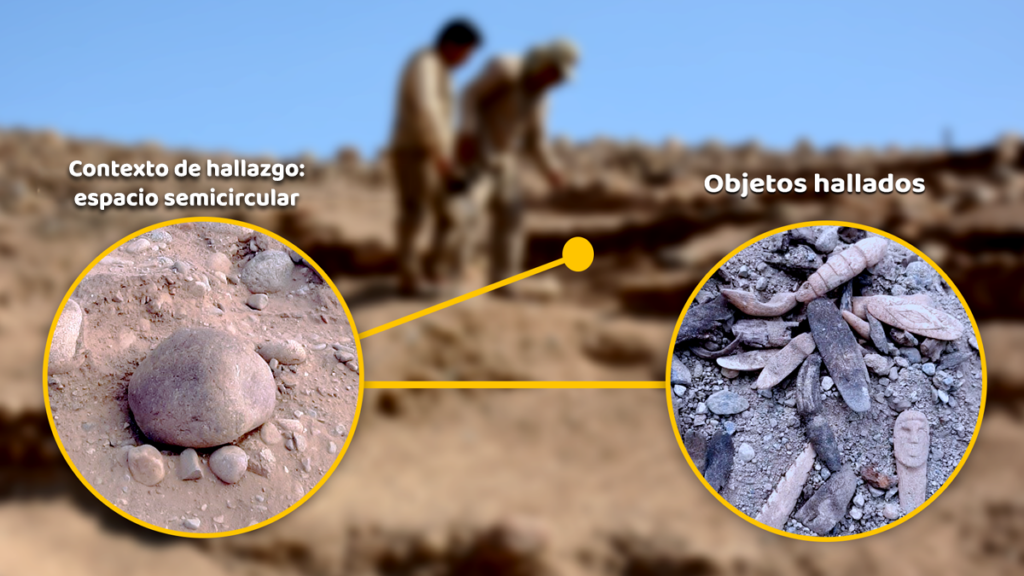
The offering had been placed inside a small space bordered by rounded stones arranged in a semicircle. It was then covered with a large stone, suggesting that the deposit was deliberately hidden or sealed as part of a ritual act.
Researchers associate the offering with the early construction phase of a new platform in the Major Public Building. In ancient Andean societies, the construction or renewal of important buildings often involved ceremonial deposits, especially in places connected with collective life, authority, and ritual.
At Peñico, the careful placement of the objects beneath a public structure suggests that the act was not casual. It appears to have been part of a planned ceremony connected with the building itself.
Shell Eyes, Carved Figures, and Burned Objects
The offering includes carved and engraved pieces in wood and bone. Some show signs of exposure to fire. Others carry incised designs or small cavities that may have held minerals or semiprecious stones.
Among the most striking finds are nine eye-shaped pieces made from mollusk shell. Researchers believe these were intended to be placed in sculptures, giving ritual figures a more visible and possibly more powerful presence.
The carved objects include anthropomorphic figures, a female representation, possible authority figures, and mythic characters. Animal forms are also present, including birds, snakes, and tadpoles. Geometric designs and abstract shapes appear among the pieces as well.
The assemblage also contained three beads and three fragments of chrysocolla, a blue-green copper mineral often valued in ancient Andean contexts for its color and visual impact. Two fragments of beads made from terrestrial gastropod shells were also identified, along with eight smaller objects whose function has not yet been determined.
Taken together, the materials point to a ceremonial deposit rather than an everyday cache. The shell eyes, mineral fragments, carved bodies, animal forms, and traces of burning all suggest an object group made for symbolic use.
Peñico After Caral
Peñico was founded around 1800 BC, after the oldest urban centers of the Caral civilization had begun to lose their earlier prominence. The site covers 19.44 hectares and lies about 12.93 kilometers from the Sacred City of Caral-Supe, one of the best-known centers of the earliest civilization in the Americas.
Archaeologists have identified 15 public buildings at Peñico. The city appears to have developed as a center linking the coast, the highlands, and the Amazonian region, with evidence for the movement of goods and ideas across different ecological zones.
The new offering adds an important detail to that picture. It suggests that Peñico was not simply a later settlement built after Caral’s decline. It preserved parts of an older Supe Valley tradition while adapting them to a new urban and ritual setting.
Researchers point to similarities in materials, incision techniques, and iconographic patterns between the Peñico objects and earlier traditions associated with Caral. The discovery therefore helps trace how religious ideas, craft practices, and symbols continued after the first major urban centers of the valley lost power.
What the Offering Reveals
The most important part of the discovery is not only the age of the objects, but their context. They were placed during construction, sealed beneath stone, and associated with one of Peñico’s major public buildings.
That makes the offering a rare piece of evidence for how architecture and ritual were connected at the site. Public buildings at Peñico were not just spaces where people gathered or organized daily life. They also carried ceremonial meaning.
The find also gives archaeologists a closer look at the visual world of Peñico. The shell eyes suggest sculptures or sacred figures with inserted facial elements. The birds, snakes, tadpoles, human-like figures, and abstract motifs point to a symbolic language that is still being studied.
For now, the offering does not answer every question about Peñico. It does not prove a direct political continuation from Caral, and it does not identify the exact figures represented in the carved pieces. What it does show is that ritual traditions in the Supe Valley remained active after Caral’s main centers declined.
Nearly four millennia later, a deposit small enough to fit in a hand-length space is helping archaeologists reconstruct a larger story: how one of the oldest urban traditions in the Americas survived, changed, and found new expression at Peñico.