
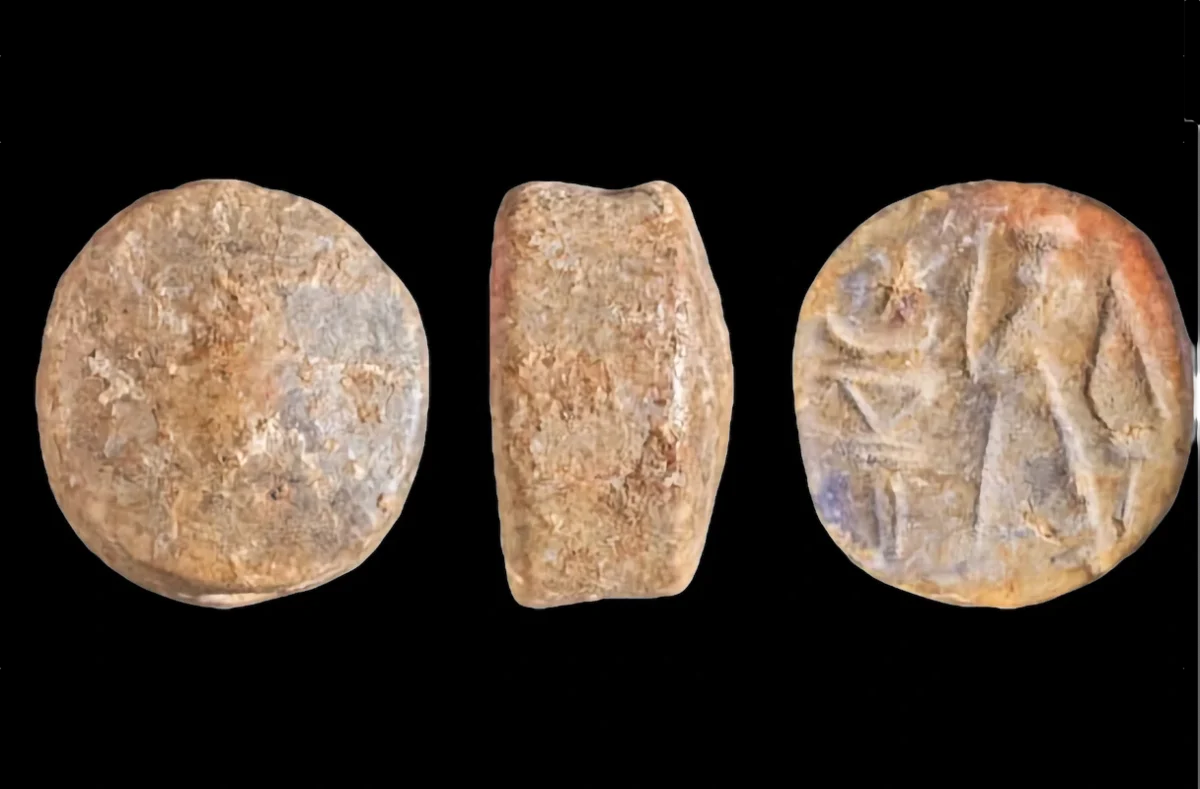
A small stone seal found at ancient Yavne in southern Israel is giving archaeologists a closer look at the religious and symbolic world of Iron Age Judah, where images of the moon, stars, and planets circulated alongside local traditions and the influence of the Neo-Assyrian Empire.
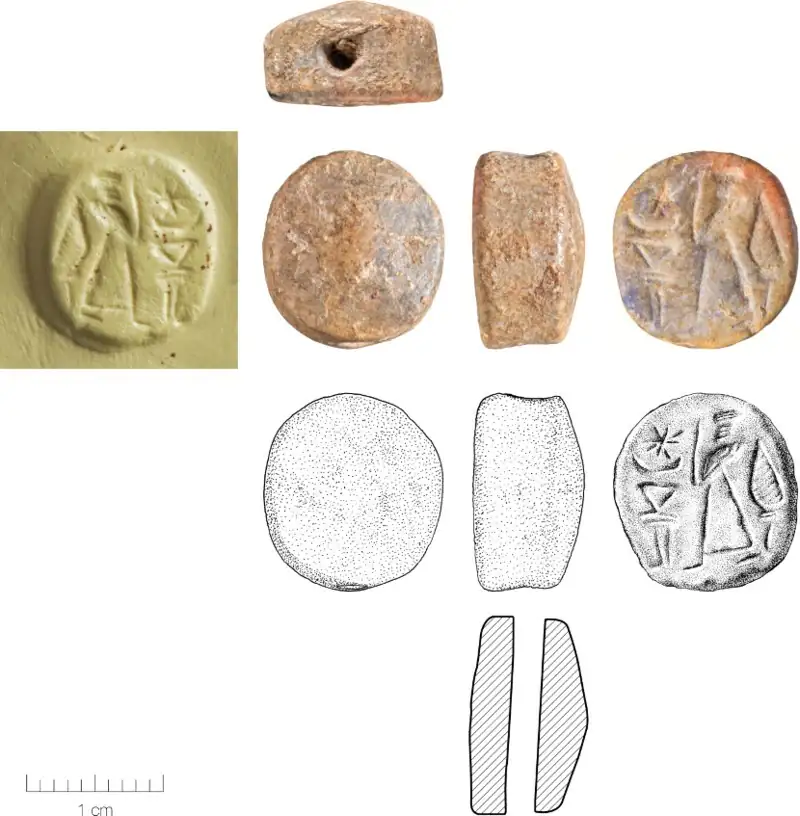
The seal was uncovered in Area U of the Yavne-East excavations, inside a large pottery production complex dated to the Iron Age IIC, around the 7th century BCE. The area contained kilns, potters’ wheels, paved working surfaces, grinding stones, storage jars, and tools connected with ceramic production. The seal was found on one of the working surfaces, together with storage vessels, a mortar, and loom weights.
A Seal Found in a Pottery Workshop
The object measures only 14.6 millimeters long, 13.2 millimeters wide, and 8 millimeters high. It was made from reddish crystalline limestone and pierced lengthwise, which suggests it may have been worn or carried as a pendant as well as used as a stamp seal.
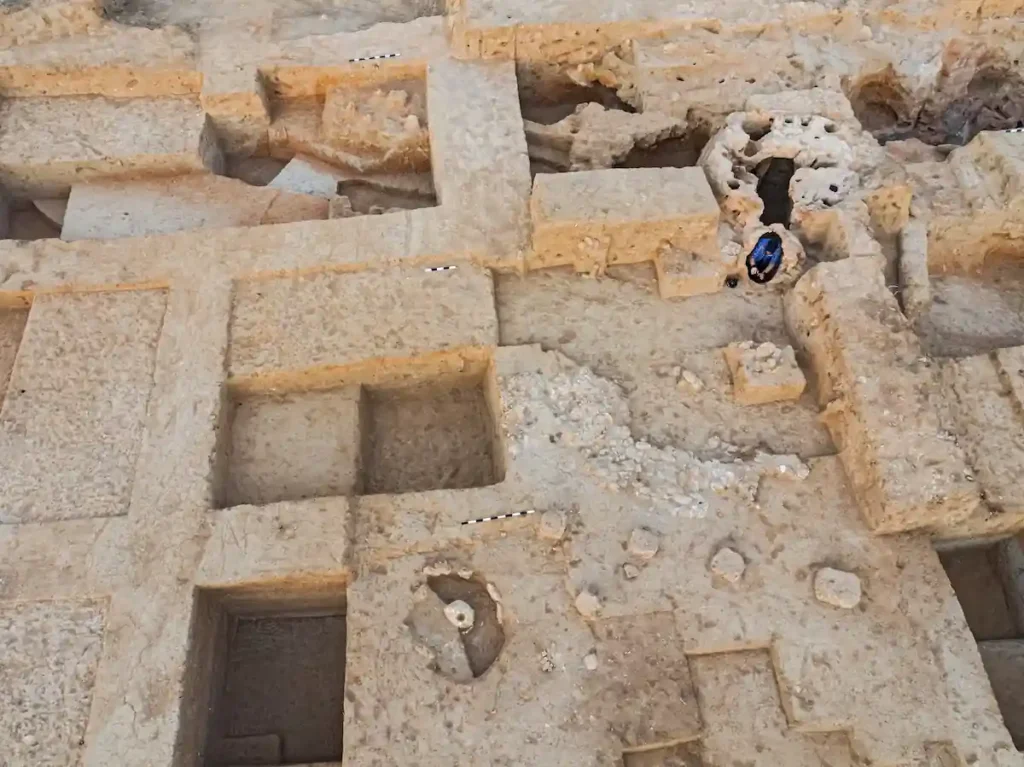
Researchers identify it as an Assyro-Levantine-style stamp seal. The study was prepared by Christoph Uehlinger of the University of Zurich, Pablo Betzer, Revital Golding-Meir, and Daniel Varga of the Israel Antiquities Authority, and Gunnar Lehmann of Ben-Gurion University of the Negev.
A Bearded Figure Before a Crescent and Star
The carved scene shows a bearded male figure wearing a long garment and facing left. One arm is extended forward, with the open hand interpreted by the researchers as a gesture of worship or ceremonial greeting.
In front of the figure is a vertical arrangement of three elements. At the bottom is a stand or pedestal. Above it is a crescent. At the top is an eight-pointed star. The crescent is associated with the Mesopotamian moon god Sin, while the star is connected with the Venus symbolism of Ishtar/Inanna.
The scene places the Yavne seal within a wider visual language shared across the Assyrian and Levantine worlds. In the 7th century BCE, Judah was under strong Neo-Assyrian political pressure, and Assyrian imagery was part of the cultural environment in which local objects were made, used, and understood.
Assyrian Traces at Yavne
The seal did not come from a temple or shrine. It was found in a production area, among objects tied to daily work. That setting is one of the most interesting parts of the discovery, because an object with clear astral and Mesopotamian associations appears inside a working pottery complex.
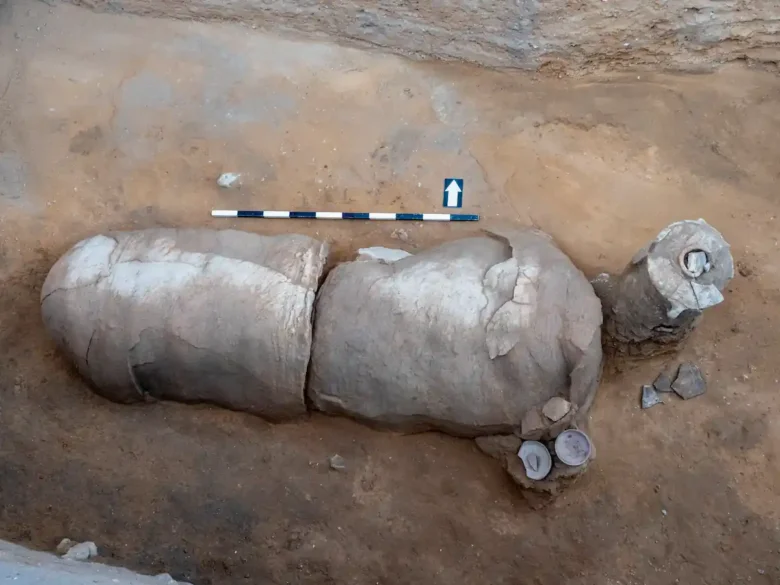
Yavne has produced other evidence pointing toward contact with the Assyrian world. About 160 meters north of Area U, in Area H, archaeologists documented burials linked with Assyrian funerary customs. These included graves covered by large inverted vessels and a mudbrick-built crypt. Taken with the seal, those finds suggest that Yavne’s Assyrian connections may have involved people as well as images and objects.
The Biblical Term Kemarim
The seal has also attracted attention because of its possible connection with the Hebrew Bible term kemarim. In 2 Kings 23:5, the word is used for priests who burned incense to Baal, the sun, the moon, the constellations, and “all the host of heaven.” The term also appears in Hosea 10:5 and Zephaniah 1:4.
The Yavne seal shows a male figure making a ritual gesture before a crescent and star. The image belongs to the same broad world of astral symbolism reflected in those biblical passages, where worship connected with heavenly bodies formed part of the religious landscape criticized by later reforming traditions in Judah.
Judah, Assyria, and the Language of the Sky
In the 7th century BCE, the Kingdom of Judah stood under the political power of the Neo-Assyrian Empire. This was not only a matter of armies and tribute. Assyrian rule also carried images, administrative habits, luxury objects, and religious symbols across the southern Levant.
At Yavne, that wider movement appears in a small object from a working environment: a pierced limestone seal showing a human figure before celestial signs.
About 2,700 years after it was made, the seal helps trace how astral symbols moved through Iron Age Judah, not as an abstract idea, but as something carved, worn, carried, and used.
Uehlinger, C., Betzer, P., Golding-Meir, R., Varga, D., & Lehmann, G. (2026). An ‘Assyro-Levantine’ Stamp Seal with a Worship Scene Found near Tel Yavne. Tel Aviv, 1–26. doi.org/10.1080/03344355.2026.2637186