
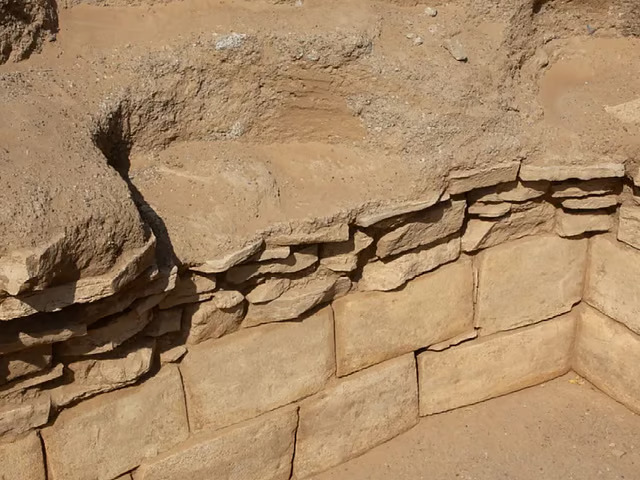
A 4,000-year-old communal tomb in Al Ain has been found containing the remains of hundreds of people. Discovered at the Qattarah Necropolis in the United Arab Emirates, the underground chamber remained in use for at least 1,000 years.
Measuring approximately 11 metres long and 2.5 metres wide, the tomb dates to the Wadi Suq period and the Late Bronze Age, between about 2000 and 1300 BCE. Burials appear to have continued into the Iron Age.
Much of the chamber was built with dressed stone blocks taken from older Umm an-Nar funerary monuments dating to around 2700–2000 BCE. Its entrance was sealed by a carefully shaped stone door weighing more than 200 kilograms.
Built with stones from older tombs
The reused blocks show that parts of earlier burial monuments were incorporated into the later structure. The stone door was also shaped from material taken from an older monument.
The entrance faces east. The Department of Culture and Tourism – Abu Dhabi has suggested that the alignment may have allowed the rising sun to illuminate the chamber during rituals, although this remains an interpretation rather than a confirmed feature of the tomb’s design.
Used by generations of the same community
The chamber held the remains of hundreds of individuals buried over many centuries.
As new burials were added, earlier remains were probably moved or rearranged inside the confined space. The result was a complex communal deposit rather than a group of separate graves.
Archaeologists do not yet know how the individuals were related. DNA analysis may determine whether some belonged to the same families or wider community.
The tomb also contained vessels, weapons and personal ornaments. These objects will be studied alongside the human remains to trace changes in burial customs during the long period in which the chamber remained active.
Human remains under study
Archaeologists and osteoarchaeologists from DCT Abu Dhabi are now examining the skeletal material.
DNA and isotope analyses are expected to provide information about ancestry, diet and mobility. Researchers will also look for signs of disease, injury and other health conditions preserved in the bones.
Isotope results may help establish whether those buried in the tomb grew up around Al Ain or came from elsewhere in southeastern Arabia.
A necropolis used across several periods
The tomb forms part of the Pre-Islamic Qattarah Necropolis, where burials from several periods have been identified.
Previous excavations uncovered other communal tombs dating to the Wadi Suq and Late Bronze Age, individual shaft graves from the Iron Age and tower tombs from the Late Pre-Islamic period.
The newly excavated chamber stands out for its preservation, its long period of use and the number of people buried inside. It also shows that Qattarah remained an important burial ground as local funerary practices changed over time.
The artefacts will be conserved and studied before being displayed in museums in Abu Dhabi.