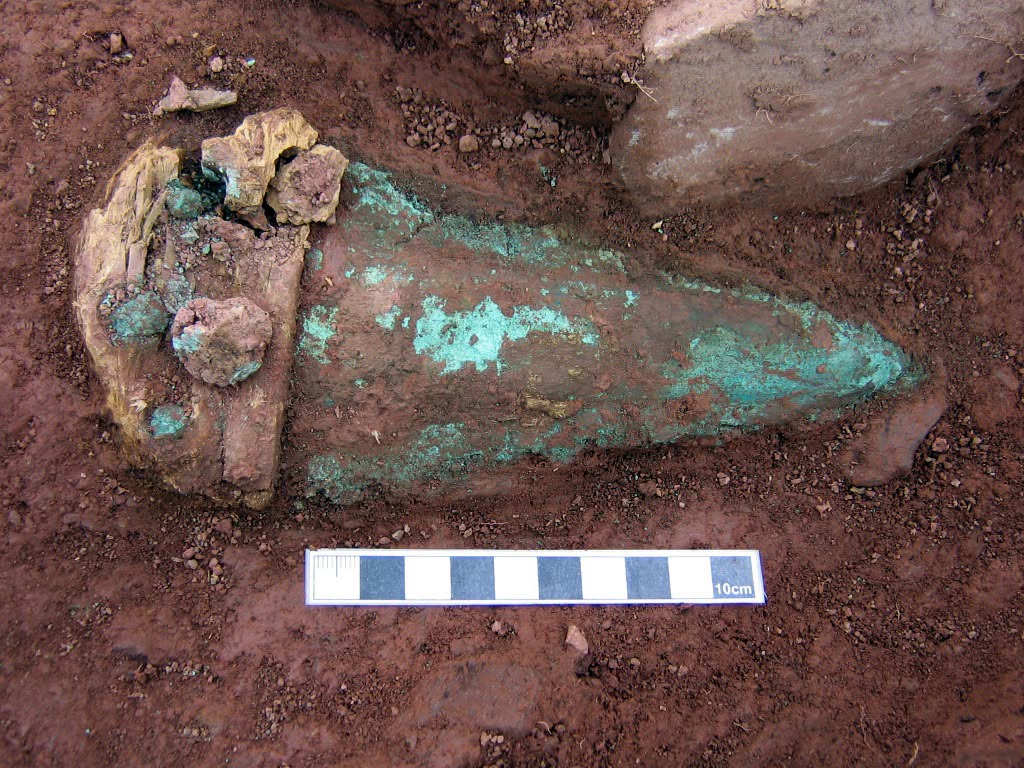
A rare copper halberd excavated in Powys, Wales, is helping archaeologists understand how some of the earliest metal objects reached Britain more than 4,000 years ago.
Known as the Trecastell Halberd, the object belongs to the British Chalcolithic, or Copper Age. It is one of only 64 halberds known from Britain, and one of just two recovered from archaeological excavation. Most others were chance finds, which makes their original context harder to interpret.
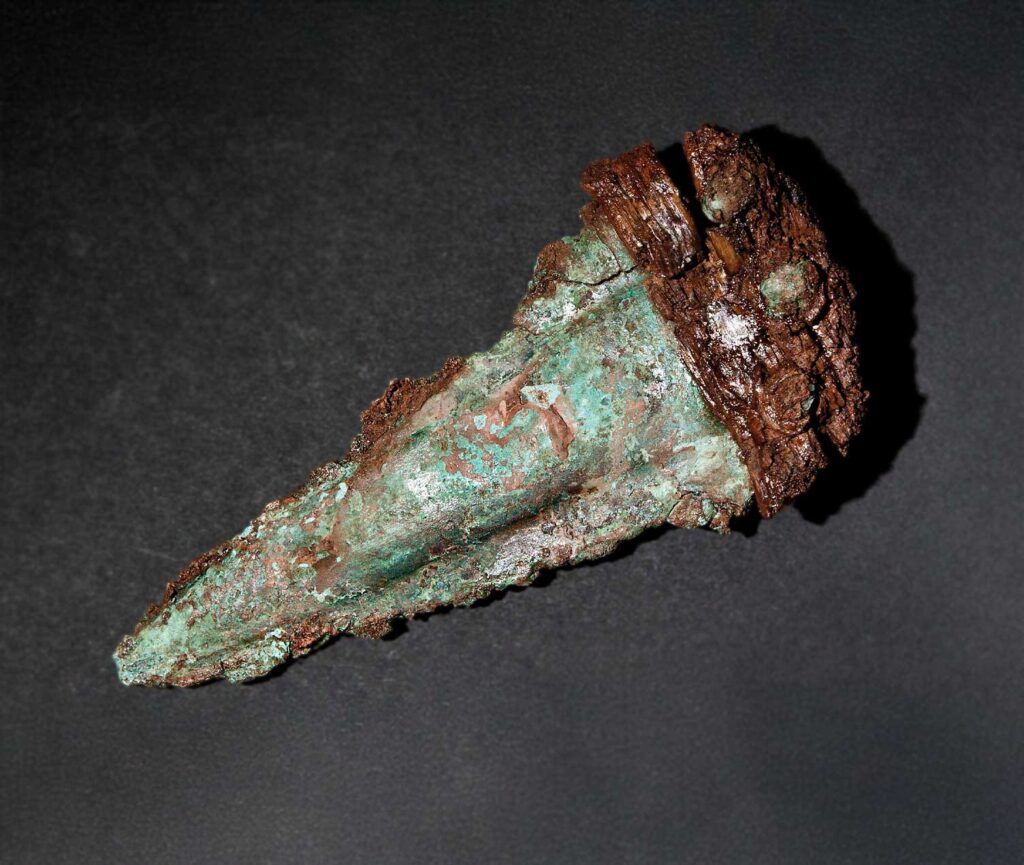
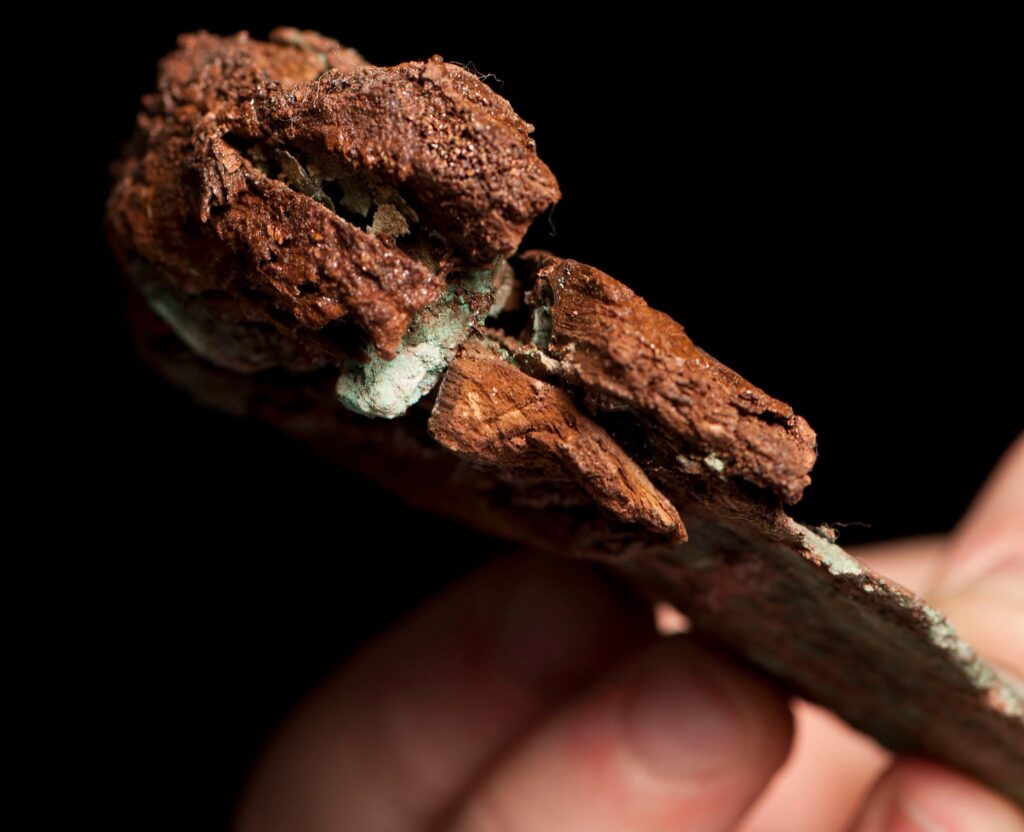
Halberds are unusual weapons. They have a dagger-like blade mounted at a right angle to a wooden shaft, creating a form that is neither a simple axe nor a conventional dagger. In most cases, the wooden haft has disappeared. At Trecastell, part of it survived.
That small piece of wood is what makes the find especially important. Analysis identified the haft as probably hawthorn, rowan or crab apple, and radiocarbon dating placed it between 2470 and 2200 BC. This makes the Trecastell Halberd one of the earliest scientifically dated metal objects from the British Isles.
A Welsh find with Irish copper
The halberd was found during Cotswold Archaeology excavations at Trecastell, near Welshpool, in 2006. The copper blade was recovered from a pit at the centre of a ring-ditch monument.
Although the object was found in Wales, its material and style point strongly toward Ireland. Scientific analysis suggests the copper was likely mined at Ross Island, County Kerry, an important early copper source in Ireland.
This does not mean the halberd was certainly made in Ireland. But it does show that copper, metalworking knowledge, or finished objects were moving across the Irish Sea at a very early date.
For Britain’s Copper Age, that matters. Metalworking did not develop here in isolation. The Trecastell Halberd fits into a wider pattern in which early metal objects in Britain show close links with Irish sources and forms.
A weapon placed inside a monument
The context of the find is as important as the object itself. The halberd was not found in a grave or a settlement layer. It was placed in a pit within a ring ditch.
The same monument also contained a large central posthole, probably once holding a timber post. Such a feature would have made the site more visible in the landscape. Later burials in the area suggest that people returned to this place long after the halberd had been buried.
Archaeologists therefore interpret the deposition as deliberate. Whether it was a ritual offering, a marker of status, or part of a ceremony cannot be proven. But it was almost certainly not casual loss.
Why the Trecastell Halberd matters
The Trecastell Halberd is not a new discovery. It was excavated in 2006 and published in detail in 2015. Its importance lies in what it brings together: a rare object type, surviving wood, direct dating, early Irish copper, and a carefully chosen place of deposition.
For a period when written records do not exist, that combination is unusually valuable. The object shows how a single weapon can carry evidence for technology, long-distance contact, and the use of monuments in early prehistoric Britain.
Source note
This article is based on Cotswold Archaeology’s report on the Trecastell Halberd and the study published in Proceedings of the Prehistoric Society: Needham, S., Davis, M., Gwilt, A., Lodwick, M., Parkes, P., & Reavill, P. (2015). A Hafted Halberd Excavated at Trecastell, Powys: From Undercurrent to Uptake — The Emergence and Contextualisation of Halberds in Wales and North-west Europe. Proceedings of the Prehistoric Society, 81, 1–41. https://doi.org/10.1017/ppr.2015.8