
A shallow pit beneath an ancient hill in Cambridgeshire has yielded a discovery that feels unexpectedly modern: a young man from the ninth century whose skull bears the unmistakable sign of surgical intervention.
The remains were uncovered during a training excavation by students from the University of Cambridge at Wandlebury Iron Age hill fort. Among a grim collection of disarticulated bones and hastily buried bodies lay a skull with an oval opening roughly three centimeters across — clean, deliberate, and almost certainly made while the individual was alive.
The man was between 17 and 24 years old. What sets him apart even before the surgical evidence, however, is his extraordinary stature. Standing approximately 6 feet 5 inches (around 1.96 meters), he would have towered above most men of his era, when the average height was closer to 5 feet 6 inches.
That unusual height may hold the key to understanding the hole in his skull.
A Medical Clue Hidden in Bone
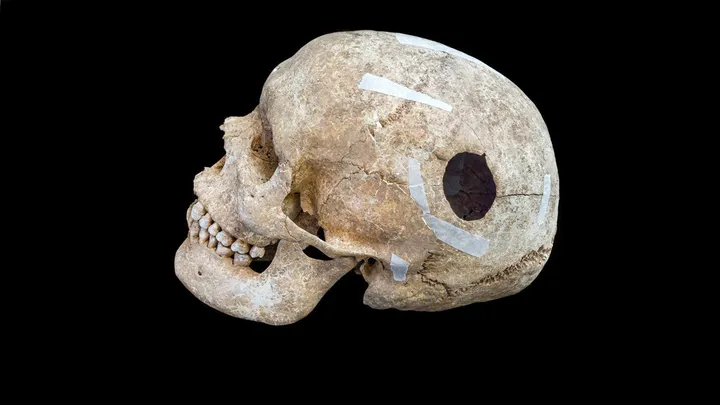
According to Trish Biers, curator of the Duckworth Laboratory at Cambridge, the long bones of the skeleton display distinctive growth patterns. These features are consistent with excessive production of growth hormone, possibly triggered by a tumor affecting the pituitary gland.
Such a condition can lead to increased intracranial pressure — and debilitating headaches.
The oval opening is believed to be the result of trepanation, an ancient surgical practice in which a section of skull is removed to relieve pressure or treat neurological symptoms such as seizures or chronic pain. While trepanation is documented in prehistoric and classical contexts, its appearance in a ninth-century British burial is striking.
If the interpretation is correct, this young man underwent a controlled cranial procedure intended to ease suffering. The aim — reducing pressure inside the skull — echoes principles still applied in modern neurosurgery today.
A Mass Grave with Signs of Violence
The broader burial context adds another layer of complexity.
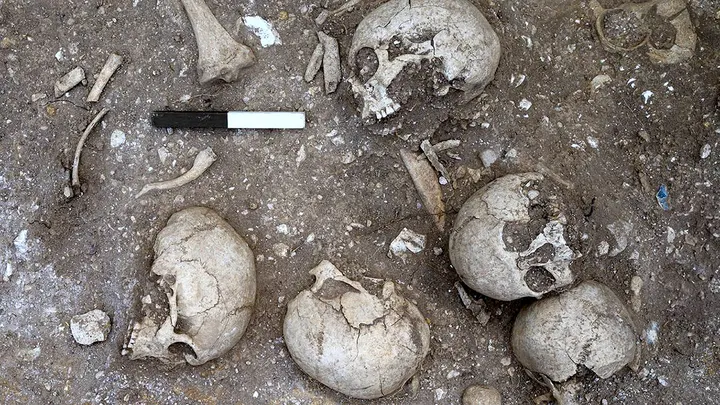
The pit contained a mixture of complete skeletons and dismembered remains. Archaeologists documented clusters of skulls and even what they described as a “stack of legs.” Four largely intact skeletons were recovered, some positioned in ways that suggest they may have been bound at the time of death.
Most of the individuals appear to have been young men. The absence of careful burial rites and the chaotic arrangement of body parts point toward violence — possibly the aftermath of a skirmish, execution, or collective punishment.
Oscar Aldred of the Cambridge Archaeological Unit has suggested that Wandlebury may have functioned as a sacred or recognized meeting place. In such settings, corporal punishment or public execution would have carried symbolic weight. Some of the disarticulated limbs, he notes, could even have been displayed as trophies before eventual interment.
Medicine and Violence in the Viking Age
Taken together, the findings present a stark juxtaposition.
On one hand, evidence of a sophisticated surgical attempt to relieve pain — a reminder that early medieval communities possessed practical anatomical knowledge and the willingness to intervene medically. On the other, a burial scene marked by apparent brutality.
The three-centimeter opening in that young man’s skull is more than a medical curiosity. It hints at the lived experience of pain, at experimental treatment, and at a society navigating both care and cruelty.
More than a thousand years later, the bone still carries the story.
Cover Image Credit: Cambridge Archaeological Unit/Da / SWNS