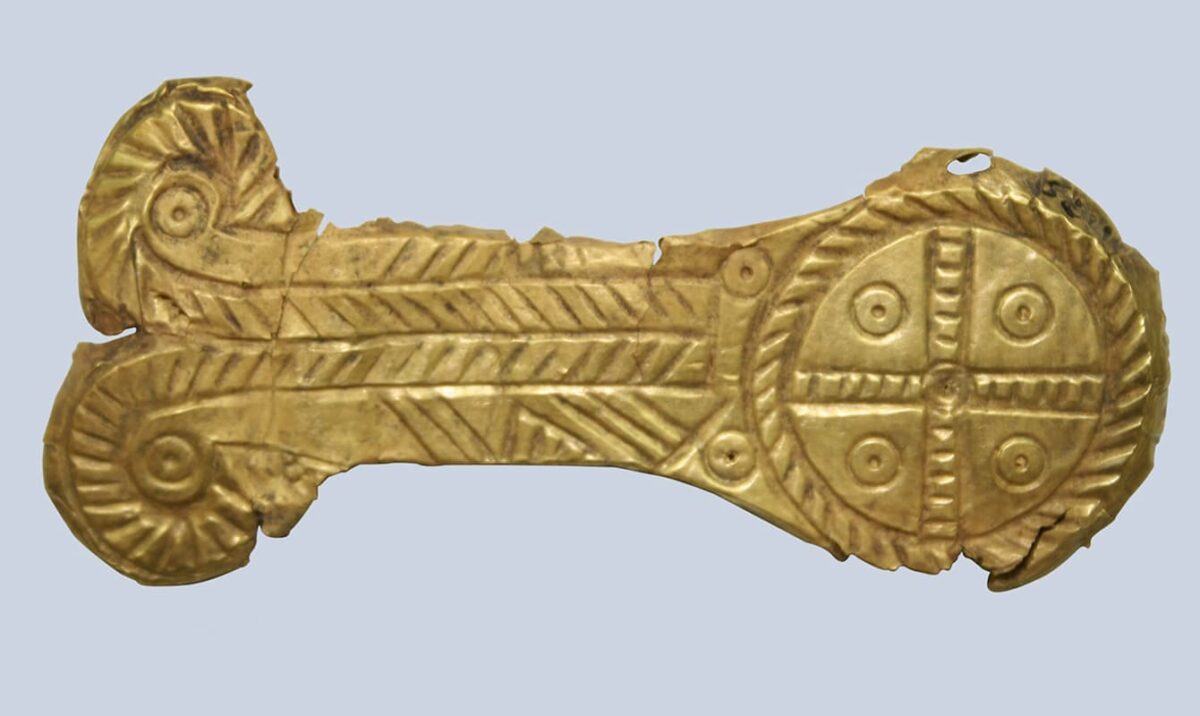
A pair of modest-looking gold ornaments from Mycenaean graves on the Ionian island of Kefalonia has opened an unexpectedly wide window onto the connected world of the Late Bronze Age. According to a new study published in the European Journal of Archaeology, the solar symbols embossed on these objects did not originate in the Aegean at all. Their roots lie far to the north, in central and northern Europe.
Dated to the 12th–11th centuries BC, the ornaments come from two separate cemeteries in the Livatho region of Kefalonia. Both are fashioned from hammered gold and display solar imagery, yet their forms and meanings diverge in telling ways.
Two objects, two stories
The first piece, discovered at Mazarakata, survives as a fragment of what was likely a circular disc about 12 centimetres in diameter. Its surface carries concentric raised circles—an image immediately evocative of solar symbolism.
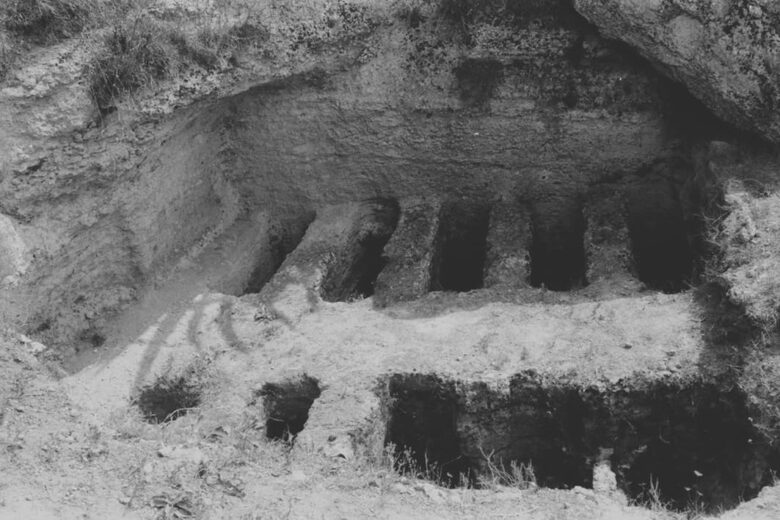
The second, from Lakkithra, is intact and elongated, measuring just under 10 centimetres. At its centre appears a four-spoked wheel—a cross set within a circle—from which extend two bands ending in carefully balanced volutes. This ornament was placed in a collective rock-cut tomb alongside weapons and grave goods, suggesting burial with a warrior.
A northern sun in southern gold
What makes these objects remarkable is not their craftsmanship alone, but their iconography. Concentric circles and four-spoked solar wheels are not characteristic Mycenaean motifs. Instead, the study traces them to Bronze Age northern and central Europe, where such symbols carried strong cosmological and religious associations linked to the sun’s journey across the sky and, in some cases, to solar deities.
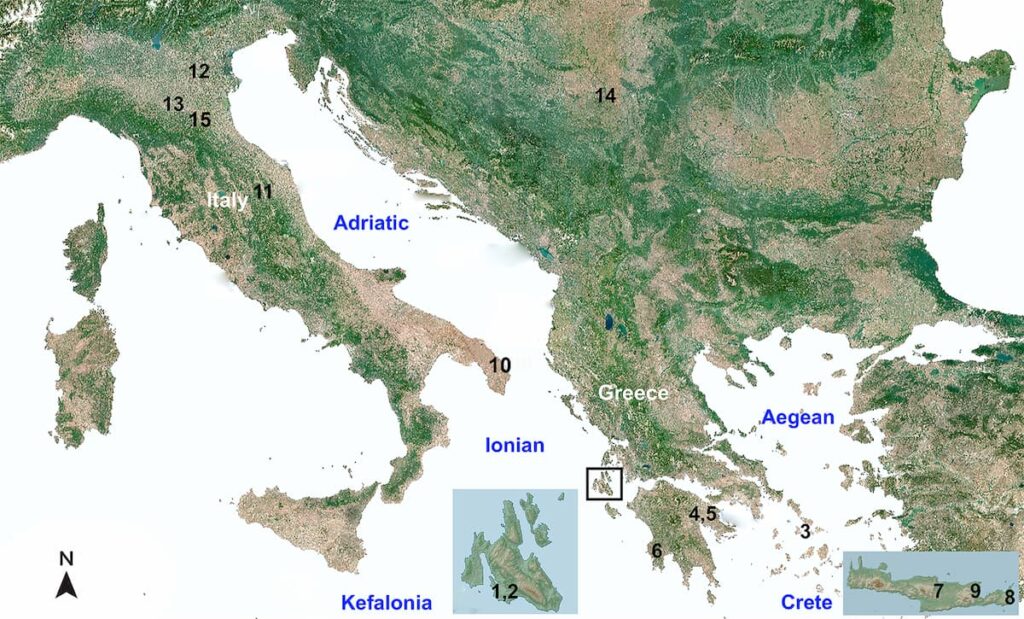
The closest parallels are not found in Greece but in Italy, particularly gold discs from votive deposits at Gualdo Tadino in Umbria and Rocavecchia in Apulia. These Italian examples are themselves understood as expressions of central European solar traditions, acting as intermediaries between northern Europe and the Mediterranean.
Import, adaptation, or something else?
Crucially, the research rejects a simple “import” explanation. The Mazarakata disc may indeed have arrived largely unchanged, later deposited in a Mycenaean funerary context where gold was rarely used for such purposes. Its likely role was to adorn a burial garment or shroud, echoing known Aegean practices but with unusually precious material.
The Lakkithra piece tells a more complex story. While its solar wheel clearly reflects European inspiration, its voluted ends and zigzag infill resonate with Mycenaean decorative language, seen in local pottery and floral motifs. Even its method of manufacture—edges folded to attach the gold to another object—fits Mycenaean metalworking traditions.
The result, the author argues, is not imitation but hybridisation: a “creative translation” in which a foreign symbol was actively reworked within a local visual and technical system.

Mirrors, weapons, and the afterlife
The precise function of the Lakkithra ornament remains debated. Its form could suit the covering of a small dagger hilt, yet the study leans toward another possibility: the handle of a bronze mirror. Mirrors were elite objects in the Late Bronze Age Aegean and appear predominantly in funerary contexts. Their reflective surfaces carried obvious symbolic potential, especially when combined with solar imagery.
Such symbolism extends into beliefs about death and the afterlife. In European Bronze Age iconography, the sun is often linked with boats or chariots, metaphors for cosmic or spiritual journeys. Comparable ideas existed in the Aegean, where ships, birds, and divine movement frequently intersected in religious thought.
Kefalonia at the crossroads
How did these ideas reach an island off western Greece? The answer lies in geography. Kefalonia sat astride maritime routes connecting the Aegean with the Adriatic and, beyond Italy, with continental Europe. After the collapse of the Mycenaean palatial system, these sea lanes likely became less restricted, encouraging mobility and exchange.
Other finds from the island reinforce this picture: Baltic amber beads, probably arriving via northern Italy, and glass beads linked to Frattesina in the Po Valley. Together, they point to elite networks of travel, trade, alliance, and perhaps intermarriage.
Beyond “imports”
In the study’s conclusion, simply labelling these ornaments as imported goods misses the point. They represent an active process of selection, reinterpretation, and integration. As the author, Christina Souyoudzoglou-Haywood, notes, they are tangible expressions of Late Bronze Age “globalisation”—evidence of long-distance interaction combined with strong local identities.
Small in scale yet rich in meaning, these gold ornaments testify to a Mycenaean world that was neither isolated nor passive. On Kefalonia, northern suns were not merely adopted; they were reshaped to speak a local language of power, memory, and belief at the end of the Bronze Age.
Souyoudzoglou-Haywood C. The Aegean Meets Europe: Two Ornaments with Solar Motifs from Mycenaean Kefalonia (Greece). European Journal of Archaeology. Published online 2026:1-19. doi:10.1017/eaa.2025.10031