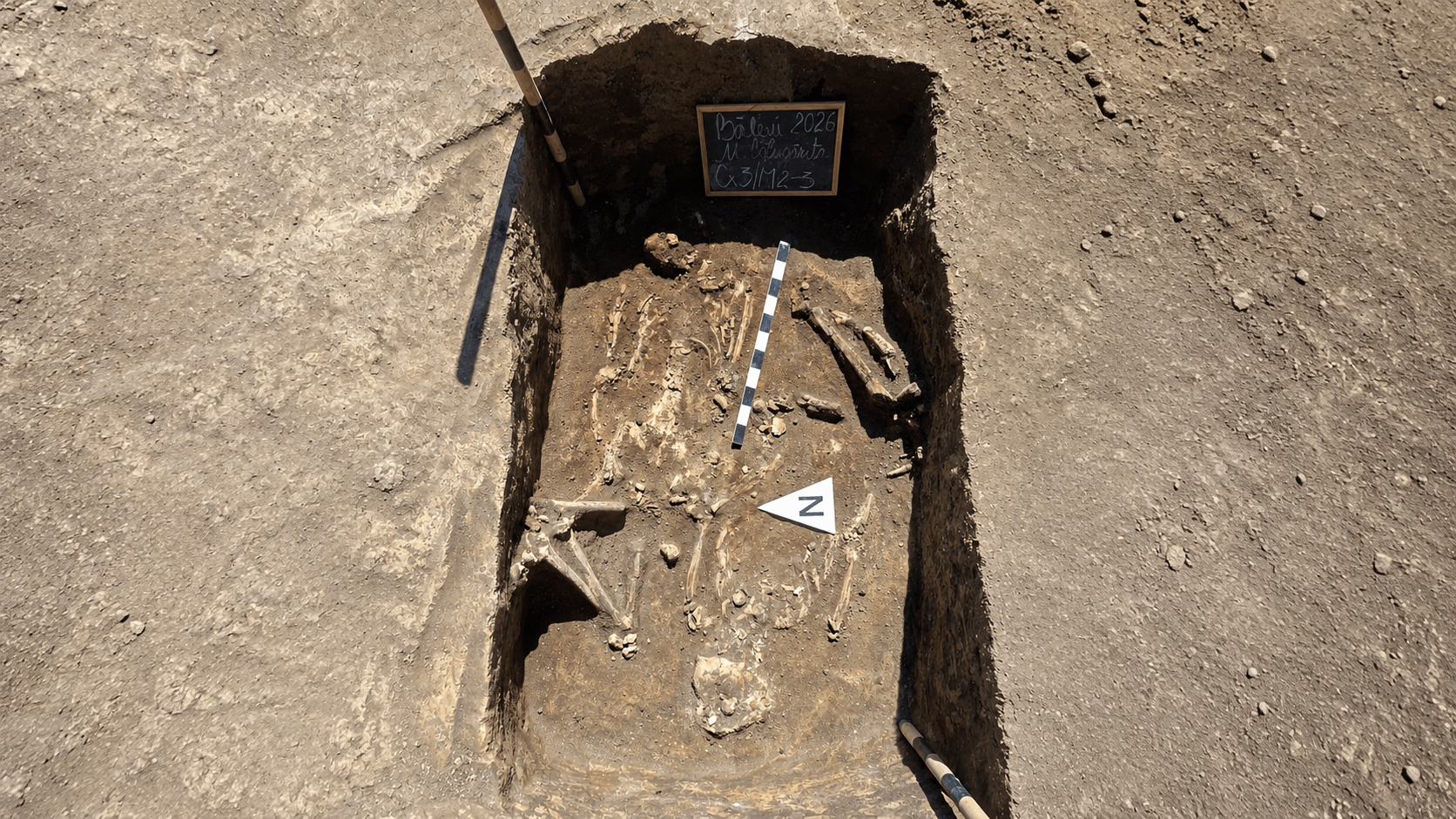
More than 5,000 years ago, several people were buried beneath a mound in what is now eastern Romania. Archaeologists have now uncovered four Yamnaya graves, including a double burial, revealing traces of an elaborate funerary tradition involving red ochre, wooden beams, matting and fire.
One burial contained an especially unusual detail. The skull was not in its anatomical position beside the rest of the skeleton. Instead, archaeologists found it placed higher in the grave, beside the individual’s left forearm. Why it was positioned separately remains unknown.
The graves were discovered during a preventive excavation at Băleni in Galați County, at a burial mound known as Bisericuța or Movila Călugărița. Researchers from Dunărea de Jos University of Galați and the Teodor Cincu History Museum in Tecuci carried out the investigation between May 11 and 26, 2026.
Four graves and five individuals beneath the mound
Although the mound had survived for millennia, much of it had already been disturbed before archaeologists arrived. Approximately half was destroyed during construction of the DN24D road between Galați and Bârlad, while repeated agricultural activity affected the remainder. Fibre-optic cables crossing the surviving portion further complicated the excavation.
Within what remained, archaeologists identified four rectangular inhumation graves containing five skeletons in total. One grave held two individuals, while the burials were oriented either east-west or west-east.
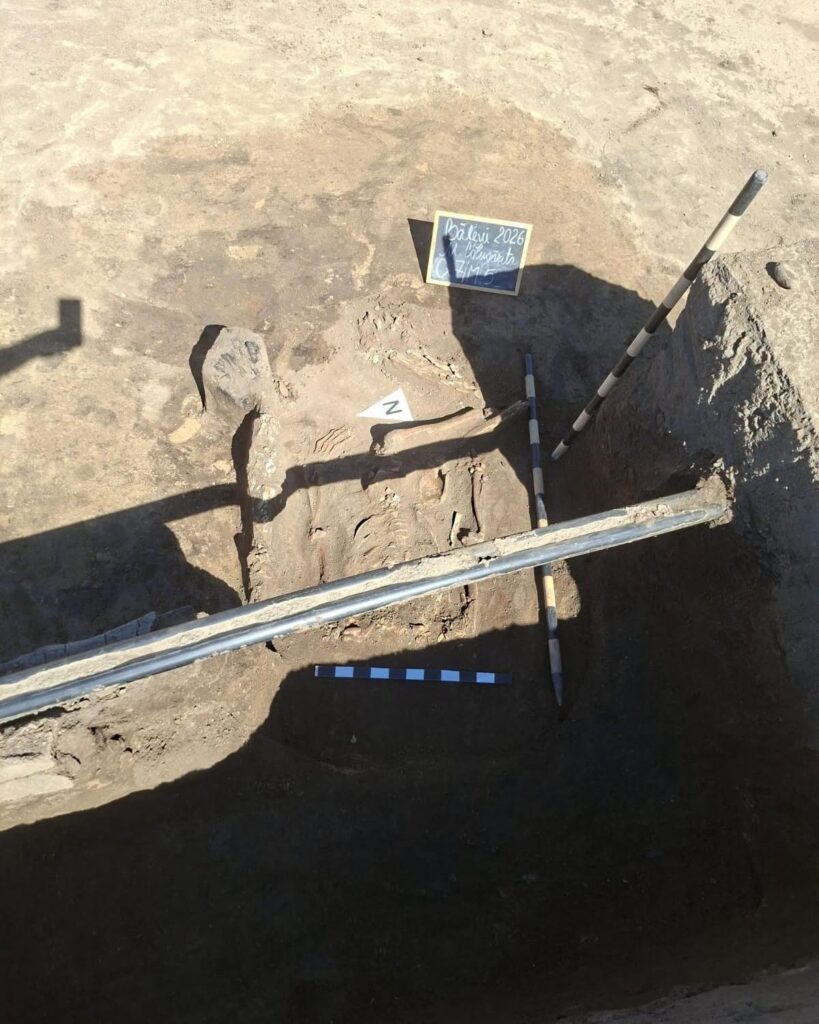
The dead had generally been placed on their backs with their arms alongside their bodies. Their legs had originally been raised and bent at the knees before falling to one side after decomposition. Combined with other characteristics of the graves, this positioning helped the researchers associate the burials with the Yamnaya culture.
The double grave was more elaborate. Archaeologists identified what they describe as an access or visitation chamber in the southeastern corner of the burial pit. The available report does not establish precisely how this feature was used.
The grave with the separately positioned skull adds another question. Rather than lying in its expected anatomical position, the skull had been deposited above the skeleton, level with the left forearm. The researchers have not yet offered an explanation for the arrangement.
Ochre, timber and fire formed part of the burial ritual
The graves contained remarkably little in the way of conventional grave goods. Only one produced an artifact listed as funerary inventory: a piece of flint bearing traces of intentional flaking.
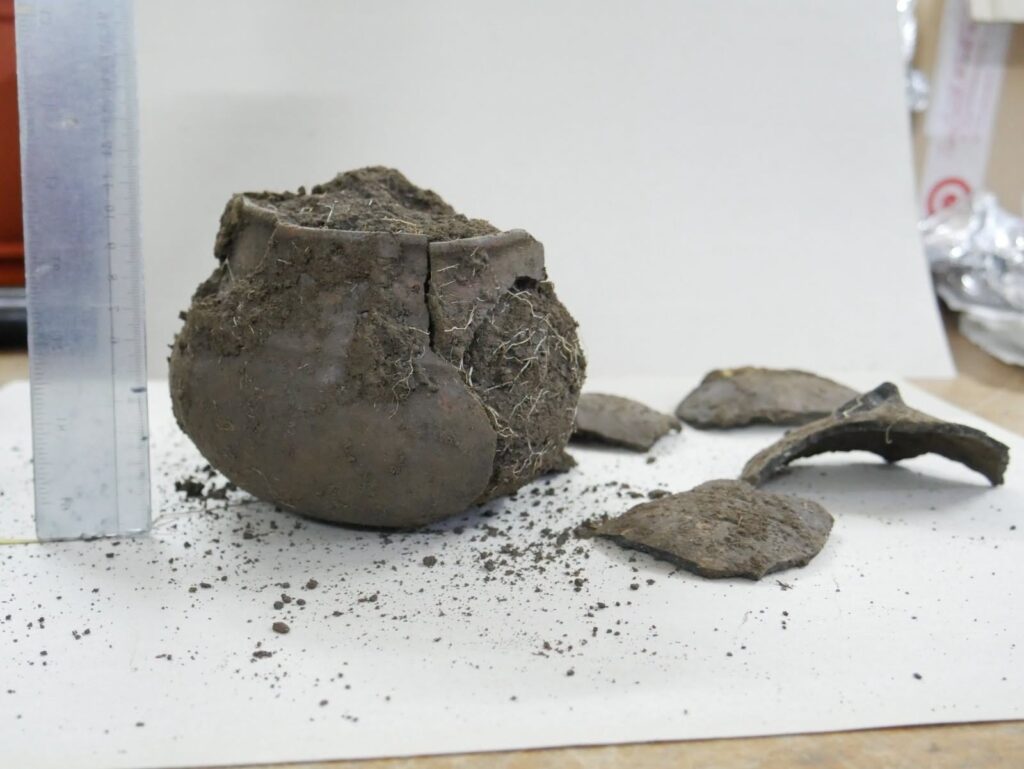
What survived instead was evidence for the actions that accompanied burial, including wooden beams, calcium hydroxide, traces of matting on the grave floor and red ochre scattered over both the deceased and the base of the burial pit. In one funerary complex, archaeologists also found thick wooden logs that had been burned along the northeastern side of the grave.
These details are important because archaeological evidence for a funeral is often more than the objects placed beside the dead. The preparation of the grave, position of the body, use of organic materials and treatment of the burial space can preserve traces of ceremonies that took place thousands of years ago.
In Băleni, the combination of ochre, body position and construction of a mound above the graves led the excavation team to attribute the complex to the Yamnaya culture, which flourished across the Pontic-Caspian steppe and neighboring regions during the late fourth and early third millennia BC. The excavators place the Yamnaya horizon broadly between about 3300 and 2600 BC.
Why Yamnaya burials matter
The Yamnaya are central to research into one of the major demographic transformations of prehistoric Europe. Ancient DNA studies have shown that populations associated with the steppe expanded westward on a large scale during the third millennium BC.
A major genomic study published in Nature, for example, found that individuals associated with the Corded Ware culture in Central Europe derived a substantial proportion of their ancestry from populations related to the Yamnaya, demonstrating a major movement of steppe ancestry into Europe.
The Băleni discovery provides a much more local view of that broader prehistoric world. Rather than population movements measured through genomes, these graves preserve the physical choices surrounding five individual deaths: how bodies were positioned, what materials were placed around them and how the burial space itself was constructed.
Researchers now plan to send all five skeletons to the Francisc I. Rainer Institute of Anthropology in Bucharest for anthropological analysis. Charcoal produced by the burning of wooden logs in one of the graves will also undergo further study.
Those analyses may provide a clearer picture of the people buried beneath the Băleni mound. For now, however, one feature remains particularly striking: more than five millennia after the burial was created, archaeologists have found a skull deliberately positioned apart from the rest of the body, within a funerary landscape shaped by ochre, timber, fire and carefully arranged graves.
Cover Image: Two individuals uncovered in Yamnaya graves at the Bisericuța (Călugărița) burial mound near Băleni, Galați County, Romania. Credit: Dunărea de Jos University of Galați.