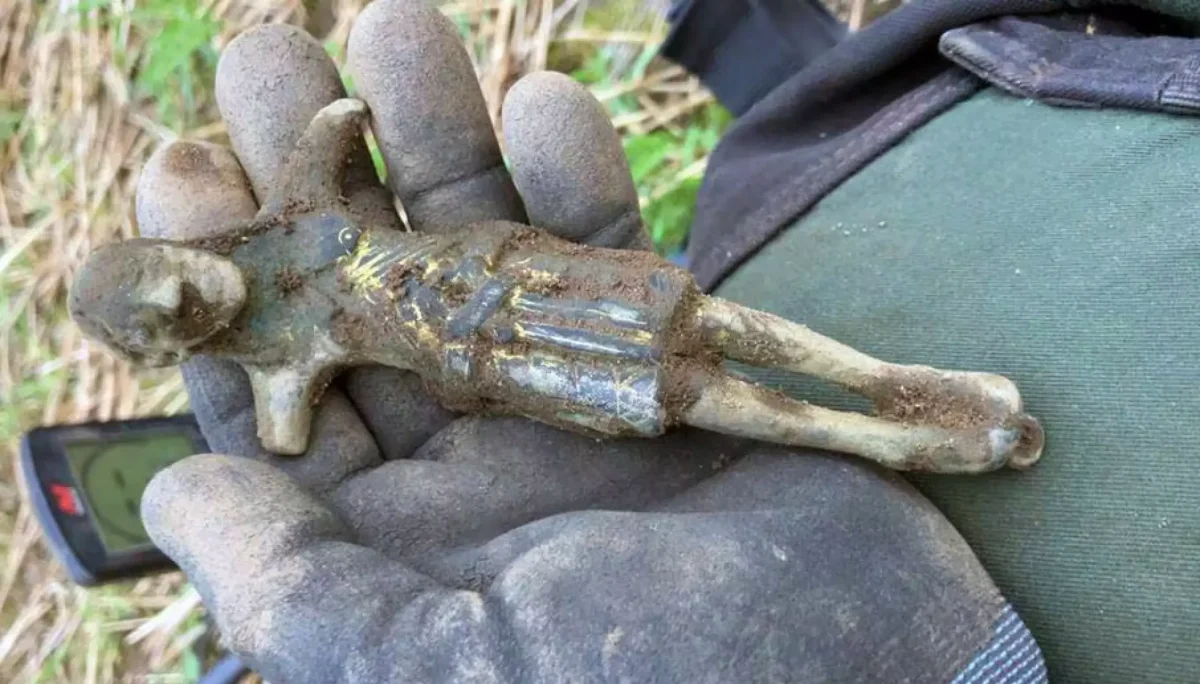
A metal detectorist’s last sweep of the day uncovered a rare gilded bronze Christ statue from the High Middle Ages — a discovery now triggering a renewed archaeological investigation in Åndalsnes.
As the daylight faded over Åndalsnes, Kim Erik Fylling Dybvik made one final pass across a freshly ploughed field — a routine gesture that unexpectedly delivered one of Norway’s most remarkable medieval finds in recent years. His detector gave a sharp, unmistakable signal. A few centimeters below the topsoil lay a small gilded bronze Christ figure, still carrying patches of its original gold and crafted with striking precision.
Dybvik, who has spent more than a decade travelling across Norway with his detector, immediately understood he was holding something extraordinary. The figure, likely dating to the late 12th or early 13th century, preserves delicate facial contours, outstretched arms, and faint but visible traces of medieval gilding. “My pulse shot up. These are the moments we live for — saving cultural history before it’s lost,” he said.
A high-medieval artifact on the brink of destruction
The bronze figure survived by chance. Positioned just beneath the surface of a heavily worked field, it could easily have been shattered by ploughing. Its preservation becomes even more striking when viewed alongside earlier finds from the same area — a Viking ring brooch, intact pin and all, was recovered only a week earlier, while silver coins and dozens of tin and copper buttons have surfaced over the years.
Such density of finds is rarely accidental. The field lies near the recorded location of a medieval church, long vanished but remembered in local tradition. The newly unearthed figure adds fresh weight to the possibility that structural remains still lie buried below.
Archaeologists rush to the scene
Field archaeologist Aaron Johnston arrived within minutes, guided only by car headlights as night settled over the valley. The gilding, casting technique, and iconographic details made the piece immediately recognizable as high-medieval church art. He logged its coordinates, photographed the object, took measurements, and carefully placed it in a padded container — then into his refrigerator, the safest short-term storage solution for metal finds at risk of rapid deterioration.
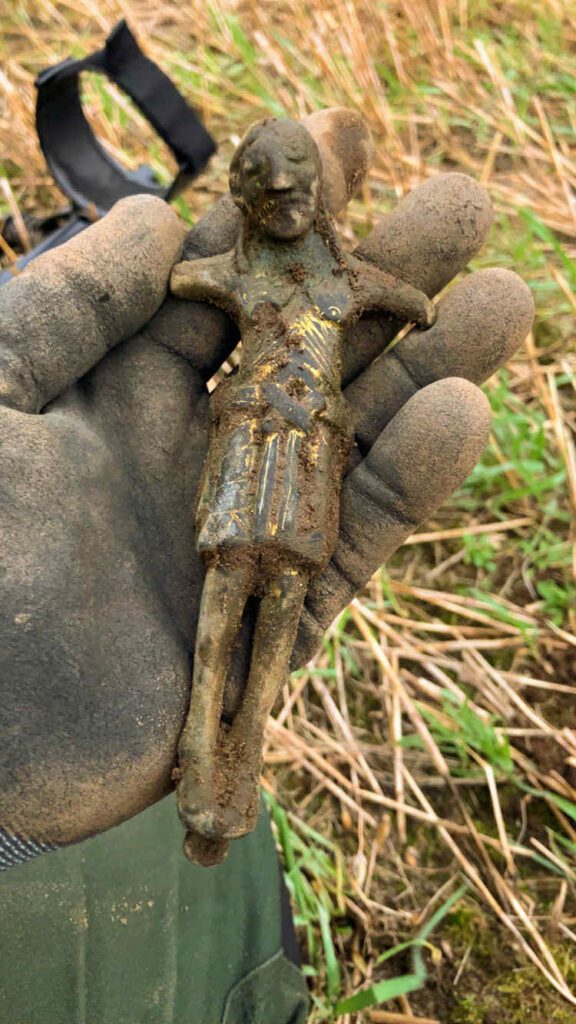
The figure is now being transferred to the cultural heritage department in Molde and then to NTNU in Trondheim, where specialists will analyse its alloy, gilding technique, and wear patterns. These tests may reveal whether the figure originally belonged to a processional cross, a liturgical staff, or a personal devotional object once owned by a medieval cleric.
A discovery that may reshape the local medieval landscape
Plans are underway for a georadar survey around the findspot. If subsurface anomalies match expected church foundations or associated buildings, the quiet farmland at Åndalsnes may soon become an active archaeological zone. A lost church — and possibly a forgotten medieval settlement cluster — could emerge from the soil.
A detectorist motivated by preservation
Dybvik has been clear: he is not driven by monetary reward. “This is about protecting history, honestly and cleanly,” he told local reporters. As agricultural machinery grows heavier each year, objects like this face a real risk of being crushed beyond recognition. His find is a reminder of how much medieval heritage still lies hidden — and how easily it can vanish.
The gilded bronze Christ, improbably intact after eight centuries, has already shifted archaeological attention back to a landscape long considered quiet. Had Dybvik ended his sweep minutes earlier, the past might have remained buried.
Credit: Kim Erik Fylling Dybvik / NTNU Trondheim