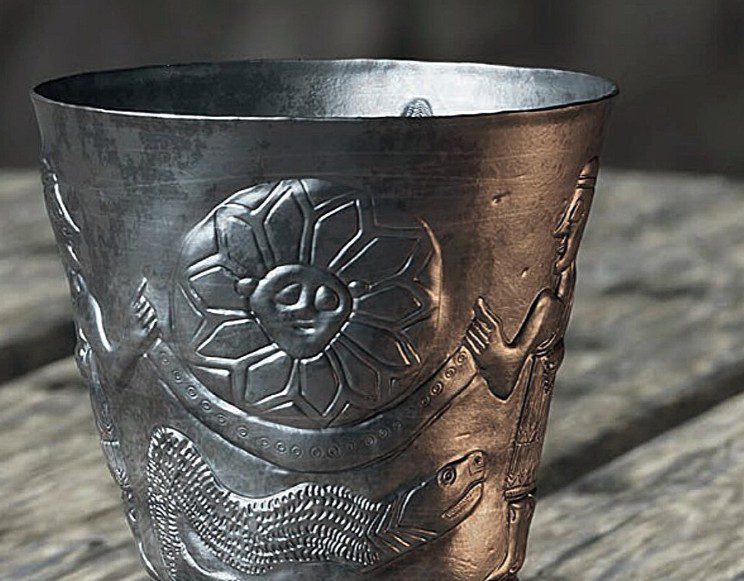
A new study is challenging long-held assumptions about one of the most enigmatic artworks from the Bronze Age Levant. The ˁAin Samiya goblet—an 8-centimeter silver vessel dated to the Intermediate Bronze Age (c. 2650–1950 BCE)—has traditionally been interpreted as an early visual reference to the Babylonian Enuma Elish creation myth. Now, fresh evidence suggests the imagery may instead portray a symbolic ordering of the cosmos, far removed from the later Mesopotamian narrative.
Published in the latest volume of Ex Oriente Lux (Journal of the Ancient Near Eastern Society), the study argues that the goblet’s scenes do not correspond to any specific textual tradition. Instead, they present a conceptual shift from primordial chaos to cosmic order.
A Rare Artistic Window into the Early Bronze Age Levant
The ˁAin Samiya goblet, discovered in a tomb in the Judean Hills more than 50 years ago, is often described as the only genuine, high-quality artwork from this period in the Levant. Its exterior shows a sequence of complex symbolic scenes, although part of the vessel was damaged and a section of the narrative is missing—one reason why scholarly interpretations have long diverged.
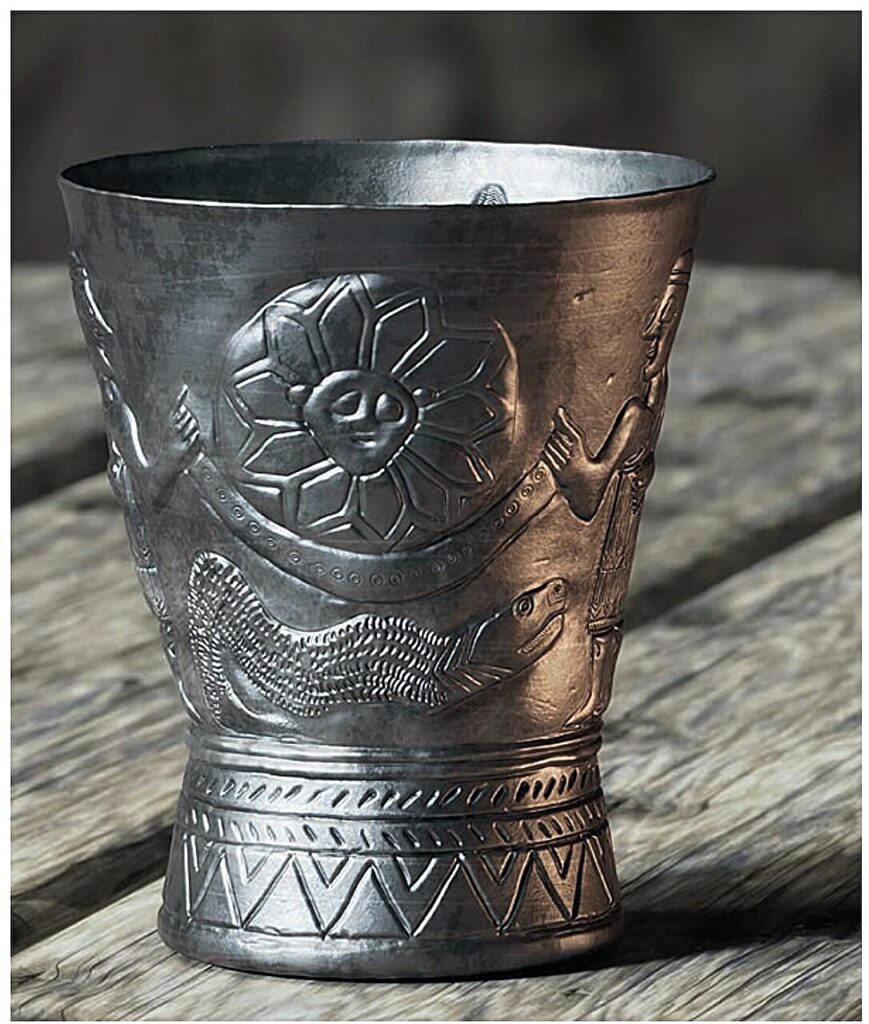
The first visible scene depicts a hybrid being with human and bull features. The figure holds fragments of plants, while a tiny celestial rosette appears between its legs—interpreted as a newborn sun. A tall serpent stands beside the chimera, seemingly dominant.
A subsequent scene shows two human figures lifting a crescent-shaped carrier supporting a face-bearing sun disk. The serpent, once upright and imposing, now lies flattened beneath the crescent, noticeably diminished.
For decades, scholars such as Yigael Yadin proposed that these scenes mirrored Marduk’s defeat of the chaos serpent Tiamat in Enuma Elish. But the timeline does not align: the myth emerges around a millennium after the goblet was crafted. Moreover, the goblet shows no battle, no violence, and no direct iconographic markers of the later Babylonian narrative.
A Different Reading: Time, Transformation, and Cosmic Stabilization
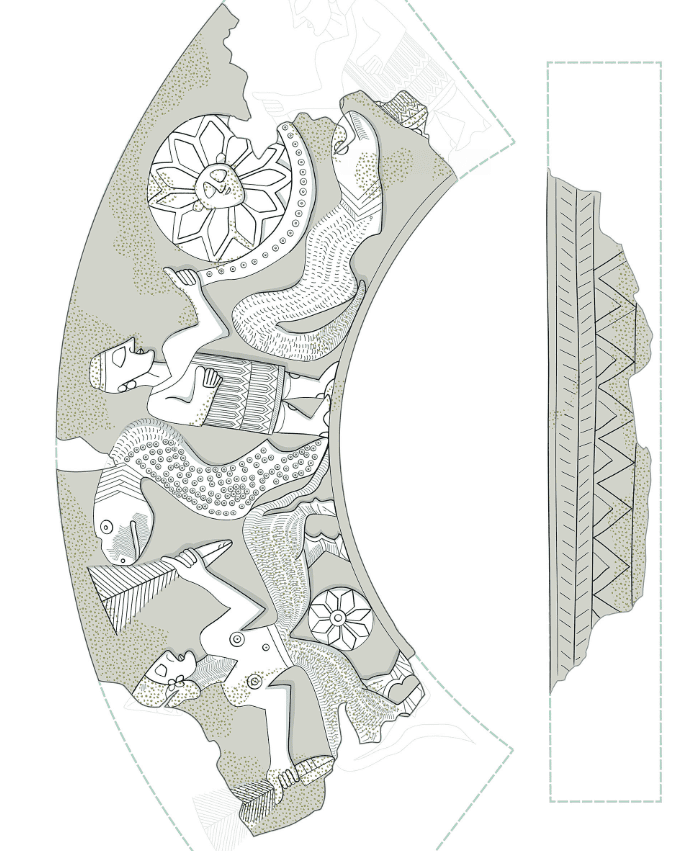
According to the new study, the imagery represents the gradual establishment of cosmic order, not a retelling of a myth known from later texts.
Key points of the reinterpretation include:
- The small rosette in the first scene symbolizes the sun at birth.
- In the second scene, the sun grows in size and is shown en face, reinforcing its ascendancy.
- The divine figures appear immortal—similar in scale in both scenes—but their clothing, headgear, and accessories evolve, indicating the passage of time.
- The serpent’s transformation—from upright to subdued—signals the taming of earlier disorder.
The authors suggest that the artist deliberately used stylistic cues to show temporal progression, a rare narrative technique for the early 2nd millennium BCE.
Broader Near Eastern Parallels
The study highlights striking similarities with early cosmological imagery across the Near East. Crescent-shaped celestial boats, bull-human hybrids, and divine processions appear in Egyptian, Mesopotamian, and Anatolian contexts.
Two parallels stand out:
- The concluding register on the sarcophagus of Seti I (c. 1279 BCE),
- The bull-men reliefs at Yazılıkaya, the Hittite sanctuary in central Anatolia (c. 1230 BCE).
These analogies suggest that the goblet may reflect an early source of an iconographic tradition that spread widely across the Bronze Age world. Based on metallurgical and stylistic clues, the team proposes the goblet was designed by an artisan from southern Mesopotamia and produced in northern Mesopotamia or northern Syria, where silver was more readily available.
Uncertainties Remain
Despite the convincing elements of this reinterpretation, many aspects of the goblet’s meaning remain unresolved. Documentation from its original discovery was incomplete, leaving gaps in reconstruction. And without textual accompaniment, iconographic readings inevitably remain interpretive.
Not all scholars agree with the new proposal. Princeton’s Mark Smith, for instance, argues that the scenes might align better with the Baal Cycle or another Levantine tradition rather than a creation story at all.
Still, the study reshapes a long-standing assumption. Rather than illustrating a proto-Marduk narrative, the ˁAin Samiya goblet may offer one of the earliest artistic attempts to conceptualize the transition from cosmic chaos to structured order—a rare window into Bronze Age thought.
More information: Eberhard Zangger et al, The Earliest Cosmological Depictions: Reconsidering the Imagery on the ˁAin Samiya Goblet, Journal of the Ancient Near Eastern Society “Ex Oriente Lux” (2025). DOI: 10.5281/zenodo.17594729